Lesson 05 — Conservation of Energy and Energy Transformations
Learners explain the **law of conservation of energy** — energy is never created or destroyed, only transformed — and analyze **energy transformations and efficiency** in a real system. They see that "lost" energy is never gone; it spreads as heat, and efficiency measures how much stays useful.
Objectives
Objectives
- D06.S3.09.01 Explain the law of conservation of energy and analyze energy transformations and efficiency in a real system.
Essential question
How is energy conserved yet transformed, and what does efficiency mean in a real system?
Key vocabulary
Materials
Standard materials
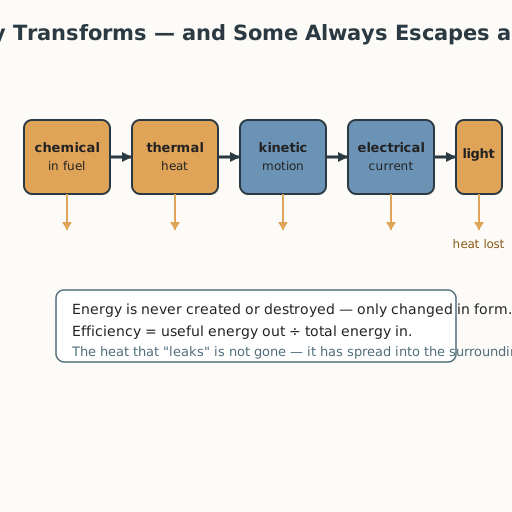
- Energy-transformation chain sheet · 1 per learner A chain of energy forms (chemical → thermal → kinetic → electrical → light) with a "heat lost" arrow at each step, to label
- Efficiency calculation card · 1 per learner A worked example computing efficiency = useful output ÷ total input, with three practice cases
Low-tech / no-cost
- A shared board or large paper Draw the transformation chain together, marking where heat leaves at each step
- Voice and a partner Trace one real device's energy path aloud, naming each form as it changes
Enriched / lab & device
- A simple energy-lab kit (a lamp, a hand-crank generator, a motor) · 1 set per group Feel energy change form and estimate where it is lost as heat
- An energy-metering app or device · 1 per group Measure input and useful output of one device and compute its efficiency
Works in different contexts
- large-group Model one chain and one efficiency calculation to the whole group, then pairs do the practice cases and report
- multi-age Younger learners name the forms of energy in order; older learners compute efficiency and explain the "lost" heat
- self-directed A learner labels the chain, computes the three efficiencies, and self-checks against the worked example
- level-grouped Learners ready to extend compare the efficiencies of two real technologies and explain the difference in everyday words
- outdoor-only Trace energy through something outdoors — sunlight to a plant, wind to a moving leaf, a falling stone — naming each transformation
Lesson 5 — Conservation of Energy and Energy Transformations
Summary
Learners explain the law of conservation of energy — energy is never created or destroyed, only transformed — and analyze energy transformations and efficiency in a real system. They see that “lost” energy is never gone; it spreads as heat, and efficiency measures how much stays useful.
Objectives
- Explain the law of conservation of energy and analyze energy transformations and efficiency in a real system. (D06.S3.09.01)
Connection
Strike a match and you feel the point where chemical energy becomes thermal (heat) and light. Rub your hands together on a cold day and motion becomes warmth. In every case, nothing is made from nothing: the energy was already there, locked in the match or in your moving muscles, and it only changed costume. The rule is absolute and has no exceptions ever observed: energy is conserved. The catch — and it matters for every engine, battery, and body on Earth — is that each change drops a little energy as spread-out heat that is hard to use again.
Materials
- Energy-transformation chain sheet
- Efficiency calculation card
Preparation
- Copy the chain sheet and efficiency card.
- Retrieval: from Grade 6, recall the forms of energy (kinetic, potential, thermal, chemical, electrical); from Grade 8, recall atoms, elements, and reactions.
Facilitator note
This lesson is written to the learner (“you”). The two ideas to land: (1) conservation of energy — energy is neither created nor destroyed, only transformed from one form to another (kinetic, potential, thermal, chemical, electrical, light); (2) efficiency — in any real transformation, some energy always spreads as heat into the surroundings, so efficiency = useful energy out ÷ total energy in, always less than 100%. Use a worked example first (S-011): a power plant chain chemical → thermal → kinetic → electrical → light, with heat leaving at each step. The critical-thinking lens: the word “lost” is a trap — the heat is not gone, it is spread out and no longer available to do useful work; say “spread as heat,” not “destroyed.” The technology lens: efficiency is where physics meets engineering — a more efficient engine, battery, or lamp does more with the same energy, which is why efficiency is a design goal everywhere (S-256, S-435). The environment lens: because no process is 100% efficient, every energy source carries a heat and waste cost — and choosing between sources is partly a question of how much energy we waste as heat and how we make the energy in the first place (S-256). The global lens: the same law governs a rice cooker in Asia, a wind turbine in Europe, and a body anywhere — energy conservation is universal. Keep the numbers honest and hedged; efficiency is always less than 1 (or 100%), never exactly, in any real machine.
Procedure
- Recall (5 min). From Grade 6: name five forms of energy. Which two do you feel when you rub your hands together?
- Meet conservation (8 min). Energy is never created or destroyed — only transformed. Say the rule in your own words, then again in a partner’s.
- Trace a chain (12 min). Worked example: a power plant. Chemical (fuel) → thermal (heat) → kinetic (turning turbine) → electrical (current) → light (a lamp). Label each step on the sheet, and mark where heat spreads out at every arrow.
- Meet efficiency (12 min). Efficiency = useful energy out ÷ total energy in. If a lamp takes 100 J and gives 15 J of light, its efficiency is 15%. The other 85 J is not gone — it has spread as heat. Do the three practice cases.
- Peer-check (8 min). Swap sheets. Did each case divide output by input? Did each answer stay below 100%?
- Close (10 min). Energy is never lost — but every change taxes it a little heat. Efficiency is the honest score of how well we keep it useful.
Differentiation
- Support: Provide the chain pre-labeled; the learner only fills the efficiency calculation using the formula with the numbers already arranged.
- Extension: Compare the efficiency of two real devices (an incandescent lamp vs. an LED, a gasoline vs. an electric motor) and explain the difference in everyday terms.
Assessment
- Formative (observation): Can the learner state conservation of energy and compute efficiency for a simple input/output pair, explaining where the “lost” energy went?
- Portfolio artifact: The labeled chain and the three efficiency calculations, kept in the portfolio.
Home connection
Pick a device at home — a kettle, a phone charger, a bicycle. Trace its energy path in forms, and ask where the heat spreads out along the way.
Resources
- On the law of conservation of energy and energy transfers with waste heat: EIA Energy Kids, “Laws of Energy,” https://www.eia.gov/kids/what-is-energy/laws-of-energy.php (S-256).
- On energy and work in everyday systems, openly licensed: OpenStax, College Physics, https://openstax.org/details/books/college-physics-2e (S-435).
- On explicit instruction and worked examples: Kirschner, Sweller & Clark (2006), https://doi.org/10.1207/s15326985ep4102_1 (S-011).