Lesson 06 — The Atom, Bonding, and Chemical Energy
Learners use the **structure of the atom** — a nucleus of protons and neutrons with electrons in shells — to explain **bonding** (atoms sharing or moving electrons) and how **chemical reactions absorb or release energy**: breaking bonds absorbs energy, forming bonds releases it, and the balance is felt as heat.
Objectives
Objectives
- D06.S3.09.02 Use the structure of the atom to explain bonding and how chemical reactions absorb or release energy.
Essential question
How does the structure of the atom explain bonding, and how do chemical reactions absorb or release energy?
Key vocabulary
Materials
Standard materials
- Atom-and-bonding sheet · 1 per learner Two atoms with nuclei and electron shells, to draw the shared or moved electrons that form a bond
- Reaction cards · 1 set per group Cards for several reactions (burning, photosynthesis, rusting, cooking) to sort as exothermic or endothermic
Low-tech / no-cost
- A shared board or large paper Draw the nucleus-and-shells model together, then show two atoms sharing a pair of electrons
- Voice and a partner Say aloud, for each reaction, whether bonds are being broken or formed and whether energy enters or leaves
Enriched / lab & device
- A ball-and-spring or ball-and-stick molecular model kit · 1 per group Build two atoms, join them with a bond, and "break" and "form" bonds to feel energy in and out
- A safe, observed demonstration of an exothermic and an endothermic reaction · 1 Feel the temperature change on the outside as a sign of energy moving
Works in different contexts
- large-group Model the atom and one bond to the whole group, then small groups sort the reaction cards and report
- multi-age Younger learners identify the parts of an atom; older learners explain how bond-breaking absorbs and bond-forming releases energy
- self-directed A learner labels the atom, draws one bond, sorts the reactions, and writes one sentence each for exothermic and endothermic
- level-grouped Learners ready to extend explain, in energy terms, why some reactions feel hot and others feel cold to the touch
- outdoor-only Find a real chemical change outdoors — a fire, rust, a cooking pot — and name whether it absorbs or releases energy
Lesson 6 — The Atom, Bonding, and Chemical Energy
Summary
Learners use the structure of the atom — a nucleus of protons and neutrons with electrons in shells — to explain bonding (atoms sharing or moving electrons) and how chemical reactions absorb or release energy: breaking bonds absorbs energy, forming bonds releases it, and the balance is felt as heat.
Objectives
- Use the structure of the atom to explain bonding and how chemical reactions absorb or release energy. (D06.S3.09.02)
Connection
Why does a campfire warm you, while a wet cloth on your skin feels cold as it dries? Both are the same deep process looked at from opposite sides. Everything around you is built of atoms, and atoms join by bonding — sharing or moving the tiny electrons in their outer shells. Breaking a bond takes energy in; forming one gives energy out. A fire forms new bonds and releases energy as heat; evaporating water breaks bonds and pulls heat in from your skin. One idea explains both the warmth and the chill.
Materials
- Atom-and-bonding sheet
- Reaction cards
Preparation
- Copy the atom-and-bonding sheet and reaction cards.
- Retrieval: from Grade 8, recall atoms, elements, compounds, and that reactions rearrange atoms; from Lesson 5, recall conservation of energy.
Facilitator note
This lesson is written to the learner (“you”). The ideas to land: (1) an atom is a nucleus of protons (positive) and neutrons (neutral) with electrons (negative) arranged in shells; the outermost electrons are the ones that take part in bonding; (2) atoms bond by sharing or moving these outer electrons, forming molecules and compounds; (3) breaking a bond absorbs energy (endothermic) and forming a bond releases energy (exothermic) — a reaction’s net feel of hot or cold is the balance between the two. Use a worked example first (S-011): burning — bonds in the fuel and oxygen break (absorbing energy), new bonds in the products form (releasing more), so the net is heat released. The critical-thinking lens: the atom is a model — no one has seen an electron the way we see a stone; we infer the structure from many experiments, and the model keeps being refined, so hold it as a model with evidence, not a literal picture (philosophy §11). The technology lens: chemical energy is the stored power behind fuels, batteries, food, and living bodies — understanding bonding is understanding where our energy comes from (S-359, S-439). The environment lens: burning carbon-based fuel releases energy and carbon dioxide, tying this lesson to the next on greenhouse gases. The egalitarian lens: this chemistry belongs to everyone — the same atoms and bonds run every body on Earth regardless of wealth or nation; no one’s atoms are “better.” Cite the atoms-and-bonding sources (S-359, S-439); endothermic/exothermic definitions are standard chemistry (S-439).
Procedure
- Recall (5 min). From Grade 8: what are the three particles in an atom, and which ones are rearranged in a chemical reaction?
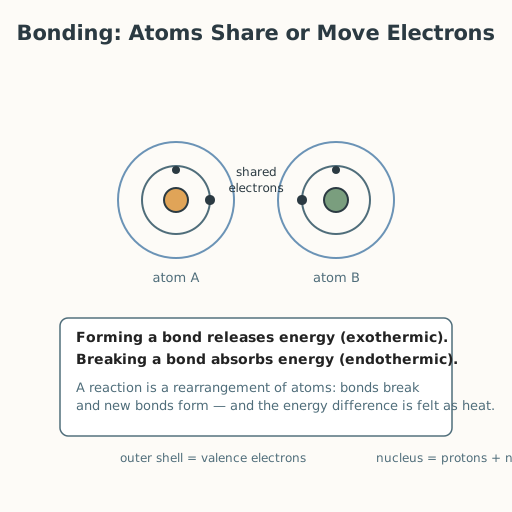
- Meet the atom (10 min). Draw and label it: a nucleus of protons (+) and neutrons (0), with electrons (−) in shells around it. The outermost electrons are the ones that bond.
- Meet bonding (12 min). Atoms bond by sharing or moving outer electrons. Draw two atoms sharing a pair of electrons to form a bond. A molecule or compound is atoms joined this way.
- Meet chemical energy (12 min). Breaking a bond absorbs energy (endothermic). Forming a bond releases energy (exothermic). Sort the reaction cards: burning (net exothermic), photosynthesis (endothermic — takes in light energy), rusting (exothermic, slowly), cooking an egg (endothermic).
- Explain the feel (8 min). For one reaction, write: “In ___, bonds ___ (break/absorb or form/release), so the reaction feels ___ (hot/cold).”
- Close (8 min). Fire and frost are the same physics in two directions: bonds breaking, bonds forming, and energy moving between them.
Differentiation
- Support: Provide the atom pre-labeled; the learner only draws the shared electrons and matches each reaction to “releases” or “absorbs.”
- Extension: Explain, in energy terms, why a reaction can feel hot even though breaking bonds absorbs energy — name which step (forming) releases more.
Assessment
- Formative (observation): Can the learner describe the atom’s structure and explain, with an example, how bond-breaking and bond-forming account for a reaction absorbing or releasing energy?
- Portfolio artifact: The labeled atom-and-bonding sheet with the sorted reactions, kept in the portfolio.
Home connection
Find a chemical change at home — baking, a battery, a rusting nail. Ask: is it forming bonds (releasing energy) or breaking them (absorbing it), and how can you tell?
Resources
- On atoms, elements, compounds, and reactions: BBC Bitesize (KS3), “Atoms, elements and compounds,” https://www.bbc.co.uk/bitesize/topics/zstp34j (S-359).
- On bonding, and exothermic/endothermic reactions, openly licensed: OpenStax, Chemistry 2e, https://openstax.org/details/books/chemistry-2e (S-439).
- On explicit instruction and worked examples: Kirschner, Sweller & Clark (2006), https://doi.org/10.1207/s15326985ep4102_1 (S-011).