Lesson 08 — Design, Technology & the Environment
Learners trace two contrasting designed objects — one handmade and local, one mass-produced — through their full **life cycle** (materials, making, use, disposal) and analyze how design and technology shape everyday life and the environment. They weigh **trade-offs** — cost, convenience, durability, waste, energy, accessibility — and compare at least two contexts, asking who designs, who is left out, and where the burden of harm falls.
Objectives
Objectives
- D07.S4.09.02 Analyze how technology and design shape everyday life and the environment, using examples from more than one context.
Essential question
How do technology and design shape everyday life and the environment, and how does the answer differ from one context to another?
Key vocabulary
Materials
Standard materials
- Two contrasting object case studies (e.g., a clay pot vs. a plastic bottle; an earthen building vs. a concrete one) · 1 set per group Real everyday objects or images that embody different design choices across contexts
- A life-cycle organizer (materials / making / use / disposal) · 1 per learner To trace each object from source to waste
Low-tech / no-cost
- Two found objects from the local environment Compare a local handmade object with a mass-produced one — both are all around us
- A chalkboard or large paper life-cycle chart Draw the four stages together and trace each object through them
Enriched / lab & device
- A product's life-cycle or carbon data sheet · 1 per group To attach rough numbers to materials, energy, and waste
- A circular-economy case study · 1 A designed object meant to be reused, repaired, or returned to the loop (S-452)
Works in different contexts
- large-group Trace one object's life cycle together on the board, then groups trace their own object
- multi-age Younger learners identify what an object is made of and where it goes when broken; older learners weigh the full trade-offs across two contexts
- self-directed A learner completes the two-case comparison alone and writes one paragraph on the trade-offs
- level-grouped Learners ready to extend add a third context (a different climate or economy) and analyze how the design answer changes
- outdoor-only Compare the built things around you — a mud wall, a tin roof, a plastic container, a woven basket — and ask what each costs the land
Lesson 8 — Design, Technology & the Environment
Summary
Learners trace two contrasting designed objects — one handmade and local, one mass-produced — through their full life cycle (materials, making, use, disposal) and analyze how design and technology shape everyday life and the environment. They weigh trade-offs — cost, convenience, durability, waste, energy, and accessibility — and compare at least two contexts, asking who designs, who is left out, and where the burden of harm falls. This closes the unit by turning the maker’s hand and the critical eye onto the made world itself.
Objectives
- Analyze how technology and design shape everyday life and the environment, using examples from more than one context. (D07.S4.09.02)
Connection
The objects around you are not neutral. The plastic bottle cools nothing by itself and lasts for centuries after you throw it away; a clay pot cools water by evaporation, breaks down into earth, and is made by a neighbor’s hands. A concrete building soaks up and radiates heat and pours carbon into the air as it is made; an earthen wall breathes and returns to soil. The same need — to hold water, to shelter a family — can be answered by designs that leave very different marks on the living world. Today you learn to see that difference, because design is a decision someone made, and it can be made differently.
Materials
- Two contrasting object case studies (a clay pot vs. a plastic bottle; an earthen building vs. a concrete one)
- A life-cycle organizer with four stages: materials / making / use / disposal
Preparation
- Gather the two object case studies; if possible, bring the actual objects so learners can hold them.
- Retrieval: from Grade 8, recall that a design can be critiqued on function, materials, fairness, and environmental footprint. Today we trace the full footprint.
Facilitator note
This lesson is analysis, not a morality play — the point is that every design is a trade-off, and the trade-offs look different in different places. The environment and technology lenses carry it: trace each object from materials → making → use → disposal, and ask about embodied energy (the energy spent to make it), durability, and waste. The egalitarian lens: who can afford the cheap plastic bottle versus the handmade pot, who lives near the factory and the landfill, and who has no choice at all — environmental harm falls unevenly (this lesson connects to Grade 9 environmental justice). The ethics lens: a designer who leaves out wheelchair users, children, or the poor has made a decision, not an oversight; accessibility is a design choice. Keep the worked example on one object, then let learners trace the other (S-011). Use the circular economy idea as a horizon: designing so a thing can be repaired, reused, or returned to the loop, not thrown away (S-452). Hold questions as questions — there is rarely one “right” object, only clearer trade-offs.
Procedure
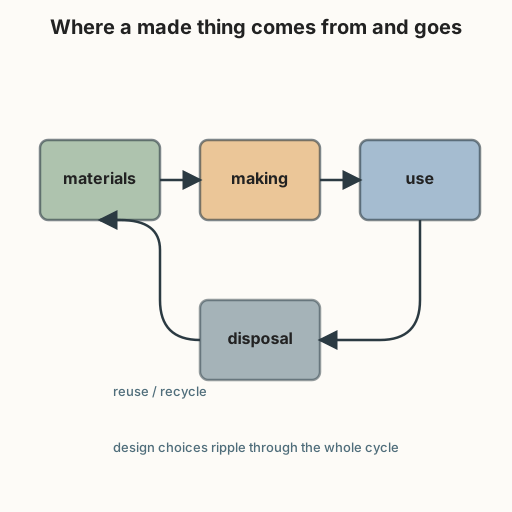
- Meet the life cycle (5 min). Look at the life-cycle diagram. Every made thing travels materials → making → use → disposal, and ideally back to materials through reuse or recycling.
- Worked example: one object, together (15 min). Trace the plastic bottle (or the mass-produced object) through the four stages: what it is made of, where it is made and at what energy cost, how it is used, and where it goes when it is done. Note one way it helps life (convenient, light, cheap) and one way it costs the environment (waste, energy, persistence).
- Analyze: the other context (20 min). In pairs, trace the clay pot or earthen wall (or the handmade local object) through the same four stages. Compare: what does each do better, and for whom?
- Weigh the trade-offs (10 min). For each object, ask: who can afford it, who is left out, and where does the harm fall? Say which answers are evidence and which are your values.
- Close (5 min). Name one design choice in your own life you would now make differently, or one question about a made object you want answered.
Differentiation
- Support: Provide a partly filled life-cycle chart with one stage blank to complete.
- Extension: Add a third context — a different climate or economy — and explain how the “best” design answer changes there.
Assessment
- Formative (observation + artifact): Does the learner trace both objects through all four stages and name at least one trade-off across two contexts, keeping evidence separate from values?
- Peer-check: Can your partner find the trade-off you described in the actual objects?
Home connection
Pick one object at home and ask: what is it made of, where will it go when it breaks, and could it have been made differently?
Resources
- Ellen MacArthur Foundation — the circular economy (designing out waste, keeping materials in use): https://ellenmacarthurfoundation.org/ (S-452).
- On explicit instruction and worked examples: Kirschner, Sweller & Clark (2006), https://doi.org/10.1207/s15326985ep4102_1 (S-011).