Lesson 08 — Tracing a Systemic Injustice
Learners apply the three-layer analysis to one documented case, producing the unit's systemic-injustice trace artifact. They build a causal chain from a past rule through a structure and repeated actions to an unfair outcome, then identify where the loop could be broken — moving from analysis to possible change.
Objectives
Objectives
- D09.S2.09.01 Analyze a systemic injustice, tracing how individual actions, rules, and structures combine to produce unfair outcomes.
Essential question
How do I trace one systemic injustice from cause to outcome — and identify where it could be changed?
Key vocabulary
Materials
Standard materials
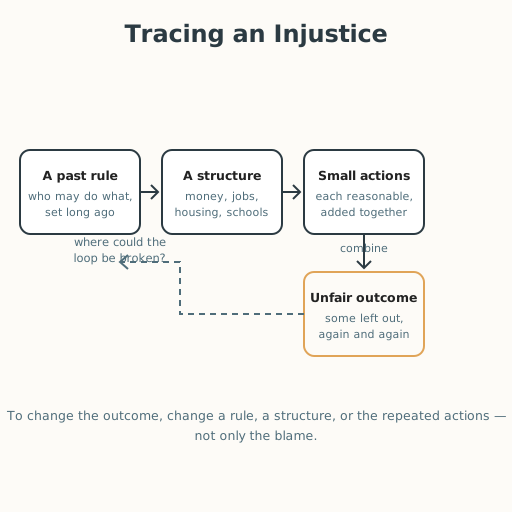
- Injustice trace sheet · 1 per learner A left-to-right chain — past rule, structure, small actions, unfair outcome — with a dashed arrow asking where the loop could be broken
- Case dossier · 1 per learner A short, sourced case of a documented systemic injustice, chosen from a globally varied set
Low-tech / no-cost
- A shared board or large paper Build the causal chain together instead of using printed sheets
- Voice Discuss the case aloud, each learner naming one link in the chain
Enriched / lab & device
- A digital whiteboard · 1 Build the chain collaboratively and annotate the break points
- Additional source material on the case · 1 per group A second, independent account to check and enrich the trace
Works in different contexts
- large-group Model one chain whole-group, then groups build a second and present their break point
- multi-age Younger learners order pre-made chain cards; older learners write the chain and argue a break point
- self-directed A learner reads a case dossier, builds the chain, and writes where the loop could be broken and why
- level-grouped Learners ready to extend weigh two possible interventions and argue which is more just and more feasible
- outdoor-only Trace the chain for a visible local inequality (water, shade, paths) and mark where a change would matter
Lesson 8 — Tracing a Systemic Injustice
Summary
Learners apply the three-layer analysis to one documented case, producing the unit’s systemic-injustice trace artifact. They build a causal chain from a past rule through a structure and repeated actions to an unfair outcome, then identify where the loop could be broken — moving from analysis to possible change.
Objectives
- Analyze a systemic injustice, tracing how individual actions, rules, and structures combine to produce unfair outcomes, and identify where the pattern could be changed. (D09.S2.09.01)
Connection
Every unfair pattern has a history — a rule set long ago, a structure that hardened around it, and countless small choices that kept it going. Tracing that chain is the first step to changing it, because you cannot fix a pattern you cannot see. Today you follow one injustice from cause to outcome and ask the question every reformer asks: where could this loop be broken?
Materials
- Injustice trace sheet
- Case dossier
Preparation
- Copy the trace sheet and case dossiers.
- Choose a globally varied set of case dossiers (e.g., unequal access to land, water, schooling, or fair wages in different regions), each short and sourced, so learners can trace a real, documented pattern without overwhelm.
Facilitator note
This lesson is written to the learner (“you”). Its goals: (1) move learners from the idea of systemic injustice (Lesson 7) to a skill — building a causal chain from a past rule → a structure → repeated small actions → an unfair outcome; (2) model once, then guide: build one chain whole-group, then let each learner build their own from a dossier (Kirschner, Sweller & Clark 2006, S-011); (3) end in agency, not despair — the dashed arrow (“where could the loop be broken?”) turns analysis into possible change (philosophy §12). The ethics lens: naming an injustice accurately is an act of care. The egalitarian lens: the dossier set must be globally varied so no single region is framed as the site of injustice. The global lens: each case is one place’s story — present it as an example, not as that people’s essence. Distinguish evidence from values: the facts of each case are sourced and hedged; the judgment that they are unjust is argued, and learners may reach different conclusions about the best fix. Keep emotional safety: choose cases at a depth the age can hold, and always connect to what people have done and can do (development “9–12”; facilitation “holding difficult topics safely”).
Procedure
- Retrieval (5 min). Name the three layers of systemic injustice from memory (actions, rules and norms, structures). What does “systemic” mean in one sentence?
- Model the trace (15 min). As a group, build one chain: (a) the past rule; (b) the structure it hardened into; (c) the small actions that repeat it; (d) the unfair outcome. Then, on the dashed arrow, mark one place the loop could be broken.
- Choose a case (5 min). Pick a case dossier — ideally one you have not studied before, and from a place different from your own.
- Trace it (20 min). Build the full chain for your case. For each link, write one specific, sourced fact. End by naming the break point and one sentence on why you chose it.
- Peer check (5 min). Trade with a partner. Is each link a cause of the next, or just a nearby fact? Is the break point a change to a rule, a structure, or a repeated action?
- Close (5 min). Analysis done; change imagined. Next: we step back and ask whether the idea of human rights itself travels fairly across cultures.
Differentiation
- Support: Provide the chain boxes pre-labeled and one worked link to copy the method.
- Extension: Compare two possible interventions and argue, in writing, which is more just and which is more feasible — and why they might differ.
Assessment
- Formative (observation): Does the learner’s chain show genuine causes (not mere facts) and a break point that changes a rule, structure, or repeated action?
- Artifact (portfolio): The completed injustice trace.
Home connection
Ask someone at home: what is one unfair thing in our town’s history that still shapes today? Whose rule or choice started it? Bring one sentence next time.
Resources
- On theories of justice and the structure of unfair arrangements: Stanford Encyclopedia of Philosophy, “Distributive Justice,” https://plato.stanford.edu/entries/justice-distributive/ (S-388).
- On explicit instruction and worked examples: Kirschner, Sweller & Clark (2006), https://doi.org/10.1207/s15326985ep4102_1 (S-011).