Lesson 07 — Systemic Injustice: Actions, Rules, Structures
Learners meet the idea of systemic injustice: unfair outcomes that no single person intended, produced when individual actions, rules and norms, and durable structures combine. They learn to trace a case across all three layers, distinguishing "someone did wrong" from "a system is arranged unfairly."
Objectives
Objectives
- D09.S2.09.01 Analyze a systemic injustice, tracing how individual actions, rules, and structures combine to produce unfair outcomes.
Essential question
How do individual actions, rules, and structures combine to produce unfair outcomes that no single person intended?
Key vocabulary
Materials
Standard materials
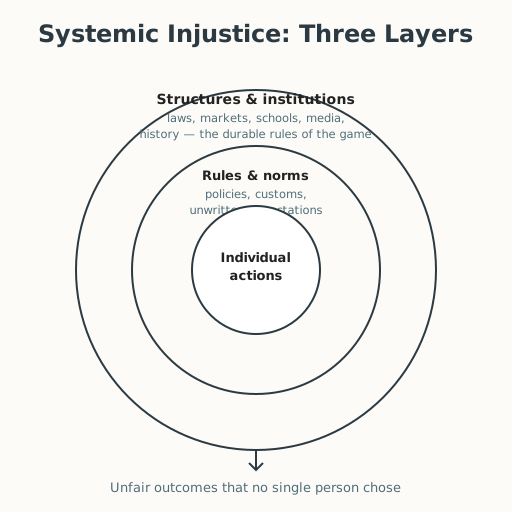
- Three-layers sheet · 1 per learner A diagram of three nested layers — individual actions inside rules and norms inside structures and institutions
- Worked-example case · 1 One everyday case (e.g., who gets clean water, safe housing, a fair school start) to trace through the three layers
Low-tech / no-cost
- A shared board or large paper Draw the three nested layers together instead of using printed sheets
- Voice Discuss the case aloud in a circle, naming one action, one rule, and one structure
Enriched / lab & device
- A digital whiteboard · 1 Co-build the three layers for a current local case, adding layers from learners' own knowledge
- A short data table or news item · 1 per group A documented inequality (e.g., access, income, housing) to ground the trace in evidence
Works in different contexts
- large-group Model the case whole-group, then groups trace a second case and present one layer each
- multi-age Younger learners identify one action and one rule; older learners add the structural layer and the outcome
- self-directed A learner traces one case through all three layers and writes how the layers combine
- level-grouped Learners ready to extend identify where a change at one layer would interrupt the unfair outcome
- outdoor-only Use a visible shared inequality outdoors — which neighborhoods have shade, clean water, safe paths — and trace its layers
Lesson 7 — Systemic Injustice: Actions, Rules, Structures
Summary
Learners meet the idea of systemic injustice: unfair outcomes that no single person intended, produced when individual actions, rules and norms, and durable structures combine. They learn to trace a case across all three layers, distinguishing “someone did wrong” from “a system is arranged unfairly.”
Objectives
- Analyze a systemic injustice, tracing how individual actions, rules, and structures combine to produce unfair outcomes. (D09.S2.09.01)
Connection
Why do some neighborhoods have clean water, shade trees, and safe paths, while others — a short walk away — do not? No one person decided “let us keep water from those people.” Instead, many small choices, written and unwritten rules, and long-standing arrangements combined to produce a pattern no individual chose. That is what “systemic” means: the unfairness lives in the system — the actions, rules, and structures working together — not only in one person’s intent.
Materials
- Three-layers sheet
- Worked-example case
Preparation
- Copy the layers sheet.
- Choose a worked-example case that is real and documented but not overwhelming — unequal access to clean water, safe housing, or a fair school start — and prepare the three layers to model.
Facilitator note
This lesson is written to the learner (“you”). Its goals: (1) introduce “systemic injustice” precisely — an unfair outcome produced by the interaction of (a) individual actions, (b) rules and norms, and (c) durable structures/institutions, often with no single bad actor; (2) model once, then guide: trace one case through the three nested layers, then let learners trace another (Kirschner, Sweller & Clark 2006, S-011); (3) hold a crucial distinction — systemic analysis explains a pattern, not every individual case, and it assigns responsibility to arrangements, not blame to whole groups. The ethics lens: unfairness can be real even when no one intends it. The egalitarian lens: always ask who the arrangement benefits and who it leaves out, and who has the power to change it. The global lens: systemic injustice takes different forms in different societies — do not assume one country’s pattern is the world’s pattern. Distinguish evidence from values: that unequal access is documented is a factual claim (cite a source); that it is unjust is a value claim we argue for, and there is room for more than one answer. Keep hope attached: systems are human-made, so they can be re-made (philosophy §12).
Procedure
- Retrieval (5 min). Last time we formed values. Now: what is the difference between an individual wrong and a pattern that keeps repeating? Say it in one sentence.
- Meet the three layers (10 min). Read the three-layers sheet. Individual actions sit inside rules and norms (policies, customs, unwritten expectations), which sit inside structures and institutions (laws, markets, schools, media, history). Unfair outcomes often come from all three working together.
- Worked example (15 min). Together, trace the worked-example case. Step by step: (a) name the unfair outcome; (b) list individual actions that feed it; (c) name the rules and norms; (d) name the structures. Notice: no single person intended the whole thing.
- Guided practice (15 min). In groups, trace a second case through the three layers. For each layer, name one thing, and end by saying: the unfairness lives in the arrangement, not in any one hand.
- Name the distinction (5 min). “Someone did wrong” (an individual wrong) is different from “a system is arranged unfairly” (a systemic wrong). Why does the difference matter for how we fix it?
- Close (5 min). Next: we trace one injustice in full — cause to outcome — and ask where the loop could be broken.
Differentiation
- Support: Provide the three layers pre-labeled and one worked entry in each.
- Extension: Identify the single change — to a rule, a structure, or a repeated action — most likely to interrupt the unfair outcome, and defend your choice.
Assessment
- Formative (observation): Can the learner trace a case across all three layers and explain how they combine, rather than blaming a single actor?
- Artifact: The completed layers trace, kept in the portfolio.
Home connection
Ask someone at home: what is one thing our neighborhood or town has that another nearby place lacks? Whose choices and rules do they think made it that way? Bring one sentence next time.
Resources
- On theories of justice and the structure of unfair arrangements: Stanford Encyclopedia of Philosophy, “Distributive Justice,” https://plato.stanford.edu/entries/justice-distributive/ (S-388); Rawls (1971), A Theory of Justice (S-459).
- On explicit instruction and worked examples: Kirschner, Sweller & Clark (2006), https://doi.org/10.1207/s15326985ep4102_1 (S-011).