Lesson 10 — Power & Accountability
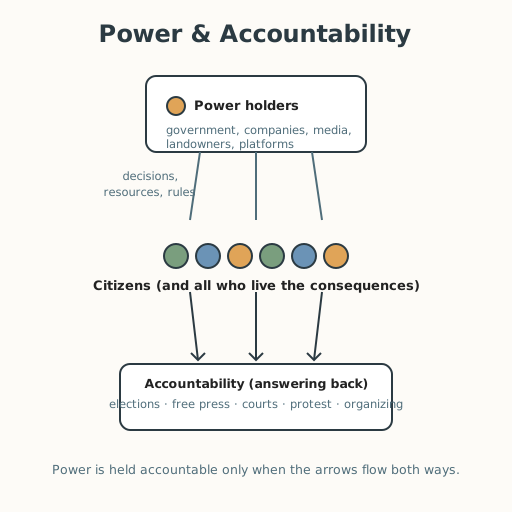
Learners analyze how power is distributed in a society and how citizens can hold it to account, using a specific case. They learn that power flows down (decisions, resources, rules) and must flow back up through accountability — elections, a free press, independent courts, protest, and organizing — and they produce a case study as a portfolio artifact.
Objectives
Objectives
- D09.S3.09.01 Analyze how power is distributed in a society and how citizens can hold power accountable, using a specific case.
Essential question
How is power distributed in a society, and how can citizens hold power accountable?
Key vocabulary
Materials
Standard materials
- Power and accountability sheet · 1 per learner A diagram of power holders over citizens, with upward arrows of accountability — elections, press, courts, protest, organizing
- Case study · 1 per learner A short, sourced case of a society where citizens did (or did not) hold power to account
Low-tech / no-cost
- A shared board or large paper Draw the two-way arrows together instead of using printed sheets
- Voice Discuss the case aloud, each learner naming one way citizens answered back
Enriched / lab & device
- A digital whiteboard · 1 Co-build the diagram and annotate a current case with sources
- Two contrasting case studies · 1 set per group One where accountability worked and one where it failed, to compare
Works in different contexts
- large-group Model one case whole-group, then groups read contrasting cases and present their accountability tools
- multi-age Younger learners name one person with power and one way people answer back; older learners analyze the case
- self-directed A learner reads a case, fills the diagram, and writes how power was distributed and held to account
- level-grouped Learners ready to extend compare formal checks (courts, elections) with informal ones (press, protest, organizing) and argue which mattered
- outdoor-only Identify who holds power over a shared outdoor resource and how users can hold them to account (meetings, rules, complaints)
Lesson 10 — Power & Accountability
Summary
Learners analyze how power is distributed in a society and how citizens can hold it to account, using a specific case. They learn that power flows down (decisions, resources, rules) and must flow back up through accountability — elections, a free press, independent courts, protest, and organizing — and they produce a case study as a portfolio artifact.
Objectives
- Analyze how power is distributed in a society and how citizens can hold power accountable, using a specific case. (D09.S3.09.01)
Connection
Every day, people with power — officials, employers, landowners, platform owners — make decisions that shape your life. The question of a fair society is not only who has power but whether the rest of us can answer back. A society where power flows only downward is one where abuse can thrive; a society where power flows both ways is one where people can demand an accounting. Today you study both directions.
Materials
- Power and accountability sheet
- Case study
Preparation
- Copy the sheet and case studies.
- Choose one case where accountability worked and one where it failed (from different regions), each short and sourced, so learners can compare, not just admire or condemn.
Facilitator note
This lesson is written to the learner (“you”). Its goals: (1) teach power and accountability precisely — power is distributed unevenly across a society (government, companies, media, landowners, platforms), and accountability is the set of ways the governed answer back: elections, a free press, independent courts, protest, organizing, and other checks; (2) model once, then guide: analyze one case whole-group, then let learners analyze another (Kirschner, Sweller & Clark 2006, S-011); (3) avoid dogma — present democracy’s accountability tools as some ways, not the only ones, and do not rank one society’s arrangements above another’s (philosophy §11). The ethics lens: power without accountability is a moral problem. The egalitarian lens: ask who has power, who is left out, and which accountability tools the least powerful can actually use. The global lens: accountability looks different across societies — formal checks in some, community and customary mechanisms in others — none is the default. Distinguish evidence from values: that power is unevenly distributed is a documented fact; that it should be held to account is a value we argue for. This is a portfolio artifact — keep the case study.
Procedure
- Retrieval (5 min). From memory: what does “systemic” mean, and how does it differ from one person’s wrongdoing? (One sentence.)
- Meet the diagram (10 min). Read the power and accountability sheet. Power flows down — decisions, resources, rules. Accountability flows up — elections, a free press, independent courts, protest, organizing. A fair society needs both directions.
- Worked example (15 min). Together, analyze one case: (a) who holds power? (b) how is it distributed — who is left out? (c) what tools did citizens use to answer back? (d) did accountability work, and why or why not?
- Analyze a second case (15 min). In groups, work a contrasting case through the same four questions. End by naming the one accountability tool that mattered most — and one that was missing.
- Compare (5 min). What did the successful case have that the failed one lacked? Is it always a single tool, or a combination?
- Close (5 min). Power is answered by accountability — and accountability must be built. Next: how does democracy compare with the alternatives?
Differentiation
- Support: Provide the four questions pre-printed and one worked answer to model.
- Extension: Compare a formal check (courts, elections) with an informal one (press, protest, organizing) and argue which mattered more in your case — and why.
Assessment
- Formative (observation): Can the learner name who holds power, how it is distributed, and at least two accountability tools, grounded in the case?
- Artifact (portfolio): The completed power-and-accountability case study.
Home connection
Ask someone at home: who holds power over something that affects our family, and how — if at all — can ordinary people answer back? Bring one sentence next time.
Resources
- On how power is distributed and checked across societies: V-Dem Institute, “Varieties of Democracy,” https://v-dem.net/ (S-461).
- On explicit instruction and worked examples: Kirschner, Sweller & Clark (2006), https://doi.org/10.1207/s15326985ep4102_1 (S-011).