Lesson 11 — Democracy & Its Alternatives
Learners evaluate the strengths and limits of democratic participation and compare it with alternatives across societies. They place ways of deciding on a spectrum from one-person rule to broad participation, weigh what democracy protects and what it still excludes, and produce a comparison as a portfolio artifact.
Objectives
Objectives
- D09.S3.09.02 Evaluate the strengths and limits of democratic participation, and compare with alternatives across different societies.
Essential question
What are the strengths and limits of democratic participation, and how does it compare with alternatives across different societies?
Key vocabulary
Materials
Standard materials
- Ways-of-deciding spectrum sheet · 1 per learner A spectrum from one-person rule to broad participation, with democracy and its alternatives placed along it
- Comparison chart · 1 per learner A table to compare ways of deciding — who decides, strengths, limits, who is left out
Low-tech / no-cost
- A shared board or large paper Draw the spectrum and comparison chart together instead of using printed sheets
- Voice Discuss each way of deciding aloud in a circle
Enriched / lab & device
- A digital whiteboard · 1 Co-build the comparison and annotate with real examples from more than one region
- A short dataset on participation · 1 per group A few documented measures of who participates and who is excluded, from more than one country
Works in different contexts
- large-group Build the spectrum whole-group, then groups each take one way of deciding and teach its strengths and limits
- multi-age Younger learners match each way of deciding to a picture; older learners fill the comparison chart
- self-directed A learner fills the chart and writes one paragraph comparing democracy with one alternative
- level-grouped Learners ready to extend argue whether democracy's value lies in better decisions or in equal voice — or both
- outdoor-only Discuss how a shared outdoor space is governed — by one caretaker, a few elders, a vote, or consensus — and compare
Lesson 11 — Democracy & Its Alternatives
Summary
Learners evaluate the strengths and limits of democratic participation and compare it with alternatives across societies. They place ways of deciding on a spectrum from one-person rule to broad participation, weigh what democracy protects and what it still excludes, and produce a comparison as a portfolio artifact.
Objectives
- Evaluate the strengths and limits of democratic participation, and compare with alternatives across different societies. (D09.S3.09.02)
Connection
How should a group decide anything — by one person’s word, by a few elders or owners, by a vote, or by talking until everyone can live with it? Your school, your town, and every country answer this differently. Democracy — rule by the many — is one answer with real strengths and real limits, and honest citizens weigh it against the alternatives rather than praising it automatically. Today you compare them with open eyes.
Materials
- Ways-of-deciding spectrum sheet
- Comparison chart
Preparation
- Copy the spectrum sheet and comparison chart.
- Prepare accurate, non-ranking examples of each way of deciding from more than one region, including consensus-based councils (e.g., the Haudenosaunee) as a living form of broad participation, not a “primitive” stage.
Facilitator note
This lesson is written to the learner (“you”). Its goals: (1) teach the ways societies decide, placed on a participation spectrum — rule by one (autocracy, monarchy), by a few (oligarchy, aristocracy), by many through voting and parties (democracy), and broad participation through deliberation and consensus (including Indigenous and other council traditions); (2) evaluate democracy honestly — its strengths (equal voice, peaceful transfer of power, accountability) and its limits (majorities can overlook minorities, wealth can capture voice, participation is unequal); (3) avoid dogma — democracy is compared, not preached; alternatives are described accurately, not caricatured, and learners may reach different conclusions about which arrangement best serves justice in a given place (philosophy §11). The ethics lens: how a group decides is itself a moral question. The egalitarian lens: in every arrangement ask who gets a real voice, and who is excluded. The global lens: democracy and its alternatives appear in many cultural forms across societies — none is the default, and consensus traditions are living, not relics. Distinguish evidence from values: that participation is uneven is a documented fact (cite a dataset); that broader participation is better is a value we argue for. This is a portfolio artifact — keep the comparison.
Procedure
- Retrieval (5 min). From memory: name two accountability tools from last lesson (e.g., a free press, independent courts, elections, protest, organizing).
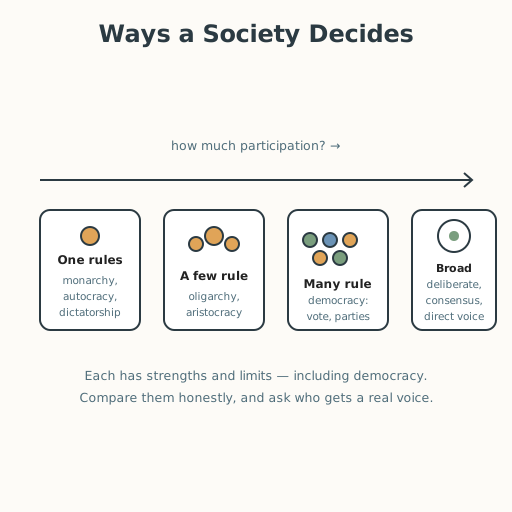
- Meet the spectrum (10 min). Read the ways-of-deciding sheet. From left to right, participation grows: one rules → a few rule → many rule (democracy) → broad participation (deliberation, consensus). Each is a real way real societies decide.
- Worked example (15 min). Together, fill the comparison chart for democracy: who decides (citizens through voting and parties), strengths (equal voice, peaceful transfer of power, accountability), limits (majorities can overlook minorities; wealth and media can capture voice; participation is unequal).
- Compare the alternatives (15 min). In groups, take one alternative — rule by one, rule by a few, or broad participation by consensus — and fill the same chart. Be fair: name its strengths as well as its limits, and give a real example.
- Weigh (5 min). Where does democracy protect what the alternatives risk — and where does it still fall short of broad participation? What would a more democratic arrangement add?
- Close (5 min). Democracy is a practice to improve, not a prize to display. Next: the roots of conflict — inequality, fear, scarcity.
Differentiation
- Support: Provide the comparison chart pre-filled for democracy and one worked row for an alternative.
- Extension: Argue whether democracy’s value lies in better decisions, in equal voice, or in both — and defend your answer with an example.
Assessment
- Formative (observation): Can the learner state a strength and a limit of democracy and fairly describe one alternative, grounded in a real example?
- Artifact (portfolio): The completed democracy-versus-alternatives comparison.
Home connection
Ask someone at home: how did our family or community make its last big decision — one person, a few, a vote, or talking it through? What worked and what didn’t? Bring one sentence next time.
Resources
- On how democracies and their alternatives are measured and compared: V-Dem Institute, “Varieties of Democracy,” https://v-dem.net/ (S-461).
- On the Universal Declaration of Human Rights, Article 21 (the right to take part in government): United Nations (1948), https://www.un.org/en/about-us/universal-declaration-of-human-rights (S-149).