Lesson 03 — Continuity & Change: The Growth of Cities
Learners extend their continuity-and-change skill to a second global process — the growth of cities — by placing five cities (Mohenjo-daro, Cahokia, Great Zimbabwe, Angkor, Timbuktu) on a timeline and naming what stayed the same and what changed across regions and centuries.
Objectives
Objectives
- D08.S1.09.01 Analyze continuity and change in one global process, such as long-distance trade or the growth of cities, across several regions and centuries.
Essential question
How did the growth of cities change and stay the same across regions and centuries?
Key vocabulary
Materials
Standard materials
- City cards · 1 set per group Cards naming five cities — Mohenjo-daro, Cahokia, Great Zimbabwe, Angkor, Timbuktu — with one fact each
- Continuity-and-change sheet · 1 per learner Reused from Lesson 2, now applied to cities
Low-tech / no-cost
- A shared board or large paper Draw a long timeline of the five cities and fill "stayed" and "changed" together
- Voice and memory Describe each city aloud and have learners retell its one key feature
Enriched / lab & device
- An atlas or digital map · 1 To locate each city on its river, coast, or trade route
- Images of the five cities' remains · 1 set Photographs or drawings of ruins and plans to examine
Works in different contexts
- large-group Introduce the five cities to the whole group, then small groups sort the cards into a timeline and a stayed/changed table
- multi-age Younger learners match each city to a picture and one fact; older learners place each on a timeline and state a continuity and a change
- self-directed A learner reads the five city cards, places them on a timeline, and writes one continuity and one change with evidence
- level-grouped Learners ready to extend choose a sixth city from their own region and add it to the timeline with evidence
- outdoor-only Walk to the oldest settled place nearby and ask why people settled here, and what has changed and stayed about it
Lesson 3 — Continuity & Change: The Growth of Cities
Summary
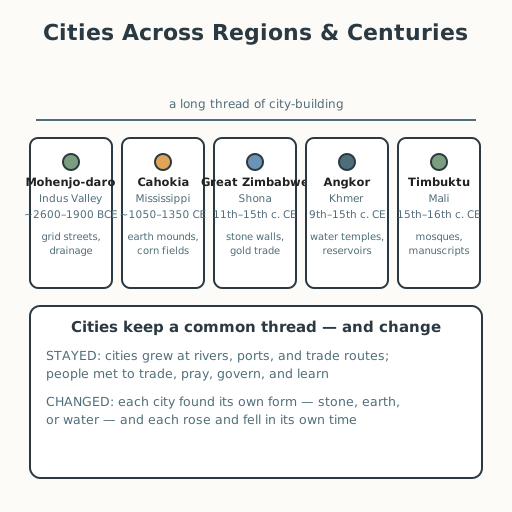
Learners extend their continuity-and-change skill to a second global process — the growth of cities — by placing five cities on a timeline and naming what stayed the same and what changed. The cities are Mohenjo-daro (Indus Valley), Cahokia (Mississippi), Great Zimbabwe (Shona), Angkor (Khmer), and Timbuktu (Mali).
Objectives
- Analyze continuity and change in the growth of cities across several regions and centuries, naming what stayed the same and what changed. (D08.S1.09.01)
Connection
Every city you have ever seen — and every town you have lived in — began somewhere: usually at a river crossing, a port, a trade route, or a place where people could gather. Cities are one of the oldest human inventions, and they are still being invented today. Some things about them have stayed the same for thousands of years; other things change with every century. Today we trace that double story across the world.
Materials
- City cards
- Continuity-and-change sheet
Preparation
- Copy the city cards and the sheet.
- Retrieval: from Lesson 2, recall the two-column method (stayed the same / changed). Today we apply it to cities.
Facilitator note
This lesson is written to the learner (“you”). The idea to land: cities are a second global process to analyze for continuity and change. What stayed the same: cities grew at rivers, ports, and trade routes, and people gathered in them to trade, pray, govern, and learn. What changed: each city found its own form — stone, earth, or water — and each rose and fell in its own time. The five cities, each a real, documented case: (1) Mohenjo-daro — an Indus Valley city of ~2600–1900 BCE with grid streets and an elaborate drainage system (S-132); (2) Cahokia — a Mississippian city near the Mississippi River, ~1050–1350 CE, built around earth mounds (S-472); (3) Great Zimbabwe — a Shona stone city of the 11th–15th centuries CE, center of a gold-trading kingdom linked to the Indian Ocean coast (S-199); (4) Angkor — a Khmer city of the 9th–15th centuries CE whose vast water system of reservoirs and canals managed the monsoons (S-471); (5) Timbuktu — a Saharan trade city that became a center of manuscript learning in the 15th–16th centuries (S-268). Note the global range on purpose: city-building is a shared human achievement, not one region’s. This is a skill lesson, so reinforce the worked-example–guided-practice–independent pattern from Lesson 2 (Kirschner, Sweller & Clark 2006, S-011). The global lens: cities arose independently on many continents. The environment lens: cities grew where land and water met — rivers, coasts, oases. The technology lens: city-building required engineering — drains, mounds, stone walls, reservoirs. The egalitarian lens: ask who lived in the fine center of a city and who lived at its edges. Keep decline honest but multi-causal — cities rarely “collapse” from one cause (see Lesson 6).
Procedure
- Recall (5 min). From Lesson 2: what are the two columns of a continuity-and-change analysis? Today we use them on a new process: cities.
- Meet five cities (12 min). Read the five city cards. For each, note where it stood and one thing it is remembered for: Mohenjo-daro’s drains, Cahokia’s mounds, Great Zimbabwe’s stone walls, Angkor’s reservoirs, Timbuktu’s books.
- Build a timeline (8 min). Place the five cities in order on a long line. What does the order tell you? (City-building is ancient and ongoing — no single region owns it.)
- Two columns (15 min). Fill the sheet. Stayed the same: cities grew at rivers, ports, and trade routes; people gathered to trade, pray, govern, learn. Changed: each city’s form — stone, earth, or water — and each city’s rise and fall.
- Compare (8 min). How is the story of cities like the story of trade from Lesson 2, and how is it different?
- Close (5 min). Cities are a thread that runs through all of human history. Next: we turn to knowledge — how it is lost and how it is revived.
Differentiation
- Support: Give a pre-drawn timeline with the five cities placed, and ask learners to add one “stayed” and one “changed” fact to each.
- Extension: Choose a sixth city from your own region or another continent and add it to the timeline with a source for its dates.
Assessment
- Formative (observation): Can the learner place the five cities in time and name at least one continuity and one change with evidence?
- Portfolio artifact: The completed timeline and sheet, kept in the portfolio.
Home connection
Ask at home: why did people first settle where your town or city is? What has changed about it, and what has stayed the same?
Resources
- On urbanization as a long global process: Our World in Data, https://ourworldindata.org/urbanization (S-089).
- On Mohenjo-daro: Encyclopaedia Britannica, https://www.britannica.com/place/Mohenjo-daro (S-132).
- On Great Zimbabwe: UNESCO World Heritage Centre (Dossier 364) (S-199).
- On Timbuktu: UNESCO World Heritage Centre (Dossier 119) (S-268).
- On Angkor: UNESCO World Heritage Centre (S-471); on Cahokia: UNESCO World Heritage Centre (S-472).
- On explicit instruction and worked examples: Kirschner, Sweller & Clark (2006), https://doi.org/10.1207/s15326985ep4102_1 (S-011).