Lesson 04 — Knowledge Traditions: Suppressed, Preserved, Revived
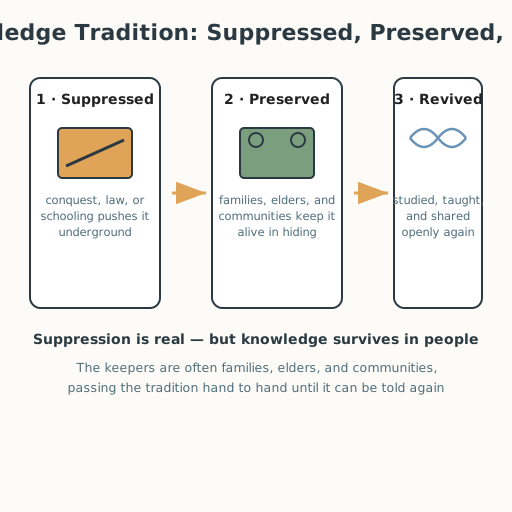
Learners analyze how knowledge traditions were **suppressed, preserved, and revived** through three case studies: the Maya codices and mathematics, the Timbuktu manuscripts, and the Andean khipu. They learn that suppression is real, but that knowledge survives in people — and can be revived.
Objectives
Objectives
- D08.S2.09.01 Analyze how a knowledge tradition was suppressed, marginalized, or lost through colonialism or conquest, and how peoples have worked to preserve or revive it.
Essential question
How were knowledge traditions suppressed or lost through colonialism and conquest — and how have peoples preserved and revived them?
Key vocabulary
Materials
Standard materials
- Case cards · 1 set per group Cards on three knowledge traditions — Maya codices and mathematics, the Timbuktu manuscripts, and the Andean khipu
- Suppressed-preserved-revived sheet · 1 per learner A three-column sheet for tracing each tradition's story
Low-tech / no-cost
- A shared board or large paper Draw the three-column path (suppressed → preserved → revived) and fill it together
- Voice and retelling Tell each case aloud and have learners retell how the tradition survived
Enriched / lab & device
- Images of a surviving codex and Timbuktu manuscripts · 1 set To examine and describe, treated as living heritage, not specimens
- A short clip on manuscript digitization · 1 How modern technology helps revive and share endangered knowledge
Works in different contexts
- large-group Tell each case once to the whole group, then small groups fill the three-column sheet
- multi-age Younger learners match each tradition to a picture and one fact; older learners trace the full suppressed-preserved-revived path
- self-directed A learner reads the three cases, fills the sheet, and writes one sentence on what preservation required
- level-grouped Learners ready to extend compare two traditions and explain which faces the harder path to revival and why
- outdoor-only Ask an elder or neighbor about a local skill or story that was nearly lost and how it was kept alive
Lesson 4 — Knowledge Traditions: Suppressed, Preserved, Revived
Summary
Learners analyze how knowledge traditions were suppressed, preserved, and revived through three case studies: the Maya codices and mathematics, the Timbuktu manuscripts, and the Andean khipu. They learn that suppression is real, but that knowledge survives in people — and can be revived.
Objectives
- Analyze how a knowledge tradition was suppressed, marginalized, or lost through colonialism or conquest, and how peoples have preserved or revived it. (D08.S2.09.01)
Connection
Think of something your family or community knows that is not written in any textbook — a recipe, a song, a way of fixing things, a story about the land. Who keeps it? What would happen if no one passed it on? All over the world, whole bodies of knowledge have been pushed underground by conquest and colonialism — and then kept alive, sometimes for centuries, by the people who refused to let them die. Today we trace three of those stories.
Materials
- Case cards
- Suppressed–preserved–revived sheet
Preparation
- Copy the case cards and the sheet.
- Retrieval: from Lessons 2–3, recall the two-column method. Today we use a three-step path instead: suppressed → preserved → revived.
Facilitator note
This lesson is written to the learner (“you”). The idea to land: colonialism and conquest can suppress a knowledge tradition — through burning books, banning languages and practices, or forcing a foreign system of record-keeping — but knowledge survives in people, and it can be revived. Three documented cases: (1) The Maya. The Maya built a civilization (Classic period ~250–900 CE) with writing, astronomy, and a precise calendar; Spanish colonial authorities destroyed most of their bark-paper codices, and only a few survive — among them the Dresden Codex with its astronomical tables — yet Maya peoples still speak their languages and scholars and communities now study and revive Maya mathematics and astronomy (S-378, S-474). (2) The Timbuktu manuscripts. Under Songhai rule (1464–1591), Timbuktu was a center of learning whose families copied and kept thousands of manuscripts on law, astronomy, medicine, and mathematics; threatened and damaged by conquest and conflict, they were rescued and hidden by families, and many are now preserved and digitized (S-268, S-201). (3) The khipu. The Inka and their predecessors recorded numbers and information in knotted cords called khipu; the Spanish colonial administration suppressed them as a record-keeping system, and their full reading was largely lost — but surviving khipu are now the subject of careful study and community revival (S-473). This is a concept lesson, so let inquiry and story carry it, with the three-step path as the scaffold (philosophy §13). The ethics lens: what is owed to the keepers of lost knowledge? The egalitarian lens: whose knowledge counts as “real” knowledge, and who decides? The global lens: these are three of many such stories on every continent. The technology lens: digitization is now helping revive and share endangered knowledge — a tool with power and limits. Handle with care and hope: always end on revival and agency, never only on loss (facilitation.md).
Procedure
- Recall (5 min). From Lesson 2: what is a continuity-and-change analysis? Today we trace a different path — suppressed → preserved → revived.
- Meet three traditions (12 min). Read the three case cards. For each, note two
things: what the tradition knew, and how it was pushed underground.
- Maya: writing, mathematics, and astronomy; most codices burned by Spanish authorities.
- Timbuktu: manuscripts on law, astronomy, medicine, and math; threatened and hidden during conquest and conflict.
- Khipu: knotted cords recording numbers and information in the Andes; suppressed as a system of record-keeping.
- Trace the path (15 min). Fill the three-column sheet for one tradition. Who suppressed it, and how? Who preserved it, and where did it hide? Who revived it, and how is it studied today?
- Notice the keepers (10 min). In every case, the keepers were families, elders, and communities — not conquerors. Write one sentence on what preservation required of them.
- Connect to today (8 min). Where do you see suppressed knowledge being revived today — a language, a craft, a medicine, a way of caring for the land?
- Close (5 min). Knowledge can be lost, but it is held in people — and people endure. Next: what happens when cultures mix?
Differentiation
- Support: Provide the three-column sheet pre-filled for one tradition and ask learners to match each fact to “suppressed,” “preserved,” or “revived.”
- Extension: Compare two traditions and argue which faced the harder path to revival, using evidence and naming your reasoning.
Assessment
- Formative (observation): Can the learner trace one tradition’s full path and name who preserved it?
- Portfolio artifact: The completed three-column sheet, kept in the portfolio.
Home connection
Ask an elder at home: is there a skill, word, or story from our family that was nearly lost, and how was it kept alive? Write down what they say.
Resources
- On the Maya and their civilization: Encyclopaedia Britannica, https://www.britannica.com/topic/Maya-people (S-378); on the surviving codices: Encyclopaedia Britannica (S-474).
- On the Timbuktu manuscripts: UNESCO World Heritage Centre (Dossier 119) (S-268); UNESCO Memory of the World (S-201).
- On the khipu: Encyclopaedia Britannica (S-473).
- On Indigenous knowledge and its transmission: AIATSIS, https://aiatsis.gov.au/ (S-085).