Lesson 05 — When Cultures Mix: New Traditions, New Identities
Learners explain how the **mixing of cultures** created new traditions and identities through three examples: the Swahili coast, the Haitian Creole language, and the Columbian Exchange of foods. They learn that mixing is **creative**, not a loss.
Objectives
Objectives
- D08.S2.09.02 Explain how the mixing of cultures created new traditions and identities, using specific historical examples.
Essential question
How did the mixing of cultures create new traditions and identities?
Key vocabulary
Materials
Standard materials
- Mixing cards · 1 set per group Cards on three mixings — the Swahili coast, Haitian Creole, and the Columbian Exchange of foods
- Mixing sheet · 1 per learner A sheet with "what met" on the left and "what new thing grew" on the right
Low-tech / no-cost
- A shared board or large paper Draw two streams meeting and name the new thing that grew, for each case
- Voice and memory Tell the three mixings aloud and have learners retell each new thing that grew
Enriched / lab & device
- Food samples or images of mixed cuisines · 1 set Real or pictured dishes born of cultural mixing, to identify and describe
- A short audio clip of a creole or Swahili phrase · 1 To hear a new language born of contact
Works in different contexts
- large-group Tell the three mixings to the whole group, then small groups fill the mixing sheet
- multi-age Younger learners match each food or word to its mixing; older learners explain the two sources and the new thing that grew
- self-directed A learner reads the three cases, fills the sheet, and writes one sentence on why mixing is creative, not loss
- level-grouped Learners ready to extend trace a mixing from their own region — a dish, a word, a music — and name its sources
- outdoor-only Look at the foods grown or eaten locally and ask which came from other lands and what new dishes they became
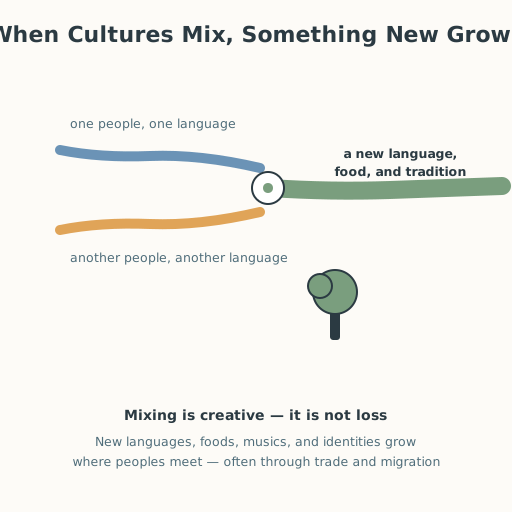
Lesson 5 — When Cultures Mix: New Traditions, New Identities
Summary
Learners explain how the mixing of cultures created new traditions and identities through three examples: the Swahili coast, the Haitian Creole language, and the Columbian Exchange of foods. They learn that mixing is creative — it is not a loss.
Objectives
- Explain how the mixing of cultures created new traditions and identities, using specific historical examples. (D08.S2.09.02)
Connection
Think of a food you love that is really two foods meeting — a dish that could not exist without ingredients or ideas from more than one place. Or think of a word in your own language that came from somewhere else. Cultures are never sealed boxes; they meet, borrow, and blend, and out of the meeting come things no one planned. Today we look at three famous mixings and the new things that grew from them.
Materials
- Mixing cards
- Mixing sheet
Preparation
- Copy the mixing cards and the sheet.
- Retrieval: from Lesson 4, recall how knowledge is suppressed and revived. Today’s question is the other side — what happens when cultures meet and mix.
Facilitator note
This lesson is written to the learner (“you”). The idea to land: when peoples meet — through trade, migration, or empire — they create new traditions and identities that are more than the sum of their parts. Mixing is creative, not a loss. Three documented examples: (1) The Swahili coast. Over centuries, Bantu-speaking East Africans met Arab, Persian, and Indian Ocean traders, and from that contact grew the Swahili language and a coastal culture of stone towns, trade, and literature (S-381, S-207). (2) Haitian Creole. On the island that became Haiti, enslaved Africans and French colonists were forced into contact, and from that meeting grew Haitian Creole — a full new language, not a broken version of either, now spoken by millions (S-475). (3) The Columbian Exchange. After 1492, plants, animals, and people moved between the Americas and Afro-Eurasia: maize, potatoes, tomatoes, cacao, and chilies went one way; wheat, rice, horses, and cattle the other — and the world’s cuisines were remade (S-273). This is a concept lesson, so let inquiry and story carry it (philosophy §13). The global lens: mixing happens on every continent, in every language family. The egalitarian lens: ask who gets credited for a “new” tradition — and whose contribution is erased. The ethics lens: be honest that some mixing was forced (slavery, colonization) — the new thing that grew can be beautiful and still born of harm; hold both truths. The technology lens: ships and trade routes were the tools that brought cultures into contact. Keep it honest and specific, and never romanticize the violence that sometimes forced the meeting.
Procedure
- Recall (5 min). From Lesson 4: knowledge can be suppressed but survives in people. Today’s question: what happens when cultures meet and mix?
- Meet three mixings (12 min). Read the three cards. For each, name the two (or more)
things that met:
- Swahili coast: Bantu-speaking peoples + Arab, Persian, and Indian Ocean traders.
- Haitian Creole: enslaved Africans + French colonists, forced into contact.
- Columbian Exchange: the Americas + Afro-Eurasia, after 1492.
- What new thing grew (15 min). Fill the sheet. For each, write what met and what new thing grew: the Swahili language and stone-town culture; a full new language, Haitian Creole; and remade cuisines — maize, potatoes, tomatoes, cacao, and chilies moving across the world.
- Hold both truths (10 min). Some mixing was chosen and joyful; some was forced by slavery and empire. Write one sentence naming a mixing that was forced, and one sentence honoring the creativity of the people who made something new despite it.
- Find a mixing near you (8 min). Name one thing in your own life — a food, a word, a music, a custom — that is a mixing. What are its sources?
- Close (5 min). Mixing is not the same as losing. Next: how societies and their environments have shaped each other over deep time.
Differentiation
- Support: Provide the sheet with “what met” filled in, and ask learners to name the new thing that grew.
- Extension: Trace a mixing from your own region — a dish, a word, a music — and name its sources with evidence.
Assessment
- Formative (observation): Can the learner name the sources of one mixing and the new tradition or identity that grew from it?
- Portfolio artifact: The completed mixing sheet, kept in the portfolio.
Home connection
Ask at home: what is one dish, word, or song in our family that came from another culture and became our own? Find out where it came from.
Resources
- On the Swahili language: Encyclopaedia Britannica, https://www.britannica.com/topic/Swahili-language (S-381); UNESCO, “The Indian Ocean, a shared heritage” (S-207).
- On the Columbian Exchange: Crosby, The Columbian Exchange (1972) (S-273).
- On Haitian Creole: Encyclopaedia Britannica (S-475).