Lesson 06 — Societies & Their Environments Over Deep Time
Learners analyze how societies changed — and were changed by — their environments over long spans of time, through three cases: Angkor's water system, the Maya lowlands, and Great Zimbabwe. They learn that decline is usually **multi-causal**, not one simple story.
Objectives
Objectives
- D08.S3.09.01 Analyze how societies changed and were changed by their environments over long spans of time, including adaptation and cases of decline, using evidence.
Essential question
How have societies changed — and been changed by — their environments over long spans of time?
Key vocabulary
Materials
Standard materials
- Case cards · 1 set per group Cards on three cases — Angkor's water system, the Maya lowlands, and Great Zimbabwe — with evidence for adaptation and decline
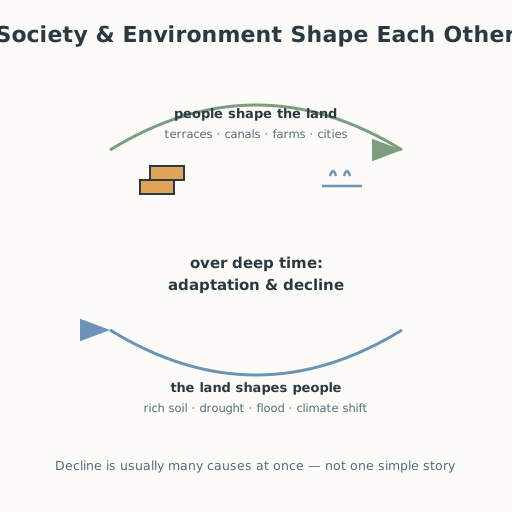
- Society-environment sheet · 1 per learner A two-way sheet with "people shaped the land" on one side and "the land shaped people" on the other
Low-tech / no-cost
- A shared board or large paper Draw the two-way loop and fill it together
- Voice and memory Tell each case aloud and have learners retell the adaptation and the decline
Enriched / lab & device
- Images or maps of the three sites · 1 set To examine the terracing, reservoirs, and stone walls
- A short clip on one site's archaeology · 1 Age-appropriate, to watch and then retell
Works in different contexts
- large-group Tell each case once to the whole group, then small groups fill the two-way sheet
- multi-age Younger learners match each site to a picture and one fact; older learners state one adaptation and one cause of decline with evidence
- self-directed A learner reads the three cases, fills the sheet, and writes one sentence on why decline is rarely one cause
- level-grouped Learners ready to extend evaluate the evidence for one site's decline and name which causes the evidence supports most strongly
- outdoor-only Study the land around you — a slope, a river, a soil — and ask how people shaped it and how it shaped people
Lesson 6 — Societies & Their Environments Over Deep Time
Summary
Learners analyze how societies changed — and were changed by — their environments over long spans of time, through three cases: Angkor’s water system, the Maya lowlands, and Great Zimbabwe. They learn that adaptation and decline both matter, and that decline is usually multi-causal — not one simple story.
Objectives
- Analyze how societies changed and were changed by their environments over long spans of time, including adaptation and cases of decline, using evidence. (D08.S3.09.01)
Connection
Walk outside and notice the land: a slope, a river, the soil, the weather. Every place people live, they have shaped — by terracing a hillside, digging a well, planting a field, building a city. And every place has shaped them back — what they can grow, how they build, when they must move. This two-way relationship runs through all of history. Today we trace it over long spans of time.
Materials
- Case cards
- Society–environment sheet
Preparation
- Copy the case cards and the sheet.
- Retrieval: from Lesson 3, recall the five cities and where each stood. Today we ask the deeper question — how did land and society shape each other?
Facilitator note
This lesson is written to the learner (“you”). The idea to land: societies and their environments shape each other in both directions. People adapt — building terraces, canals, and reservoirs to manage their land — and environments also constrain people, through drought, flood, and soil. When societies decline, it is usually many causes at once, not one simple story. Three documented cases: (1) Angkor — the Khmer built a vast water system of reservoirs and canals to manage the monsoons, an impressive adaptation; the city’s decline in the 14th–15th centuries is debated, with evidence pointing to climate stress and strain on the water infrastructure together (S-471). (2) The Maya lowlands — the Classic Maya (~250–900 CE) adapted with terracing and reservoirs, but many southern-lowland cities were abandoned around 800–950 CE; scholars now see drought, warfare, and environmental stress working together, not a single cause (S-378). (3) Great Zimbabwe — the Shona built a stone city and a gold-trading economy in the 11th–15th centuries CE, an adaptation to the region’s resources; its later decline is likewise multi-causal (S-199). The environment lens is the heart here. The technology lens: water and building engineering were the tools of adaptation. The global lens: this two-way story plays out on every continent. The critical-thinking lens: resist single-cause stories of “collapse” — good history weighs multiple causes and the evidence for each. Hold decline with care and accuracy, and end on the continuity of peoples, not only on ruin (facilitation.md).
Procedure
- Recall (5 min). From Lesson 3: name one city and where it stood. Today we ask a deeper question — how did the land and the society shape each other?
- Meet three cases (12 min). Read the cards. For each, note the adaptation and the
decline:
- Angkor: reservoirs and canals managed the monsoons; decline debated — climate stress and strained waterworks together.
- Maya lowlands: terracing and reservoirs; many cities abandoned ~800–950 CE under drought, warfare, and environmental stress together.
- Great Zimbabwe: a stone city and gold trade; later decline also multi-causal.
- Two-way sheet (15 min). Fill the sheet. People shaped the land: terraces, canals, reservoirs, stone walls. The land shaped people: what could be grown, when the rains came, when the soil tired.
- Weigh the causes (12 min). Choose one case. List the causes of decline the evidence points to. Why is “it collapsed for one reason” almost always too simple?
- Connect to now (8 min). Where do you see societies and environments shaping each other today — in how your region farms, builds, or responds to weather?
- Close (5 min). People adapt, and environments answer back. Next: a forced movement of people that changed the whole world.
Differentiation
- Support: Provide the two-way sheet pre-filled for one case and ask learners to match each fact to “people shaped the land” or “the land shaped people.”
- Extension: Evaluate the evidence for one site’s decline and argue which causes the evidence supports most strongly, naming your reasoning.
Assessment
- Formative (observation): Can the learner name one adaptation and one cause of decline for one case, and explain why decline is multi-causal?
- Portfolio artifact: The completed two-way sheet, kept in the portfolio.
Home connection
Ask at home: how has our family or community changed the land where we live — and how has the land changed how we live? Write down one example of each.
Resources
- On the Maya and the collapse debate: Encyclopaedia Britannica, https://www.britannica.com/topic/Maya-people (S-378).
- On Angkor: UNESCO World Heritage Centre (S-471).
- On Great Zimbabwe: UNESCO World Heritage Centre (Dossier 364) (S-199).