Lesson 03 — Who Controls the Platform? Power Over Users
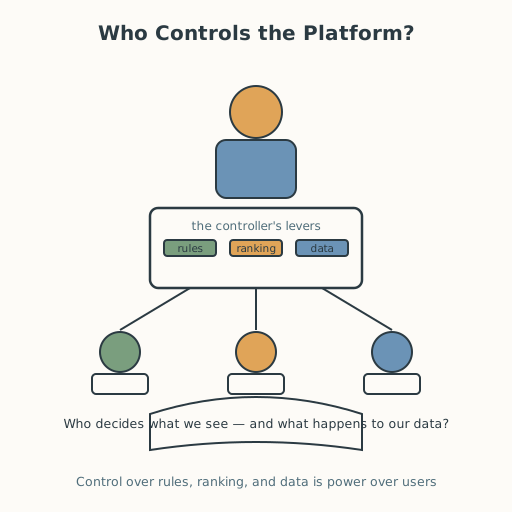
Learners analyze who controls a digital platform by naming three levers the controller holds — setting the rules, tuning the ranking, and collecting the data — and trace what that power lets them decide about users. They see that control is power, and that ownership shapes who holds it.
Objectives
Objectives
- D10.S1.09.02 Analyze who controls a digital platform and what power that control gives them over users.
Essential question
Who controls a digital platform, and what power does that control give them over users?
Key vocabulary
Materials
Standard materials
- Platform power sheet · 1 per learner A three-lever sheet — rules, ranking, data — for analyzing who controls a platform
- Platform case cards · 1 set per group Short, plain-language profiles of two or three kinds of platform (a global social network, a community-run forum, a cooperatively owned service)
Low-tech / no-cost
- A shared board or large paper Draw the three levers and fill them in together
- Voice and memory Tell each platform case aloud and have learners retell who holds each lever
Enriched / lab & device
- A real terms-of-service or content-policy page · 1 To find the actual rules a platform sets, read aloud in age-appropriate excerpts
- A short news piece on a platform policy change · 1 A current, documented example of a controller using its power over users
Works in different contexts
- large-group Analyze one platform case together on the board, then small groups work the other cases
- multi-age Younger learners match each lever (rules, ranking, data) to what it controls; older learners explain how the three levers together add up to power over users
- self-directed A learner fills the power sheet for one platform and writes one paragraph on what the controller can decide unilaterally
- level-grouped Learners ready to extend compare a for-profit platform with a cooperative or community-run one, and argue how ownership changes who holds power
- outdoor-only Ask who "owns" a shared public space — a market, a well, a meeting ground — and how ownership changes who decides the rules there
Lesson 3 — Who Controls the Platform? Power Over Users
Summary
Learners analyze who controls a digital platform by naming three levers the controller holds — setting the rules, tuning the ranking, and collecting the data — and trace what that power lets them decide about users. They see that control is power, and that ownership shapes who holds it.
Objectives
- Analyze who controls a digital platform and what power that control gives them over users. (D10.S1.09.02)
Connection
Every shared space has someone who decides its rules — who may enter a market, how a well is shared, what may be said in a meeting hall. A digital platform is a shared space too, but its rules, its ordering, and its records are all set by whoever controls the software. Knowing who that is — and what they can decide without asking you — is knowing where the power sits.
Materials
- Platform power sheet
- Platform case cards
Preparation
- Copy the platform power sheet and the case cards.
- Retrieval: from Lesson 2, recall the algorithm’s steps (signals → rank → slice). Today we ask who sets those steps — and what else they control.
Facilitator note
This lesson is written to the learner (“you”). The idea to land: whoever controls a platform holds three levers — the rules (terms of service and moderation), the ranking (the algorithm), and the data (what is collected and how it is used) — and those levers add up to power over users: what they see, what they may post, and what is known about them. This is an analysis of how power works, not a verdict that all platforms are bad. The technology lens: control is built into the software and the business model. The egalitarian lens: ask who holds power and who has none — users rarely set the rules they live under. The ethics lens: is power this concentrated fair, and what would make it accountable? The critical-thinking lens: “who controls this?” is a question to ask of every tool, not only screens. Contrast at least one community-run or cooperatively owned platform with a for-profit one so learners see that ownership is a choice, not a law of nature (S-281). Keep the treatment balanced — platforms also give real value (connection, voice, knowledge) — and hold questions open (philosophy §11).
Procedure
- Recall (5 min). From Lesson 2: what are the algorithm’s three steps? Today we ask who sets them — and what else they control.
- Meet the three levers (10 min). Look at the platform power sheet. Whoever controls a platform holds three levers: rules (what is allowed, who is removed), ranking (what rises, what is buried), and data (what is collected, what it is used for).
- Analyze two platforms (15 min). Read the case cards — one global for-profit social network and one community-run or cooperative service. For each, fill the sheet: who holds each lever, and what can they decide without asking users?
- Trace the power (12 min). For one platform, write one sentence on each: what the controller can decide about what users see, what users may post, and what is known about users.
- Peer-check (5 min). Swap sheets with a partner. Did you both find the same three levers? Where did you differ?
- Close (5 min). Control is power, and ownership decides who holds it. Next: what happens when that ranking narrows what any one person sees — the echo chamber.
Differentiation
- Support: Provide the power sheet pre-filled for one lever and ask learners to fill the other two.
- Extension: Compare a for-profit platform with a cooperative one and argue how the change of ownership changes who is accountable, naming your reasoning.
Assessment
- Formative (observation): Can the learner name the three levers and state one power each gives the controller over users?
- Portfolio artifact: The completed platform power sheet, kept in the portfolio.
Home connection
Ask at home: who owns the apps and platforms our family uses most, and have we ever read their rules? Write down one rule you discover that surprised you.
Resources
- On platforms, content moderation, and platform rules: Encyclopaedia Britannica, “Social media,” https://www.britannica.com/topic/social-media (S-481).
- On how access to and control of digital tools vary by cost, geography, and disability: World Bank, World Development Report 2016: Digital Dividends, https://www.worldbank.org/en/publication/wdr2016 (S-281).