Lesson 04 — Echo Chambers: How Feeds Narrow Us — and How to Break Out
Learners explain how an algorithmic feed can become an echo chamber: software keeps showing what a person already engages with, so the same views repeat and opposing views stay out of sight. They name and plan concrete ways to break out — seeking different sources on purpose.
Objectives
Objectives
- D10.S2.09.01 Explain how algorithmic feeds and "echo chambers" can narrow what people see, and name a way to break out of them.
Essential question
How can algorithmic feeds and "echo chambers" narrow what people see — and what is one way to break out of them?
Key vocabulary
Materials
Standard materials
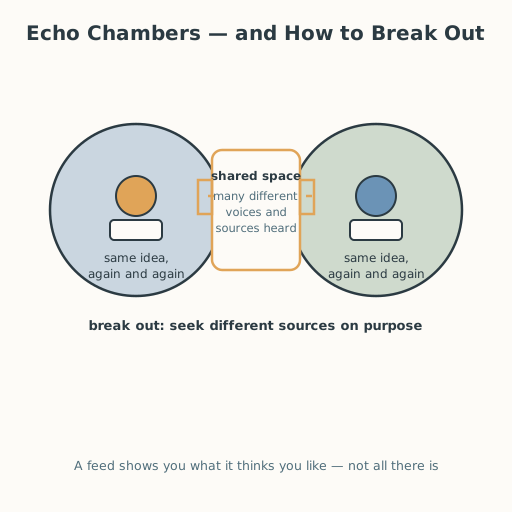
- Echo chamber diagram sheet · 1 per learner A two-bubble diagram with a door to a shared middle space of many voices
- Break-out card set · 1 set per group Cards listing concrete ways to break out (follow a source you disagree with, read an outlet from another country, ask who is absent, check an original source)
Low-tech / no-cost
- A shared board or large paper Draw the two bubbles and the shared space together
- Voice and memory Act out the "same idea again and again" loop, then name one break-out move aloud
Enriched / lab & device
- Two different news feeds or front pages side by side · 1 set To see how two feeds can present very different slices of the same world
- A short clip or article about the filter-bubble idea · 1 Age-appropriate, to watch or read and then retell
Works in different contexts
- large-group Build the echo-chamber diagram once on the board, then small groups sort the break-out cards from easiest to hardest
- multi-age Younger learners match each break-out card to a picture; older learners explain why a feed narrows and rank the break-out moves by effort and payoff
- self-directed A learner fills the diagram, audits one of their own feeds for sameness, and writes one break-out plan
- level-grouped Learners ready to extend discuss the limits of the "echo chamber" idea itself — how strong is the effect, and what evidence would settle it
- outdoor-only Ask where people in your area hear only one kind of voice, and where they hear many; compare that to a feed
Lesson 4 — Echo Chambers: How Feeds Narrow Us — and How to Break Out
Summary
Learners explain how an algorithmic feed can become an echo chamber: software keeps showing what a person already engages with, so the same views repeat and opposing views stay out of sight. They name and plan concrete ways to break out — seeking different sources on purpose.
Objectives
- Explain how algorithmic feeds and “echo chambers” can narrow what people see, and name a way to break out of them. (D10.S2.09.01)
Connection
Have you ever stood in a small room where your own voice comes back at you, again and again, so that soon it is all you hear? A feed can do that to your thinking. If it keeps showing you only what you already click on, the world quietly shrinks to your own reflection. Breaking out is a skill: stepping toward voices that are not your own.
Materials
- Echo chamber diagram sheet
- Break-out card set
Preparation
- Copy the echo chamber diagram sheet and the break-out cards.
- Retrieval: from Lesson 2, recall how a feed ranks by engagement. Today we see what that ranking does to a whole worldview over time — and how to push back.
Facilitator note
This lesson is written to the learner (“you”). The idea to land: a feed that ranks by engagement tends to show a person more of what they already respond to, which can narrow what they see into an “echo chamber” — the same views repeated, opposing views out of sight — and the way to break out is to seek different sources on purpose. The “filter bubble” term is from Pariser (S-482); hold it as a concept to examine, and note honestly that scholars debate how strong the effect really is — it is a tendency, not an iron law. The technology lens: personalization is the mechanism. The ethics lens: is it fair to others — and to one’s own judgment — to hear only one side? The egalitarian lens: whose voices get left out of a personalized feed, and whose get amplified? The global lens: break-out moves include reading outlets from other countries and languages — the world is wider than one feed. The critical-thinking lens: “my feed is not the world” is a habit, not a one-time lesson. Model one break-out move explicitly, then let learners plan their own (S-011). Keep it non-judgmental — everyone’s feed narrows; the question is what we do about it (facilitation.md).
Procedure
- Recall (5 min). From Lesson 2: a feed ranks by engagement. What does it show you more of? Today: what that does to your whole picture of the world.
- Meet the echo chamber (10 min). Look at the diagram. Follow the loop: you click what you already agree with → the feed shows more of it → you see the same view repeated → other views stay out of sight. That narrowing is an echo chamber; the invisible wall of personalization is sometimes called a filter bubble.
- Audit your own feed (10 min). Honestly: how much of what you see repeats what you already think? Name one topic where you have never seen a view opposed to your own.
- Sort the break-out cards (12 min). In a small group, sort the moves from easiest to hardest: follow a source you disagree with; read an outlet from another country; ask who is absent from this story; check the original source yourself.
- Write a break-out plan (8 min). Choose one move and write a plan: what you will read or follow, and how you will notice when your view of the world has widened.
- Close (5 min). A feed shows what it thinks you like — not all there is. Next: how to trace a single viral claim back to where it really came from.
Differentiation
- Support: Provide a pre-sorted list of break-out moves and ask learners to pick one and say why.
- Extension: Discuss the limits of the echo-chamber idea itself — what evidence would show the effect is strong or weak — and write a short, balanced note.
Assessment
- Formative (observation): Can the learner explain the narrowing loop and name one concrete break-out move?
- Portfolio artifact: The break-out plan, kept in the portfolio.
Home connection
This week, find one source that disagrees with what you already think about something you care about, and read it through. Write one sentence about what it said and one about how it felt to read.
Resources
- On the filter-bubble concept: Pariser (2011), The Filter Bubble (S-482).
- On seeking, evaluating, and contextualizing information: Common Sense Education, “News & Media Literacy,” https://www.commonsense.org/education/digital-citizenship/topic/news-and-media-literacy (S-063).