Lesson 05 — Trace It to Its Source: Evaluating a Viral Claim
Learners practice a four-step method for evaluating a viral claim: state the claim, trace it to its source, check it against independent reporting, and decide with evidence. The facilitator models the method once; learners then work it on further claims, distinguishing evidence from the conclusion it supports.
Objectives
Objectives
- D10.S2.09.02 Evaluate a viral claim by tracing it to its source and checking it against independent reporting.
Essential question
How do I evaluate a viral claim by tracing it to its source and checking it against independent reporting?
Key vocabulary
Materials
Standard materials
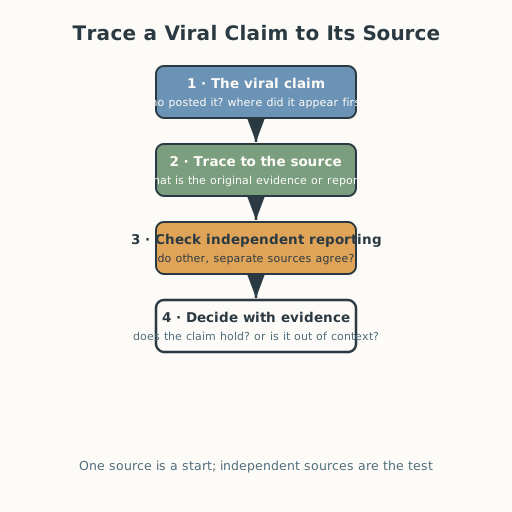
- Trace-the-claim flowchart sheet · 1 per learner A four-step sheet: the claim, trace to source, check independent reporting, decide with evidence
- Claim card set · 1 set per group Three or four short viral-style claims, each with a plausible but incomplete "source" attached
Low-tech / no-cost
- A shared board or large paper Draw the four steps and walk one claim through them together
- Voice and memory Retell each claim aloud and have learners name the next step in the trace
Enriched / lab & device
- A shared screen for a live worked example · 1 To trace one real, current claim to its source and check it against a second outlet
- A fact-check site of record · 1 An independent fact-checking outlet to compare against as a third check
Works in different contexts
- large-group Walk one claim through the four steps together on the board, then small groups trace the remaining claims
- multi-age Younger learners match each step to its job; older learners trace a claim fully and write the evidence-and-decision note
- self-directed A learner works the flowchart on two claims, then writes a one-paragraph verdict with reasons
- level-grouped Learners ready to extend trace a claim to its *original* primary source (a study, a video, a document) and evaluate whether the viral version distorted it
- outdoor-only Apply the four steps to a spoken rumor in the community: who first said it, and who else can confirm or contradict it
Lesson 5 — Trace It to Its Source: Evaluating a Viral Claim
Summary
Learners practice a four-step method for evaluating a viral claim: state the claim, trace it to its source, check it against independent reporting, and decide with evidence. The facilitator models the method once; learners then work it on further claims, distinguishing evidence from the conclusion it supports.
Objectives
- Evaluate a viral claim by tracing it to its source and checking it against independent reporting. (D10.S2.09.02)
Connection
A story reaches you in seconds — a photo, a headline, a number someone swears is true. Before you pass it on, you have one job: find out whether it is real. That job has steps, like following a rumor in a village back to the person who first said it and asking a neighbor who was there. Tracing a claim to its source and checking it against someone independent is the same skill, done with care.
Materials
- Trace-the-claim flowchart sheet
- Claim card set
Preparation
- Copy the flowchart sheet and the claim cards.
- Retrieval: from Lesson 4, recall how a feed narrows and one way to break out. Today we practice the break-out skill on a single claim.
Facilitator note
This lesson is written to the learner (“you”). This is a skill lesson, so use explicit instruction: model the four steps once on a worked example, then guide practice, then independent practice (S-011). The four steps: (1) state the claim exactly; (2) trace it to its source — who posted it, where did it first appear, what is the original evidence; (3) check it against independent reporting — separate outlets or a fact-checker that did not come from the same source; (4) decide with evidence — does the claim hold, or is it distorted, out of context, or false? This is “lateral reading” — leaving the claim to check other sources rather than only reading the claim’s own page (S-394). The technology lens: viral spread is engineered by the same ranking we studied in Lesson 2. The ethics lens: passing on a false claim does real harm; checking before sharing is a duty to others. The global lens: the same claim may be reported differently in different countries and languages — compare. The critical-thinking lens: separate what the evidence shows from what the headline says — evidence and interpretation are different things (philosophy §5). Prepare claim cards that are neutral, age-appropriate, and genuinely checkable; avoid partisan or traumatic content (facilitation.md).
Procedure
- Recall (5 min). From Lesson 4: what narrows a feed, and what is one break-out move? Today we apply that move to a single claim.
- Watch a worked example (12 min). Follow as the claim “a photo shows a rare animal in a big city” is traced: (a) state it; (b) trace it — where did it first appear, who posted it; (c) check independent reporting — does a separate outlet or fact-checker confirm it; (d) decide — holds, distorted, or false. Notice: the source and the independent check matter more than how the claim feels.
- Trace a claim with your group (18 min). Take a claim card. Work the four steps together. For each step, write what you found. If you cannot find the original source, that itself is evidence — say so.
- Decide with evidence (10 min). Write a one-paragraph verdict: what the claim says, what the evidence shows, and your decision — with the reason stated plainly.
- Self-check (5 min). Reread your verdict. Did you trace and corroborate, or did you stop at what looked convincing? One honest sentence.
- Close (5 min). One source is a start; independent sources are the test. Next: we turn from the screen to the planet — the greenhouse effect.
Differentiation
- Support: Provide a pre-traced first claim with the source and independent check filled in; ask learners to state only the decision and reason.
- Extension: Trace a claim to its original primary source (a study, a document, the full video) and evaluate whether the viral version distorted it, citing what you found.
Assessment
- Formative (observation): Can the learner work the four steps on a new claim and state a decision backed by a reason?
- Portfolio artifact: The traced claim and the evidence-and-decision paragraph, kept in the portfolio.
Home connection
Choose one claim you saw online this week. Trace it to its source and check it against one independent outlet. Bring your one-paragraph verdict to the next lesson.
Resources
- On the verification habit — tracing to source and checking independent reporting: First Draft, “Verifying Online Information: The Absolute Essentials” (2019; archived), https://web.archive.org/web/2019/https://firstdraftnews.org/latest/verifying-online-information-the-absolute-essentials/ (S-394).
- On modeling then guided practice for a new skill: Kirschner, Sweller & Clark (2006), https://doi.org/10.1207/s15326985ep4102_1 (S-011).