Lesson 06 — The Greenhouse Effect: Earth's Warm Blanket
Learners explain the greenhouse effect: sunlight warms the surface, the surface radiates heat, and greenhouse gases trap some of it — keeping Earth warm enough for life. They then explain how extra greenhouse gases thicken the blanket and hold in too much heat.
Objectives
Objectives
- D10.S3.09.01 Explain the greenhouse effect and how the carbon cycle connects living things, oceans, atmosphere, and rock over time.
Essential question
How does the greenhouse effect keep Earth warm — and what happens when extra greenhouse gases thicken the blanket?
Key vocabulary
Materials
Standard materials
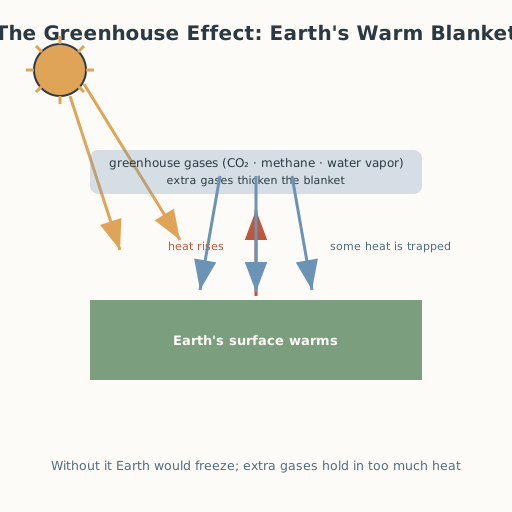
- Greenhouse effect diagram sheet · 1 per learner A labeled diagram of sunlight in, heat trapped by greenhouse gases, and the thickened-blanket effect of extra gases
- Gas card set · 1 set per group Cards for carbon dioxide, methane, water vapor, and nitrous oxide, with where each comes from
Low-tech / no-cost
- A shared board or large paper Draw the diagram together; no printed sheet needed
- Voice and body Act out the "heat trapped" idea — learners as the surface, a row as the gas layer catching and returning heat
Enriched / lab & device
- A short NASA explainer on the greenhouse effect · 1 Age-appropriate, to watch and then retell the mechanism in one's own words
- A simple demonstration (two jars or a thermometer in sun and shade) · 1 set To feel, not just hear, how trapped heat warms a space
Works in different contexts
- large-group Build the diagram once on the board as a whole group, then small groups sort the gas cards by source
- multi-age Younger learners match each gas to one source; older learners explain the mechanism and why extra gases change the balance
- self-directed A learner studies the diagram, writes the mechanism in four sentences, and lists the main gases and their sources
- level-grouped Learners ready to extend explain *why* different gases trap heat differently (molecular structure) and why water vapor is a feedback, not a direct driver
- outdoor-only Feel the sun on a surface and the shade beside it; connect that to what the gas layer does for the whole planet
Lesson 6 — The Greenhouse Effect: Earth’s Warm Blanket
Summary
Learners explain the greenhouse effect: sunlight warms the surface, the surface radiates heat, and greenhouse gases trap some of it — keeping Earth warm enough for life. They then explain how extra greenhouse gases thicken the blanket and hold in too much heat.
Objectives
- Explain the greenhouse effect, as the first step toward seeing how the carbon cycle connects living things, oceans, atmosphere, and rock. (D10.S3.09.01)
Connection
Step into the sun and then into the shade, and you feel the difference. Earth has a kind of blanket that keeps some of the Sun’s warmth in — a thin layer of gases. Without it, our planet would be frozen over and most life could not exist. The question today is not whether the blanket exists, but what happens as it gets thicker. This one shared sky has been read in more than one language: the science of gases and heat, and the long, place-based seasonal observation carried in Indigenous knowledge traditions — two ways of knowing the same warmth.
Materials
- Greenhouse effect diagram sheet
- Gas card set
Preparation
- Copy the greenhouse effect diagram sheet and the gas cards.
- Retrieval: from Lesson 5, recall the four steps of tracing a claim. Today we leave the screen for the planet and begin the unit’s second arc.
Facilitator note
This lesson is written to the learner (“you”). The mechanism to land, step by step: (1) sunlight passes through the atmosphere and warms the surface; (2) the warm surface radiates heat (infrared) back up; (3) greenhouse gases — carbon dioxide, methane, water vapor, nitrous oxide — absorb and re-radiate some of that heat, keeping Earth about 33 °C warmer than it would otherwise be; (4) extra greenhouse gases from human activity thicken the blanket, holding in too much heat. These steps are the consensus account (S-438; S-005). Name the gases and their main human sources: carbon dioxide from burning coal, oil, and gas; methane from livestock, leaks, and waste; nitrous oxide from fertilizers. Be careful to separate the established mechanism from the values: the greenhouse effect is a fact of physics; what we ought to do about it is a values question (philosophy §5). The environment lens is the heart here. The technology lens: the extra gases come largely from our energy and industrial choices (to be compared in Lesson 9). The ethics lens: the effect is real and its burdens fall unevenly — a preview of Lesson 10. The global lens: one shared atmosphere wraps everyone; no country’s gases stay at home. The critical-thinking lens: “greenhouse gases trap heat” is an evidence-backed model, not a slogan — teach the mechanism so learners can explain, not just repeat.
Multiple knowledge traditions (philosophy §11). The four-step mechanism above is Western climate science (S-438; S-005). Hold it side by side, not above, the ecological knowledge carried by Indigenous traditions, which read the same shared air and its seasons through long, place-based observation and through a relationship of reciprocity rather than a mechanism alone. The Potawatomi botanist Robin Wall Kimmerer (Braiding Sweetgrass) names this: the Honorable Harvest’s guidance to take only what is needed and to give back (“all flourishing is mutual”), and the knowledge of plants, animals, weather, and place that the Potawatomi language and tradition carry (S-427). Present it as a living tradition of a specific nation (the Citizen Potawatomi Nation), not as a specimen or a single slogan. The two accounts are not rivals to rank: science answers how the blanket works; the Indigenous tradition answers what we owe the living world that warms us. Let learners hold both, per philosophy §4 and §11.
Procedure
- Recall (5 min). From Lesson 5: what are the four steps of tracing a claim? Today we begin the planet arc: the greenhouse effect.
- Meet the mechanism (15 min). Look at the diagram and follow it in four steps: (a) sunlight reaches the surface and warms it; (b) the surface radiates heat back up; (c) greenhouse gases absorb and return some of that heat; (d) Earth stays about 33 °C warmer than it would be without them. Say the four steps back in your own words.
- Sort the gases (10 min). Use the gas cards. For each gas — carbon dioxide, methane, water vapor, nitrous oxide — name one place it comes from.
- Thicken the blanket (10 min). If extra gases are added, what changes? (More heat is held in.) What human activities add the most? (Burning coal, oil, and gas; farming; waste.)
- Explain it (8 min). Write four sentences: the mechanism, in order. Then write one sentence that separates a fact about the effect from a value about what to do.
- Close (5 min). The blanket is real; the question is its thickness. Next: how carbon itself moves between life, ocean, air, and rock.
Differentiation
- Support: Provide the four steps as a scrambled list and ask learners to put them in order.
- Extension: Explain why different gases trap heat differently (molecular structure) and why water vapor acts as a feedback that amplifies warming rather than a direct driver.
Assessment
- Formative (observation): Can the learner state the four steps of the mechanism in order and name what extra gases do?
- Portfolio artifact: The four-sentence mechanism explanation, kept in the portfolio.
Home connection
Explain the greenhouse effect to someone at home in one minute, using only your words and hands. Ask them one question they have, and bring it to the next lesson.
Resources
- On the mechanism of the greenhouse effect: NASA, “What Is the Greenhouse Effect?,” https://science.nasa.gov/kids/earth/what-is-the-greenhouse-effect/ (S-438).
- On the climate system and the human strengthening of the effect: IPCC, https://www.ipcc.ch/ (S-005).
- On a parallel Indigenous knowledge tradition — seasonal and place-based knowledge of plants, weather, and reciprocity: Kimmerer (2013), Braiding Sweetgrass: Indigenous Wisdom, Scientific Knowledge, and the Teachings of Plants (S-427).