Lesson 04 — Care Into Action: Our Cooperative Project — and the Road to Grade 10
Learners design a cooperative project that meets a real need in their community — listening first, planning together, and sharing the deciding and the doing. They gather the year's portfolio and hold a celebration of each whole person, the caring community they built, and the living Earth, then look ahead to Grade 10, where a personal narrative becomes a considered position.
Objectives
Objectives
- D02.S4.09.02 Design a cooperative project that meets a real need in their community.
Essential question
What cooperative project can we design that meets a real need in our community — and what are we carrying into Grade 10?
Key vocabulary
Materials
Standard materials
- Project design canvas · 1 per group A one-page canvas with sections — the need, who is affected, our assets, our plan, roles, and how we will know it worked
- Portfolio folders or binders · 1 per learner To gather the year's artifacts for the celebration
- Celebration space and simple refreshments · as available For the year-end gathering; anything the community can share
Low-tech / no-cost
- Paper, markers, and a shared wall Draw the design canvas large on paper or a wall, and post the portfolio as a gallery
- Voices and hands Design the project aloud and celebrate by speaking and applauding; no equipment needed
Enriched / lab & device
- A shared document or project board · 1 per group To build and revise the design collaboratively and share it beyond the room
- A short community-visit or video call · 1 To hear the real need directly from the people affected before designing
Works in different contexts
- large-group Form small design teams of three to five; each designs one project, then teams gallery-walk and give kind feedback
- multi-age Younger learners contribute the need and the celebration; older learners hold the plan, roles, and measures
- self-directed A learner completes the design canvas for one real need in their own setting and self-assesses against the checklist
- level-grouped Learners ready to extend add a budget, a timeline, and a fairness check — who benefits, who decides, who is left out
- outdoor-only Design a project for the land around you — a shared garden, a clean-up, a repair — and celebrate under the open sky
Lesson 4 — Care Into Action: Our Cooperative Project — and the Road to Grade 10
Summary
Learners design a cooperative project that meets a real need in their community — listening first, planning together, and sharing both the deciding and the doing. They gather the year’s portfolio and hold a celebration of each whole person, the caring community they built, and the living Earth, then look ahead to Grade 10, where a personal narrative becomes a considered position and care matures into fuller stewardship.
Objectives
- Design a cooperative project that meets a real need in their community. (D02.S4.09.02)
Connection
Care becomes real only when it becomes action. A need sits all around you — a neighbor who needs a hand, a shared space that is unsafe or unloved, a younger student who needs a mentor, a garden or waterway that needs tending, a community whose stories deserve to be heard. The difference between noticing a need and meeting it is a plan made with the people affected, not for them — everyone giving, everyone deciding, everyone sharing the work and the credit. That is cooperation, and it is how a classroom becomes a community and a community becomes a force.
Materials
- Project design canvas (the need, who is affected, our assets, our plan, roles, how we will know it worked)
- Portfolio folders or binders
- Celebration space and simple refreshments
Preparation
- Copy the project design canvas; prepare the portfolio folders.
- Retrieval: recall the four threads of this unit — your narrative, the society that shapes and is shaped by you, your north-star goal, and the forms of community you stand with. Today they become one thing: care put into action, and a celebration of the year.
Facilitator note
This lesson is written to the learner (“you”), and it is the capstone. The idea to land: a cooperative project meets a real need when the people affected are partners in deciding it — everyone gives, everyone decides, everyone shares the credit. The evidence is strong that cooperative structures — with individual accountability and shared goals — outperform competitive or individualistic ones for both achievement and relationships (Johnson & Johnson; S-233, and Slavin; S-147; Bloom’s early estimates put cooperative learning’s effect near 0.8 SD — S-007). Self-paced, cooperative, learner-driven schooling of the Escuela Nueva kind shows this works even in one-room, low-resource settings (S-008). The design itself should honor the distinction from Lesson 3: a cooperative project is mutual aid, not charity — the people affected hold power in the deciding, not only in the receiving (S-345). Model the canvas once, then let teams design (S-011).
The egalitarian lens is the spine: run a fairness check on every design — who benefits, who decides, who is left out, and how do we bring them in? The ethics lens: a good project is judged by whether it leaves people more able to care for themselves and each other, not more dependent. The global lens: the same cooperative impulse takes many forms worldwide (harambee, minga, gotong royong — S-164), and no one form is “the” right way. The technology & environment lens: a project may be ecological (a shared garden, a clean-up, a repair) or digital (a shared map, a mutual-aid fund), and it should ask what technology enables and what it costs. End on agency, celebration, and hope — never nihilism (facilitation.md; development.md §9–12). The celebration is not a ranking: every portfolio is honored equally, because the curriculum’s measure is growth and flourishing, not scores (philosophy §8, §12). Frame the look-ahead to Grade 10 as possibility, not pressure — purpose is found by trying and reflecting, not by certainty (S-400).
Procedure
- Recall (5 min). Gather the unit: what was your narrative thread, the force that shaped you, your north-star goal, and the community you will lean on? Speak one of these aloud in a circle if you wish.
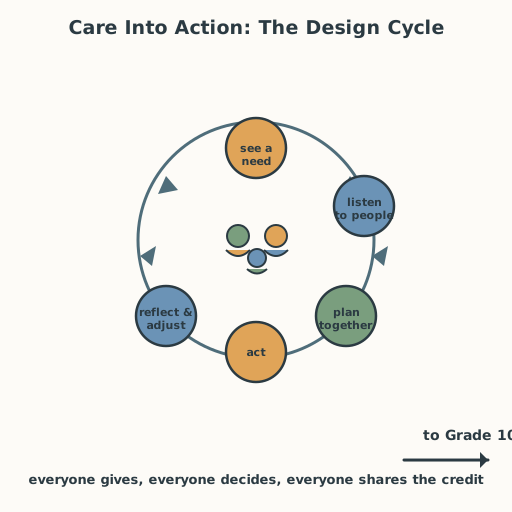
- Meet the design cycle (8 min). Look at the cycle: see a need → listen to the people → plan together → act → reflect and adjust. Watch a worked example: the need — younger students lack a quiet place to read; listen — ask them what they want; plan together — a rotating reading-corner crew with roles and a schedule; act — build and staff it; reflect — ask whether it worked and change what did not. Everyone decides, everyone does.
- Design your project (20 min). In a team, complete the design canvas for a real need in your community — your school, neighborhood, town, or the land around you. Fill each section: the need; who is affected and how you will listen to them; your assets (skills, time, things, people); the plan and roles; and how you will know it worked. Run the fairness check: who benefits, who decides, who is left out — and how will you bring them in?
- Gallery-walk and feedback (10 min). Visit another team’s canvas. Give one specific piece of kind feedback: one thing that is strong, and one question that could make it stronger. Return and improve your own design.
- Celebrate (10 min). Gather your portfolio — this unit’s narrative map, influence map, goal and milestones, community comparison, and this project design, alongside the year’s other work. In a circle, each person shares one thing they are proud of and one person who helped them. Celebrate each whole person, the caring community you built, and the living Earth.
- Look ahead (2 min). In Grade 10, a personal narrative becomes a considered position; identity is examined as socially and historically constructed; and the ethics of technology and the environment deepen into fuller stewardship. You are ready — and you are already walking the road.
Differentiation
- Support: Provide a pre-filled canvas with the need and assets given; teams add the plan and one role each.
- Extension: Add a budget, a timeline, and a “sustainability” check — what happens after the first effort ends, and who keeps it going.
Assessment
- Formative (peer): Does the design name a real need, include listening to the people affected, share the deciding and the doing, and state how it will know it worked?
- Portfolio artifact (summative for the unit and year): The completed project design canvas and the assembled portfolio, celebrated at the year-end gathering.
Home connection
Bring your portfolio home and share it with someone who cares about you. Ask: what need does our own household or street have that we could meet together, even in a small way? Then choose one small first step to take.
Resources
- On cooperative goal structures improving achievement and relationships: Johnson & Johnson (1981), “Effects of Cooperative, Competitive, and Individualistic Goal Structures on Achievement,” Psychological Bulletin (S-233); and Slavin (1995), Cooperative Learning (S-147).
- On cooperative learning’s effect size: Bloom (1984), “The 2 Sigma Problem” (S-007).
- On self-paced, cooperative schooling in low-resource settings: Escuela Nueva (S-008).
- On mutual aid versus charity — sharing the deciding, not only the giving: Spade (2020), Mutual Aid (S-345).
- On communal-work traditions across cultures: “Communal work” (harambee, gotong royong, mink’a/minga, barn raising), https://en.wikipedia.org/wiki/Communal_work (S-164).
- On purpose developing through trying and reflecting, not sudden certainty: Damon (2008), The Path to Purpose (S-400).