Lesson 03 — My North Star and My People: A Goal and My Communities
Learners set a longer-term goal with a realistic plan and milestones that will carry them into Grade 10, and they compare forms of community across cultures — birth families, chosen families, mutual-aid networks, and communal-work traditions such as harambee, gotong royong, and the Andean minga. They close by naming the community they will lean on as they pursue the goal.
Objectives
Objectives
- D01.S3.09.01 Set a longer-term goal with a realistic plan and milestones, and adjust it as needed.
- D02.S3.09.01 Compare forms of community across cultures, including chosen families and mutual-aid networks.
Essential question
What longer-term goal will carry me into Grade 10 — and what forms of community will I stand with?
Key vocabulary
Materials
Standard materials
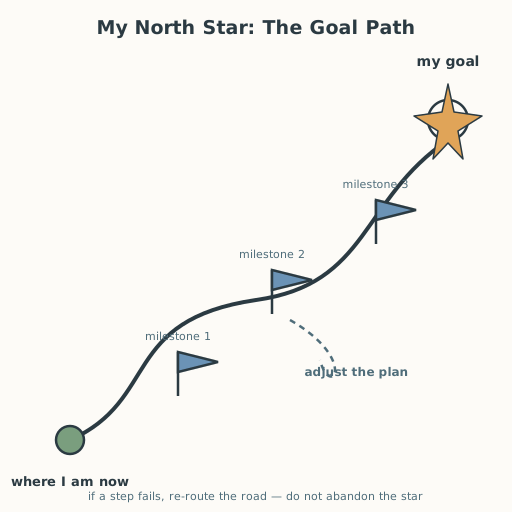
- Goal-and-milestones worksheet · 1 per learner A page with a "north star" goal at the top, a path of milestone flags down the middle, and a margin for adjustments
- Forms-of-community comparison chart · 1 per learner Columns for form, what holds it together, what it gives, and where it is found
- Community example cards · 1 set per group Cards on varied community forms — a birth family, a chosen family, a Kenyan harambee self-help group, an Andean minga work party, an Indonesian gotong royong village effort, a mutual-aid fund, an online interest community, a neighborhood
Low-tech / no-cost
- Stones or seeds and a line on the ground Lay the goal at one end, milestone stones along the path, and move a stone when a plan must change
- Voice and story Tell the community examples aloud and compare them by speaking, not writing
Enriched / lab & device
- A short video or article on one community form · 1 Age-appropriate, to see a harambee, minga, or mutual-aid network in action
- Goal-tracking app or shared spreadsheet · 1 per learner To set reminders at each milestone and log adjustments over the year
Works in different contexts
- large-group Model one goal path on the board, then learners build their own; compare community forms in a whole-class chart
- multi-age Younger learners set one near goal with two steps; older learners set the longer goal and compare the community forms
- self-directed A learner completes the goal path and the comparison chart alone, then writes one sentence on which community they will lean on
- level-grouped Learners ready to extend add a "what could go wrong" column and pre-plan an adjustment for each milestone
- outdoor-only Walk the goal path on the ground, laying a stone at each milestone; name a community around you that meets a real need
Lesson 3 — My North Star and My People: A Goal and My Communities
Summary
Learners set a longer-term goal with a realistic plan and milestones that will carry them into Grade 10, and they compare forms of community across cultures — birth families, chosen families, mutual-aid networks, and communal-work traditions such as harambee, gotong royong, and the Andean minga. They close by naming the community they will lean on as they pursue the goal, because no one reaches a north star alone.
Objectives
- Set a longer-term goal with a realistic plan and milestones, and adjust it as needed. (D01.S3.09.01)
- Compare forms of community across cultures, including chosen families and mutual-aid networks. (D02.S3.09.01)
Connection
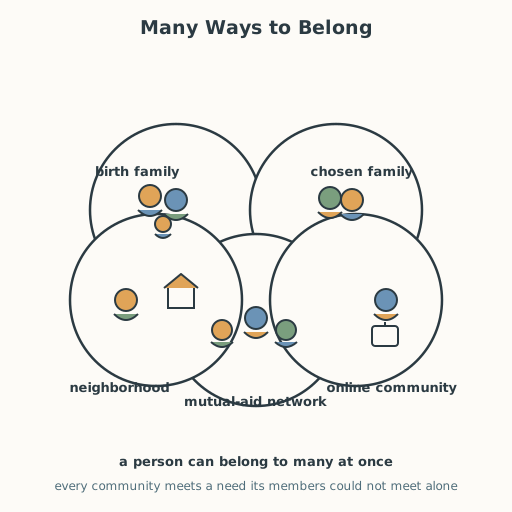
A wish is not yet a plan. “I want to do well in Grade 10” becomes a goal only when you can see the steps between here and there — the milestones you can check along the way, and the willingness to change course when life changes. And no one walks that road alone. Everywhere people belong to others — to the family they were born into, the family they choose, and to networks of neighbors who help one another not for pay but because they belong to one another. In a Kenyan town a harambee pulls a whole community together to build a school; in an Andean village a minga brings neighbors to farm the terraces; in an Indonesian village gotong royong shares the work of a shared need. Knowing your goal and your people is how a year ahead becomes a road you can actually walk.
Materials
- Goal-and-milestones worksheet
- Forms-of-community comparison chart
- Community example cards
Preparation
- Copy the goal worksheet, the comparison chart, and the community example cards.
- Retrieval: from Lesson 1, recall the “hoped-for future” column of your narrative map — that possible self is the seed of today’s goal. From Lesson 2, recall the forces and people who shape you — some of them are the community you will lean on.
Facilitator note
This lesson is written to the learner (“you”), and it carries two objectives in one arc: a goal (the “north star”) and the communities a person stands with on the way. The goal side rests on a real finding: specific, challenging goals with feedback improve performance more than vague “do your best” intentions (Locke & Latham; S-223) — translate “challenging” for age 14–15 as “meaningful and reachable,” with milestones that give the feedback. Purpose itself is found more by trying and reflecting than by sudden certainty, and only a minority of young people report a clear sense of purpose — so “I am still exploring” is a normal, healthy place to be (Damon; S-400). The community side draws on a rich record: mutual aid — cooperation and reciprocity given freely out of belonging — is a widespread human practice (Kropotkin; S-163), with named traditions across cultures: harambee (“all pull together”) in Kenya, gotong royong (“joint bearing of burdens”) in Indonesia, the mink’a/minga communal work of the Andes, and North American barn raisings (S-164). Chosen families — the people we choose as kin — and mutual-aid networks are real, honored forms of community, not substitutes for a “real” family (S-345 distinguishes mutual aid from charity: in mutual aid, people give and decide together as equals).
Model the goal path once, then let learners build their own (S-011). The global lens is the heart: treat every community form as a living tradition to understand, never a specimen to rank — and remind learners to verify local details with community members rather than freezing any tradition into a stereotype (S-164). The egalitarian lens: chosen families and mutual-aid networks are often how people with fewer resources create the care no institution provides — that is strength, not deficit. The ethics lens: ask who decides in a community — the difference between mutual aid and charity is who holds the power (S-345). The technology & environment lens: online communities and mutual-aid funds can extend belonging across distance — and a goal may also be ecological (stewarding a shared garden or waterway) — but ask who is included and who is left out. Hold all of this as description and invitation, never as a single required life-path (philosophy §11).
Procedure
- Recall (5 min). From your narrative map’s “hoped-for future”: what is one possible self you hope to become? Hold it in mind — it will become your north star.
- Meet the goal path (8 min). Watch a worked example: the goal “be ready to study the sciences I love in Grade 10” becomes a plan — milestone 1, by month’s end, list the two subjects and find one person who works in that field; milestone 2, build a study habit and a first project; milestone 3, check progress and adjust. Notice the path has room to adjust: if a milestone fails, you do not abandon the star — you re-route the road.
- Set your goal and milestones (12 min). On your worksheet: write a longer-term goal that matters to you and is reachable in the coming year. Break it into three milestones with a “by when” for each. For one milestone, write one thing that could go wrong and how you would adjust.
- Compare forms of community (15 min). Use the example cards and comparison chart. For each form — a birth family, a chosen family, a harambee self-help group, a minga work party, a gotong royong village effort, a mutual-aid fund, an online interest community, a neighborhood — record what holds it together, what it gives, and where it is found. Then ask: what do they share? How does each meet a need its members could not meet alone?
- Connect goal to people (10 min). Answer in writing: which community will you lean on as you pursue your goal — and what will you give back to it?
- Close (5 min). A north star and a people: the goal tells you where you are going; the community walks with you. Both are yours to keep building.
Differentiation
- Support: Provide a goal with the first milestone pre-filled, and ask learners to add two more steps; compare two community forms instead of all eight.
- Extension: Add a “what could go wrong → how I adjust” plan for each milestone, and compare a mutual-aid network with a charity, explaining who decides in each.
Assessment
- Formative (self): Can the learner state a longer-term goal, three milestones with dates, and one planned adjustment — and name a community they will lean on?
- Portfolio artifact (summative for the unit): The completed goal-and-milestones worksheet and the forms-of-community comparison chart, added to the year-end portfolio.
Home connection
Ask at home: what goal did someone in our family or community once set — and who helped them reach it? Then share your own goal and one milestone with a person you trust, and ask them to help you check on it.
Resources
- On specific, challenging goals with feedback improving performance: Locke & Latham (1990), A Theory of Goal Setting & Task Performance (S-223).
- On purpose developing through trying and reflecting, not sudden certainty: Damon (2008), The Path to Purpose (S-400).
- On mutual aid as a widespread human practice: Kropotkin (1902), Mutual Aid: A Factor of Evolution (S-163).
- On communal-work traditions across cultures: “Communal work” (harambee, gotong royong, mink’a/minga, barn raising), https://en.wikipedia.org/wiki/Communal_work (S-164).
- On the difference between mutual aid and charity: Spade (2020), Mutual Aid: Building Solidarity During This Crisis (and the Next) (S-345).
- On explicit modeling + guided practice before independent work: Kirschner, Sweller & Clark (2006), https://doi.org/10.1207/s15326985ep4102_1 (S-011).