Lesson 11 — What My Food Costs the Earth
Learners explore the environmental footprint of different foods and diets — the greenhouse gases, land, and water behind what we eat — and how food waste multiplies the cost. They trace one meal from field to plate and name one change, held as a choice, not a guilt.
Objectives
Objectives
- D03.S3.10.02 Explain the environmental footprint of different foods and diets and how food choices affect climate and ecosystems.
Essential question
What is the environmental footprint of different foods and diets, and how do my food choices affect climate and ecosystems?
Key vocabulary
Materials
Standard materials
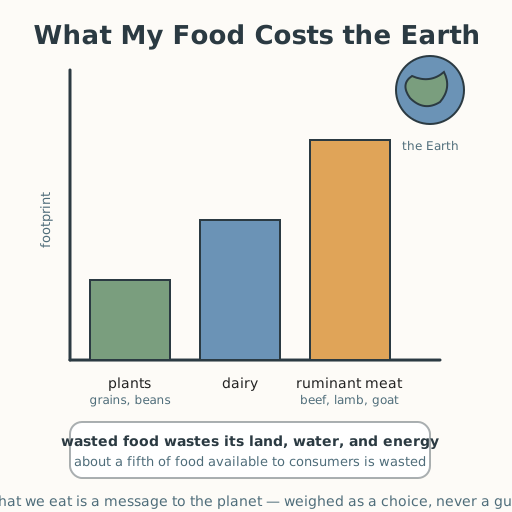
- Food-footprint diagram · 1 per learner or projected A simple comparison of the relative footprint of different foods — land, water, and greenhouse gases — alongside a food-waste note
- Writing journal · 1 per learner
Low-tech / no-cost
- Drawn bars or piles of stones of different sizes Build the footprint comparison physically — bigger pile, bigger footprint
- Voice and discussion Talk through the footprint of one common meal from field to plate
Enriched / lab & device
- Interactive footprint calculator or food data chart · 1 per group A real dataset (e.g., Our World in Data or a footprint tool) to compare foods
- Local market or garden visit (optional) · 1 per class To trace a real food's journey and its footprint hands-on
Works in different contexts
- large-group Project the comparison and discuss; groups then trace one meal's footprint and share
- multi-age Younger learners name one low-footprint and one high-footprint food; older learners compare whole diets and food waste
- self-directed A learner traces one meal's footprint and writes a paragraph on one change they could make
- level-grouped Learners ready to extend connect food choices to land use, biodiversity, and climate, and weigh fairness across diets
- outdoor-only Trace the food story of something growing or sold nearby — its water, soil, and travel — in the place itself
Lesson 11 — What My Food Costs the Earth
Summary
Learners explore the environmental footprint of different foods and diets — the greenhouse gases, land, and water behind what we eat — and how food waste multiplies the cost. They trace one meal from field to plate and name one change, held as a choice, never a guilt. This closes the unit by connecting the body to the planet it eats from.
Objectives
- Explain the environmental footprint of different foods and diets and how food choices affect climate and ecosystems. (D03.S3.10.02)
Connection
Every meal is also a message to the planet. The rice, the beans, the bread, the fish, the meat, the fruit — each came from somewhere: soil and water, sun and rain, hands and machines and fuel, and a journey to your plate. Some foods ask a great deal of the Earth to produce; some ask far less. This is not about guilt — food is a joy, a culture, a right — it is about knowing, so that the choices we do have can be made with our eyes open. Whether you eat from a market, a farm, a garden, or a food bank, the same truth holds: what we eat shapes the climate and the living world, and the world’s choices are not all ours to make alone.
Materials
- Food-footprint diagram (relative land, water, and greenhouse gases; food-waste note)
- Writing journal
Preparation
- Copy or draw the food-footprint diagram.
- Retrieval: from Lesson 10, recall the no-shame line — we judge claims, never bodies. Today we extend that care to the planet: we weigh footprints, never people. From Grade 9, recall the local food system from farm to table to waste (D03.S3.09.01).
- Prepare one worked example of tracing a meal’s footprint.
Facilitator note
This lesson is written to the learner (“you”). The idea to land: different foods and diets carry different environmental footprints — greenhouse gases, land, and water — and food waste multiplies the cost, so food choices are also Earth choices. The science is anchored by the IPCC, the authoritative intergovernmental summary of climate science, which documents that agriculture and food systems are a significant source of greenhouse gases and that land use is a major driver of ecosystem change (S-005). The relative footprint pattern is well established and stated with care: plant foods (grains, legumes, vegetables, fruits) generally carry smaller footprints than animal foods, and among animal foods, ruminant meat (beef, lamb, goat — animals that digest with methane-producing fermentation) generally carries the largest footprint per unit of food. Hold these as general, well-documented patterns with real variation (place, method, and transport all matter), not as precise numbers. The Ecological Footprint concept frames a footprint as the land and resources a product demands (S-277), and food waste — roughly a fifth of food available to consumers worldwide — wastes all the land, water, and energy that went into producing it (S-410).
The environment lens is the spine: food is a link between our bodies and the living Earth. The global lens: what people eat is shaped by place, climate, and culture — a herding community, a rice-growing region, and a coastal fishing town all eat what their land offers, and no diet is “more moral” by geography alone. The egalitarian lens is essential: choice about food is not equally shared — hunger affects roughly 1 in 11 people worldwide, and food insecurity constrains millions of choices (S-409) — so this lesson names footprint as a systems question, never a lecture aimed at the person with the fewest choices. The ethics lens: we weigh footprints of food, not worth of people; and those with the most choice carry the most responsibility to use it well. The critical-thinking lens: footprints vary by method and place, so beware oversimplified “eat this, never that” rules — the honest picture is comparative, not absolute. The social-emotional lens: this topic can stir anxiety; always connect it to agency and hope, never despair — one real change, not a whole life rewritten. Close the unit gently: the body and the Earth are one system, cared for together.
Procedure
- Recall (5 min). From Lesson 10, recall the no-shame line: judge claims, never bodies. Today we extend that care outward — we weigh footprints, never people. Ask: what did the food I ate today ask of the Earth to reach me?
- Meet the footprint (12 min). Look at the diagram. Three costs stand behind every food: greenhouse gases (warming the climate), land (fields, pasture, forest cleared), and water. Notice the pattern: plant foods — grains, beans, vegetables, fruit — generally sit low; dairy sits higher; and ruminant meat (beef, lamb, goat) sits highest, because those animals digest in a way that releases methane, and they need a great deal of land (S-005 for the climate-and-land science; the relative pattern is the standard, well-documented one).
- Trace one meal (15 min). Choose a meal you know — breakfast, lunch, or dinner. List its main foods. For each, ask: did it come from a plant or an animal? How much land, water, and travel might it have needed? Mark a rough footprint (low/medium/ high) for each. This is a trace, not a precise calculation.
- Meet the waste (8 min). Learn this: roughly a fifth of the food available to consumers worldwide is wasted — and wasted food wastes all the land, water, and energy that made it (S-410). Ask: where does food get wasted in my own life — and what is one small way I could waste less?
- Name one change, with hope (10 min). In your journal, write one change you could actually make — eating a little more plant food, wasting less, choosing local or seasonal when you can, learning where your food comes from. Frame it as choice and care, not guilt: one real step, not a perfect life.
- Close (5 min). Remember the whole unit: your body is shaped by stress, sleep, and movement; it is understood by many cultures; it can be trained with care; and it eats from a living Earth. Caring for your body and caring for the planet are the same act, done a little at a time.
Differentiation
- Support: Offer a two-food comparison (beans vs. beef) and one change to choose from a short list.
- Extension: Compare two whole diets (e.g., plant-heavy vs. meat-heavy) across land, water, and greenhouse gases, and weigh one fairness consideration — whose choices are limited, and who carries the most responsibility to choose well.
Assessment
- Formative (self): Can the learner explain the relative footprint of plant foods versus ruminant meat, state how food waste multiplies the cost, and name one change held as choice, not guilt?
- Portfolio artifact (summative for the unit): The meal trace and one-change reflection, added to the unit portfolio as the “what my food costs the Earth” entry.
Home connection
Ask an adult you trust: where did the food we eat this week come from, and is there one way our home could waste less or choose a little lighter? Decide on one shared, doable change together.
Resources
- On climate and land science for food systems: Intergovernmental Panel on Climate Change, https://www.ipcc.ch/ (S-005).
- On the ecological footprint concept (the land and resources a product demands): Global Footprint Network, “Ecological Footprint” (S-277).
- On food waste (roughly a fifth of food available to consumers): UNEP, “Food Waste Index Report 2024” (S-410).
- On hunger and food security (roughly 1 in 11 people): FAO, “The State of Food Security and Nutrition in the World” (S-409).