Lesson 01 — The Three Appeals — and Many More
Learners meet rhetoric as the art of persuasion, sort persuasive moves into three appeals — ethos (character), pathos (feeling), and logos (reasoning) — and see these as one tradition among the many arts of speaking worldwide. They close by finding one example of each appeal in a voice they already know.
Objectives
Objectives
- D04.S1.10.01 Critique rhetoric in public speech and media, distinguishing emotional appeal from reasoned argument.
Essential question
How do speakers move an audience — through character, feeling, or reasoning — and how do different cultures do this in their own way?
Key vocabulary
Materials
Standard materials
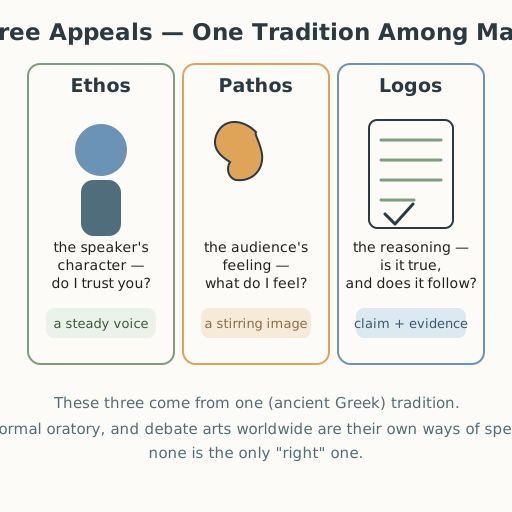
- Three-appeals chart · 1 per learner Three columns — ethos (the speaker's character), pathos (the audience's feeling), logos (the reasoning) — with room for examples
- Reading journal · 1 per learner
Low-tech / no-cost
- Paper folded into three columns, or lines drawn in the ground Columns labeled character, feeling, and reasoning
- Voice and body Say the same request three ways — as a trusted friend, as a caring voice, as a reasoned case — and feel the difference
Enriched / lab & device
- Short video clips of three different speakers (optional) · 3 per class One from a speech, one from an ad, one from a community elder — to compare appeals across media and cultures
- Shared device for looking up a recorded speech · 1 per group To find one real example of each appeal in the wild
Works in different contexts
- large-group Model one worked example whole-class, then learners sort examples in small circles of three to four before sharing one finding
- multi-age Younger learners name one appeal in a single sentence; older learners trace all three in one speech and compare across two cultures
- self-directed A learner works through the chart alone, finding one real example of each appeal in speech or media they already know
- level-grouped Learners ready to extend connect the three appeals to Toulmin's claim/data/warrant model previewed for Lesson 3
- outdoor-only A learner recalls a speaker from a community gathering, market, or religious or family ceremony, and sorts their words into the three columns
Lesson 1 — The Three Appeals — and Many More
Summary
Learners meet rhetoric as the art of persuasion and sort persuasive moves into three appeals: ethos (the speaker’s character), pathos (the audience’s feeling), and logos (the reasoning) (S-346). They learn these three as one tradition among many arts of speaking worldwide, and close by finding one example of each appeal in a voice they already know.
Objectives
- Critique rhetoric in public speech and media, distinguishing emotional appeal from reasoned argument — beginning by naming the three appeals a speaker can make. (D04.S1.10.01)
Connection
Think of the last time someone really moved you to say yes — a friend who talked you into a plan, a grandparent who settled a family argument, a speaker at a ceremony, an ad that made you want something. Each of them persuaded you somehow. One leaned on who they are to you (you trust them), one reached your feelings, and one gave you reasons. Whether the voice is a market seller in a busy city or an elder under a village tree, the same three levers are at work: character, feeling, and reason. Learning to see those levers — in your own language first, then in any language — is the first step to being persuaded on purpose instead of by accident.
Materials
- Three-appeals chart (ethos / pathos / logos)
- Reading journal
Preparation
- Copy or draw the three-column chart.
- Retrieval: from Grade 9, recall how a speaker’s word choice, tone, and delivery shape meaning and persuade (D04.S1.08.01). Today we name the kinds of appeal those choices make.
- Prepare one worked example — a short, familiar request said three ways.
Facilitator note
This lesson is written to the learner (“you”). The idea to land: persuasion works through three appeals — ethos (character), pathos (feeling), and logos (reasoning) — named in the ancient Greek tradition (S-346), and these are one tradition among many; every culture has its own arts of speaking, and none is the “right” one. Aristotle’s Rhetoric (c. 350 BCE) organized persuasion into these three appeals — the speaker’s character (êthos), the audience’s emotional state (pathos), and the argument itself (logos) (S-346). Teach this as description, not as a universal law of all speaking: West African griots (jeli/jali) carry genealogy and history through oral performance (S-446); the Māori whaikōrero is a formal, structured oratory; the Indian nyāya tradition built careful rules of debate; the Islamic khuṭba addresses a congregation in its own register. Name these as different arts with different strengths, held side by side — never ranked.
Model the skill once, then let learners practice (worked example → guided practice → independent work; S-011). The critical-thinking lens is the spine: read which lever a speaker pulls and ask whether it carries the load or hides a missing reason. The global lens: treat the three appeals as one (ancient Greek) frame among many rhetorical traditions, and invite learners to name the speaking arts of their own community. The ethics lens: persuasion can serve care or harm — the same three levers build a fair argument or a con. The egalitarian lens: whose voices get to persuade publicly, and whose are kept out, is a question of power, not skill alone (S-281). The social-emotional lens: noticing when a feeling is being stirred in you is a kind of self-awareness; invite, never force, sharing. Preview: Lesson 2 turns to the heart of the unit — telling emotional appeal apart from reasoned argument.
Procedure
- Recall (5 min). Think back to Grade 9: how did you know a speaker was trying to persuade you? (Their word choice, their tone, how they delivered it.) Today we name the kinds of persuasion behind those choices.
- Meet the three appeals (15 min). Look at the three-appeals chart. A speaker persuades in three ways: ethos — you trust who is speaking; pathos — you are moved by what you feel; logos — you are convinced by the reasoning itself. Watch one worked example: a single request (“come help carry the water”) said three ways — as a trusted friend (ethos), with warmth and urgency (pathos), and with a reasoned case (“if we share it, it’s lighter for everyone”) (logos). Label each.
- Sort real examples (15 min). In your journal, write one sentence you remember hearing that persuaded you — from a speech, an ad, a family talk, or a song. Decide: which lever did it pull most? Could it be more than one? Put it in a column, and note why.
- See it is one tradition among many (10 min). Learn that “ethos, pathos, logos” comes from one ancient culture’s study of speaking (S-346). Many other peoples have their own arts: griots who carry history in performance (S-446), formal Māori oratory, Indian debate rules, the khuṭba of a mosque. Write down the name of one speaking art from your own community or family — the way an elder opens a gathering, the way people argue well where you are from.
- Draft your map (7 min). For each appeal, write one real example from your own life in your home language, then try one sentence in a second language you know.
- Close (3 min). Remember: persuasion is a craft, and you can read it. Next time, we separate the feeling from the reasoning.
Differentiation
- Support: Offer a short list of sentences to sort into the three columns, and a starter (“This speaker leans on ___ because ___.”).
- Extension: Find a recorded speech and label one moment of ethos, one of pathos, and one of logos, then say which is strongest and whether that is a strength or a warning.
Assessment
- Formative (self): Can the learner sort a persuasive sentence into ethos, pathos, or logos and explain why?
- Portfolio artifact (unit): The three-appeals chart with one example of each appeal, added to the unit portfolio as the “rhetoric toolkit” opener.
Home connection
Ask an adult you trust: who is the best speaker you have ever heard, and what made their words work? Sort their answer together into character, feeling, or reasoning — and notice which lever your family values most.
Resources
- On the three appeals (ethos/pathos/logos) and their ancient Greek origin: Stanford Encyclopedia of Philosophy, “Aristotle’s Rhetoric,” https://plato.stanford.edu/entries/aristotle-rhetoric/ (S-346).
- On West African griots as oral historians: Encyclopaedia Britannica, “Griot,” https://www.britannica.com/art/griot (S-446).
- On modeling + guided practice before independent work: Kirschner, Sweller & Clark (2006), https://doi.org/10.1207/s15326985ep4102_1 (S-011).