Lesson 02 — Emotional Appeal vs. Reasoned Argument
Learners learn to separate emotional appeal from reasoned argument in a short, authentic passage: which words stir feeling, which claims carry evidence, and what the speaker is quietly asking them to do. They close by sorting one real message of their own choosing.
Objectives
Objectives
- D04.S1.10.01 Critique rhetoric in public speech and media, distinguishing emotional appeal from reasoned argument.
Essential question
How do I tell when a speaker is moving my feelings and when they are giving me reasons — and why does the difference matter?
Key vocabulary
Materials
Standard materials
- Two-column sheet: feeling vs. reason · 1 per learner Left column for words that stir feeling, right column for claims with evidence, plus a bottom band for what the speaker is asking you to do
- Reading journal · 1 per learner
Low-tech / no-cost
- Paper folded into two columns, or two lines drawn in the ground Feeling on one side, reason on the other
- Voice and body Read the same short passage twice — once flat and factual, once with rising emotion — and notice what changes in the listener
Enriched / lab & device
- A short recorded political or public-service message (optional) · 1 per class An age-appropriate clip to sort into feeling-moves and reason-moves in real time
- Shared device for a fact-check site (optional) · 1 per group To begin checking whether a claimed reason is backed by evidence
Works in different contexts
- large-group Model the sort whole-class, then learners work in pairs and report one feeling find and one reason find each
- multi-age Younger learners mark a single sentence as feeling or reason; older learners trace how the two are mixed in one full passage
- self-directed A learner sorts a passage alone and writes one paragraph on where the speaker's argument is strong and where it leans on feeling
- level-grouped Learners ready to extend add Toulmin's claim/data/warrant labels to the reason column
- outdoor-only Recall a speech heard at a market, a rally, a funeral, or a community meeting, and sort its sentences aloud into the two columns
Lesson 2 — Emotional Appeal vs. Reasoned Argument
Summary
Learners learn to separate emotional appeal from reasoned argument. Using a short, authentic passage, they sort words that stir feeling from claims that carry evidence, name what the speaker is quietly asking them to do, and decide whether the feeling is supporting the argument or standing in for it.
Objectives
- Critique rhetoric, distinguishing emotional appeal from reasoned argument, by sorting a real message into feeling-moves and reason-moves. (D04.S1.10.01)
Connection
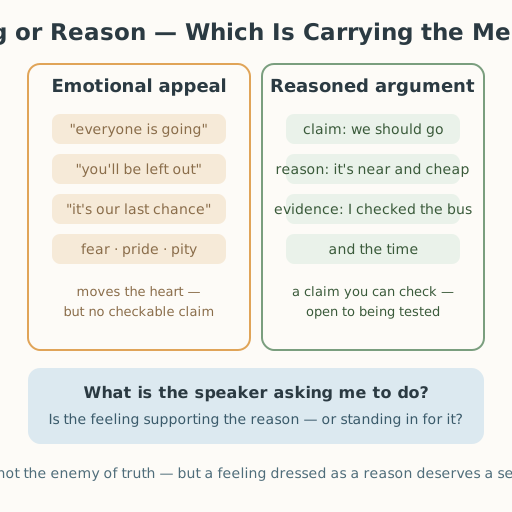
When a friend says “everyone is going — you’d be left out,” that is a feeling aimed at your fear of being alone. When the same friend says “we leave at six, the bus is cheap, and you’ll be back before dark,” that is a set of reasons you can check. Both are normal; both can be true at once. The skill is not to reject feeling — it is to see when a speaker is stirring feeling instead of giving you a reason, so you can decide with your eyes open. This happens everywhere: a campaign poster, a market cry, a funeral tribute, a sermon, a political rally on your street or on your screen.
Materials
- Two-column sheet (feeling vs. reason, with a “what are they asking me to do” band)
- Reading journal
Preparation
- Copy or draw the two-column sheet.
- Retrieval: from Lesson 1, recall the three appeals — ethos, pathos, logos. Today we focus on the line between pathos (feeling) and logos (reason), and how they mix.
- Prepare one worked example: a short, authentic passage with clear feeling-words and at least one checkable claim.
Facilitator note
This lesson is written to the learner (“you”). The idea to land: a message can move feelings and offer reasons at the same time; the critique is to find where the feeling is doing the work that a reason should do — and to notice what the speaker wants you to do. Emotional appeal is not wrong: courage, care, and grief are real, and speakers rightly reach them. The distinction to teach is between a feeling that supports a reasoned case and a feeling that substitutes for one. Reasoned argument, in the tradition that shapes this unit, means a claim backed by evidence and open to being checked (S-236). A strong feeling with no checkable claim is still a strong feeling — but it is not yet an argument.
Model the skill once, then let learners practice (worked example → guided practice → independent work; S-011). Use a passage from your own context if you prefer; the worked example should be short, real, and age-appropriate, never a trap for a learner’s own beliefs. The critical-thinking lens is the spine: mark feeling-words and checkable claims in the same text, then ask which is carrying the weight. The ethics lens: stirring fear or anger to sell a lie is manipulation; stirring hope to move people toward fairness is not the same thing — judge by what is being asked and for whom. The egalitarian lens: people with less power are often spoken at with feeling and denied the reasons; demanding the reasons is a demand to be treated as an equal. The technology lens: digital feeds optimize for feeling — outrage and awe travel farther than careful reasoning (S-481) — so the skill is most needed exactly where you read most. The social-emotional lens: naming your own feeling as it rises (“I am being made afraid”) is the first guard against being carried. Preview: Lesson 3 turns this sort into a full critique of one public speech.
Procedure
- Recall (5 min). From Lesson 1: what are the three appeals? Today we zoom into the line between pathos (feeling) and logos (reason) — the line this whole unit turns on.
- Meet the two columns (15 min). Look at the two-column sheet. In the left column go words that stir feeling — fear, pride, pity, anger, love, shame. In the right column go claims with evidence — statements you could check. Watch a worked example: read a short passage together and sort it sentence by sentence. Mark which words aim at the heart and which at the head.
- Ask what they want (10 min). Every persuasive message is asking you to do something — vote, buy, join, believe, stay quiet, act now. In the bottom band, write what this speaker is asking of you. Then ask: is the feeling supporting a reason, or standing in for one?
- Sort your own (15 min). Choose one real message you heard or read this week — an ad, a post, a speech, a family plea. Sort it into the two columns. Mark one claim that is checkable and one feeling that is doing the work of a reason.
- Write your finding (7 min). In your journal: this message moves me by ___, and it reasons with me by ___; the feeling is (supporting / replacing) the reason, because ___.
- Close (3 min). Remember: feeling is not the enemy of truth — but a feeling dressed up as a reason deserves a second look. Preview: next time, we critique a whole speech, start to finish.
Differentiation
- Support: Offer a shorter passage and pre-highlight the feeling-words; ask only “is there a reason I could check?”
- Extension: Take a message whose feeling is doing the work, and write the missing reasoned argument it would need — a claim, one piece of evidence, and what it cannot prove.
Assessment
- Formative (self): Can the learner mark one feeling-move and one reason-move in a passage, and state whether the feeling supports or replaces the reason?
- Portfolio artifact (unit): The two-column sort of a real message, added to the unit portfolio as the “feeling vs. reason” entry.
Home connection
Ask an adult you trust about an ad or speech they remember that made them feel something strongly. Together, find the sentence that stirred the feeling — and ask whether there was a reason behind it they could check.
Resources
- On the claim/evidence structure behind reasoned argument: Toulmin, The Uses of Argument (Cambridge University Press, 1958) (S-236).
- On how digital feeds amplify emotionally charged content: Encyclopaedia Britannica, “Social media,” https://www.britannica.com/topic/social-media (S-481).
- On modeling + guided practice before independent work: Kirschner, Sweller & Clark (2006), https://doi.org/10.1207/s15326985ep4102_1 (S-011).