Lesson 09 — Tracking Arguments Across a Full Work
Learners track a second thread through their extended work: the argument. Using an argument-chain tracker, they log each claim, its evidence, and any counter-argument, seeing how a thesis builds across a whole book. They connect this to the rhetoric critique of earlier lessons — now applied to a sustained text.
Objectives
Objectives
- D04.S2.10.02 Read extended, complex literary and informational texts, tracking themes and arguments across a full work.
Essential question
How do I follow an argument — its claim, its evidence, its counter-arguments — as it builds across a whole book or long essay?
Key vocabulary
Materials
Standard materials
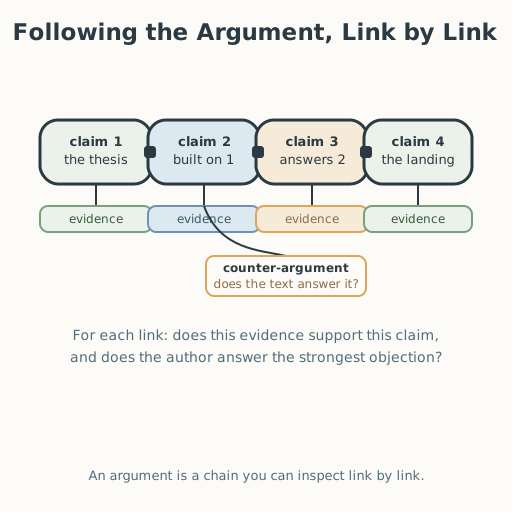
- Argument-chain tracker · 1 per learner A chain where each link is a claim, its supporting evidence, and any counter-point, ordered as they appear in the work
- Reading journal (argument log) · 1 per learner Columns for chapter/section, the claim, the evidence, and the counter-argument or rebuttal
- The chosen extended work · 1 per learner The same work begun in Lesson 8
Low-tech / no-cost
- Paper chain made of linked strips, or a line of stones each standing for a claim Each link/stone is labeled with a claim and its evidence, laid out in reading order
- Voice and body State the work's central claim aloud, then state the strongest counter-argument you can find, then say whether the work answers it
Enriched / lab & device
- Digital annotation or a shared document for the argument log (optional) · 1 per learner To keep the running argument log searchable and shareable
- A short explainer on thesis and structure (optional) · 1 per class To refresh claim/evidence/counter-argument vocabulary from earlier grades
Works in different contexts
- large-group Build one argument chain whole-class for a shared excerpt, then learners extend their own chains in their chosen works
- multi-age Younger readers track the central claim and one piece of evidence; older readers track counter-arguments and whether they are fairly answered
- self-directed A learner builds the chain alone across their work, logging each claim, its evidence, and any counter-argument the text itself raises
- level-grouped Learners compare chains across different works and discuss which arguments were most and least convincing, and why
- outdoor-only Lay the chain out with stones or sticks as you read outside, each standing for a claim, with smaller stones as its evidence
Lesson 9 — Tracking Arguments Across a Full Work
Summary
Learners track a second thread through their extended work: the argument. Using an argument-chain tracker, they log each claim, its evidence, and any counter-argument the text itself raises, watching a thesis build across a whole book. They connect the rhetoric critique of Lessons 1–3 to a sustained text rather than a single speech.
Objectives
- Read extended, complex literary and informational texts, tracking arguments across a full work — by following the claim → evidence → counter-argument chain. (D04.S2.10.02)
Connection
A long book that wants to convince you does not make one point once; it builds a case — a claim here, a piece of evidence there, a worry answered a few chapters later. Reading only the opening or only the ending would miss the work the middle is doing. Following an argument across a whole work is like following a river to its mouth: you learn not just what the author believes, but how they got there, what they considered, and what they answered along the way. Whether the work is a memoir making a case about a life, or a long essay making a case about the world, the skill is the same: keep track of the chain.
Materials
- Argument-chain tracker
- Reading journal (argument log)
- The chosen extended work
Preparation
- Copy the argument-chain tracker and argument log.
- Retrieval: from Lesson 3, recall claim, evidence, appeal, and fair counter-point. From Lesson 8, recall the theme thread. Today you track the argument thread through the same work.
- Prepare one worked example: a short passage where the author makes a claim and offers evidence, and note how you would log it.
Facilitator note
This lesson is written to the learner (“you”). The idea to land: a sustained argument is a chain — claim, evidence, and counter-argument — that builds across a work; the reader’s job is to log the links and ask whether each holds and whether the author answers the strongest objection. This reuses the Toulmin frame of claim, data (evidence), warrant, and rebuttal (S-236), now stretched across a book rather than a speech. Literary works argue too — a novel or memoir makes claims about how people are, what matters, what is just — and the same chain can be read there, more subtly.
Model the skill once, then let learners practice (worked example → guided practice → independent work; S-011). Reading comprehension is built by actively generating questions and tracking structure, not by passive rereading (S-040). The critical-thinking lens is the spine: for each link, ask does this evidence support this claim, and does the author answer the counter-argument fairly? The intellectual lens: this is the unit’s sustained scholarship — a reader who can reconstruct an author’s case has earned the right to judge it. The ethics lens: a fair reader tracks the author’s strongest argument, not a straw version; steelman before you critique. The egalitarian lens: authors from any tradition — a memoirist, an essayist, a novelist, an oral epic retold — deserve the same careful reading; argument is not the property of one culture. The global lens: the same chain appears in argumentative traditions worldwide, from Indian nyāya debate to the persuasive essay, and learners may name their own tradition’s forms. Preview: Lesson 10 brings theme and argument together into a full synthesis of the whole work.
Procedure
- Recall (5 min). From Lesson 8, what theme are you following? Today you follow a second thread — the argument — through the same book.
- Meet the argument chain (15 min). Look at the argument-chain tracker: each link is a claim; hanging below it is its evidence, and beside it any counter-argument the text raises and how it answers. Watch a worked example: read a short passage where the author claims something and gives a reason, and log the link.
- Distinguish the central thesis (10 min). As you read, ask: what is the one thing this whole work is trying to show? Write the central claim in your own words — that is the chain’s first link. Then note how later chapters add links to it.
- Log claims, evidence, and counter-arguments (15 min). Continue reading your work. For each new section, log one claim, the evidence offered for it, and any counter-argument the author names or answers. If the author ignores a strong objection, note that too — it is a real observation.
- Test one link (7 min). Choose one link from your chain. Ask: does the evidence actually support the claim, or only sit beside it? Write one sentence of judgment.
- Close (3 min). Remember: an argument is a chain you can inspect link by link. Next time, you’ll weave the theme and the argument together into one picture of the whole work.
Differentiation
- Support: Provide a pre-labeled chain with the central claim already written; ask the learner to find and add one piece of evidence and one counter-argument.
- Extension: Track the author’s warrant — the unstated rule connecting evidence to claim — for two links, and judge whether it holds (S-236).
Assessment
- Formative (self): Can the learner state the work’s central claim, log one piece of evidence and one counter-argument, and say whether the evidence supports the claim?
- Portfolio artifact (unit): The argument-chain tracker, added to the portfolio as the second strand of the extended-text reading journal.
Home connection
Tell someone at home the central argument of the work you are reading, in one sentence. Then ask them to poke one hole in it — and check whether the book has already answered their objection.
Resources
- On the claim/data/warrant/rebuttal structure: Toulmin, The Uses of Argument (1958) (S-236).
- On active, question-driven reading as the ground of comprehension: National Reading Panel, Teaching Children to Read (2000), comprehension strand (S-040).
- On modeling + guided practice before independent work: Kirschner, Sweller & Clark (2006), https://doi.org/10.1207/s15326985ep4102_1 (S-011).