Lesson 08 — Tracking Themes Across a Full Work
Learners choose an extended literary or informational work and learn to track a theme — a recurring idea — across it, logging each recurrence and watching it grow. They build a "theme thread" of bead-marked moments and begin a reading journal they will carry through the unit.
Objectives
Objectives
- D04.S2.10.02 Read extended, complex literary and informational texts, tracking themes and arguments across a full work.
Essential question
How do I read a long, complex work and follow a theme — a recurring idea — as it grows and changes from beginning to end?
Key vocabulary
Materials
Standard materials
- Reading journal (theme log) · 1 per learner A running log with columns for page/chapter, the moment, and what it adds to a chosen theme
- Theme-thread tracker · 1 per learner A thread-line where each recurrence of a theme is a bead, labeled with where it appeared and how it changed
- A chosen extended work (literary or informational) · 1 per learner Selected with the facilitator or self-chosen; any full novel, memoir, long essay, epic, or book-length informational text available in the learner's context
Low-tech / no-cost
- A thread drawn on paper with beads as dots, or stones laid in a line Each bead/stone is one appearance of the theme, labeled aloud
- Any long book already at hand, in the home language No new purchase needed — use what the family or community already owns
Enriched / lab & device
- A digital copy or audiobook of the chosen work (optional) · 1 per learner To support reading in audio form or a second language, or for learners who read better with a screen or ears
- Shared device for a reading tracker or annotation app (optional) · 1 per learner To log page numbers and notes digitally, where available
Works in different contexts
- large-group Track the theme whole-class on a shared wall thread for one common excerpt, then learners continue their own logs independently
- multi-age Younger readers track one theme with three beads; older readers track two themes and their interaction across the whole work
- self-directed A learner chooses their own extended work and keeps the theme log alone, using the tracker to watch a theme change across the book
- level-grouped Learners grouped by reading level choose works of matched length and complexity, then compare theme-threads across books
- outdoor-only Keep the theme log in a notebook read outside; use stones or sticks laid in a line as the physical thread for each recurrence
Lesson 8 — Tracking Themes Across a Full Work
Summary
Learners choose an extended literary or informational work and learn to track a theme — a recurring idea — across it. They log each recurrence, watch the theme grow and change, and build a “theme thread” of bead-marked moments, opening a reading journal they will carry through Lessons 8–10.
Objectives
- Read extended, complex literary and informational texts, tracking themes across a full work — beginning by following one theme from seed to full meaning. (D04.S2.10.02)
Connection
Have you ever read a long story and noticed that one idea keeps coming back — home, or courage, or what we owe each other — a little different each time it appears? A theme is like a thread running the whole length of a cloth: the first time you meet it, it is only a hint; by the end, it has grown heavy with meaning. Long works do not hand you their meaning in one line; they weave it, and you have to follow the thread. Whether the work is a novel, a memoir, an epic told aloud, or a book-length argument, the skill is the same: notice what returns, and watch it change.
Materials
- Reading journal (theme log)
- Theme-thread tracker
- A chosen extended work (literary or informational)
Preparation
- Help each learner choose a full work they can finish over the unit — matched to their reading level and available in their context, in their home language where possible.
- Retrieval: from Grade 9, recall how a text’s structure, style, and argument work together (D04.S2.09.01), and how a theme develops across a text (D04.S2.07.01). Today we extend that tracking across a whole work.
- Prepare one worked example: a short passage where a theme appears early, and note how you would log it.
Facilitator note
This lesson is written to the learner (“you”). The idea to land: a theme is a recurring idea that a long work returns to and develops; tracking it means logging each recurrence and noting how it grows — so the reader ends with evidence, not a vague feeling. This is the unit’s sustained reading thread (Lessons 8–10): the learner carries one work the whole way. The work is chosen, not imposed — a novel, memoir, long essay, epic, or book-length informational text available in the learner’s context and home language. Global range is essential: works such as Chinua Achebe’s Things Fall Apart, Marjane Satrapi’s Persepolis, a Sundiata epic retelling, Nnedi Okorafor’s fiction, a collection of Rumi or a contemporary poet, a long-form essay or scientific argument — the point is a full, complex work, not one canon. Multilingual learners may read in their home language first (S-019); that is wealth, not a shortcut.
Model the skill once, then let learners practice (worked example → guided practice → independent work; S-011). Reading fluency and comprehension grow with the volume of sustained reading and with question-driven tracking; the journal is the evidence of that growth (S-040). The intellectual lens is the spine: the theme log is a small, honest act of scholarship — notice, record, compare. The global lens: the works learners choose should span many traditions, and learners may bring the epics and stories of their own heritage. The ethics lens: themes are often moral questions — what a work asks about loyalty, justice, or care — and tracking them is how a reader thinks with a book rather than just about it. The egalitarian lens: every learner reads a work at their own level in their own language, and no reader is “behind” for needing audio, translation, or a shorter work. The social-emotional lens: long works can stir real feeling — make room for it, and for the learner who needs to step back. Preview: Lesson 9 tracks a second thread — argument — through the same work.
Procedure
- Recall (5 min). From Grade 9: what is a theme, and how do you know one when you see it? Today you follow one theme across a whole book — not one scene, but the whole length.
- Choose your work (10 min). With guidance, settle on one full work you can finish over this unit — a novel, a memoir, a long essay, an epic, or a book-length argument — in your home language where you can. Name it and set a realistic pace (pages or chapters per sitting).
- Meet the theme log (15 min). Look at your reading journal’s theme-log columns: where (page/chapter), the moment, and what it adds to the theme. Watch a worked example: read a short passage where a theme first appears, and log it — where it showed up, what happened, and what the passage is starting to say about that idea.
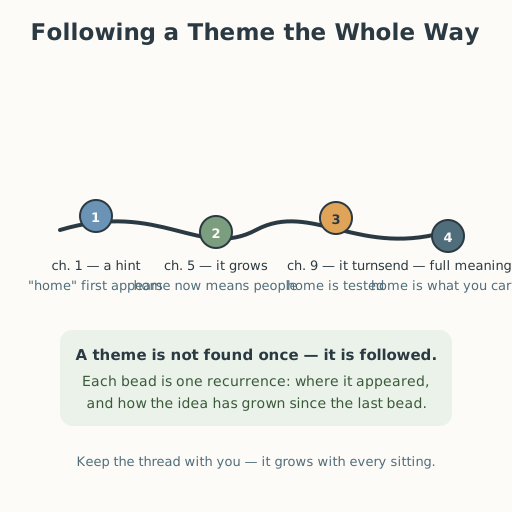
- Build the theme thread (15 min). On your tracker, draw a thread. The first bead is the theme’s first appearance — label it. As you read, each recurrence becomes a new bead: label where it appeared and, in a few words, how the idea has grown since the last bead.
- Log your first entry (7 min). Read the first section of your chosen work. Log one real recurrence in your journal, and place the first bead on your thread. Note the seed — what the work is just beginning to say about this idea.
- Close (3 min). Remember: a theme is not found once — it is followed. Keep the thread with you; it grows with every sitting.
Differentiation
- Support: Choose a shorter, accessible work; track a single, obvious theme with sentence starters for each log entry.
- Extension: Track two themes at once and note, at each bead, where the two threads touch or pull against each other.
Assessment
- Formative (self): Can the learner identify one recurring theme, log two of its appearances, and say how the second builds on the first?
- Portfolio artifact (unit): The theme-thread tracker and theme log, added to the portfolio as the start of the “extended-text reading journal.”
Home connection
Tell someone at home about the work you chose and the theme you are following. Ask them: what book or story do you still remember for one idea that kept coming back?
Resources
- On sustained, question-driven reading as the ground of comprehension: National Reading Panel, Teaching Children to Read (2000), comprehension strand (S-040).
- On honoring the home language in reading and education: UNESCO, International Mother Language Day, https://www.unesco.org/en/days/mother-language (S-019).
- On modeling + guided practice before independent work: Kirschner, Sweller & Clark (2006), https://doi.org/10.1207/s15326985ep4102_1 (S-011).