Lesson 15 — Politeness and Address Across Cultures
Learners practice communicating respectfully in a multicultural setting: they map how different cultures greet, address, and show respect, learn a "respectful check" of questions to ask rather than assume, and practice adapting. They close by reflecting that no culture's way is the only "right" one — respect is learned, not assumed.
Objectives
Objectives
- D04.S4.10.02 Communicate respectfully in a multicultural setting, adapting to different cultural norms of politeness and address.
Essential question
How do I communicate with respect in a multicultural setting, adapting to different norms of politeness and address — without treating any culture's way as the only "right" one?
Key vocabulary
Materials
Standard materials
- Politeness-and-address grid · 1 per learner Rows for settings or relationships, columns for how to greet, address, and show respect — with space to add a second culture's way
- Respectful check card · 1 per learner A short set of questions to ask before speaking across a culture — how is respect shown here, how is address handled, what should I ask rather than assume
- Reading journal · 1 per learner
Low-tech / no-cost
- Paper grid drawn by hand The same rows and columns on any sheet
- Voice and body Practice greeting and addressing a partner using two different cultural forms, and notice what each signals
Enriched / lab & device
- Short audio or video clips of greetings/address in two cultures (optional) · 2 per class To hear real forms of address and honorifics in context
- Shared device to look up honorific systems (optional) · 1 per group To explore how a specific language marks respect (titles, polite verb forms, kinship address)
Works in different contexts
- large-group Build the grid whole-class with learners contributing forms of address from their own languages, then practice in small circles
- multi-age Younger learners practice one greeting and one form of address; older learners compare two cultures' norms and reflect on adapting
- self-directed A learner fills the grid for their own culture and one other, writes a short reflection, and practices a respectful check before a real interaction
- level-grouped Learners ready to extend connect politeness to register (Lesson 4) and to honorific grammar, comparing three languages
- outdoor-only Practice greetings and address aloud in a circle, using the space to act out different cultural forms with a partner
Lesson 15 — Politeness and Address Across Cultures
Summary
Learners communicate respectfully in a multicultural setting. They map how different cultures greet, address, and show respect, learn a “respectful check” of questions to ask rather than assume, and practice adapting their own politeness. They close the unit by reflecting that no culture’s way is the only “right” one — respect is learned, not assumed.
Objectives
- Communicate respectfully in a multicultural setting, adapting to different cultural norms of politeness and address. (D04.S4.10.02)
Connection
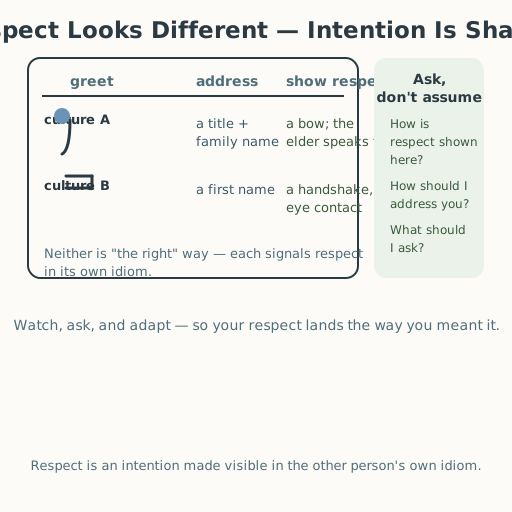
The same small act — how you greet someone — carries completely different meanings in different places. In one culture you bow and use a title; in another you shake hands and use a first name; in a third, the order of greeting, who speaks first, is what shows respect. Get it “wrong” and you have not just stumbled over words — you may have signaled disrespect you did not mean. Get it right, and you have said, in the other person’s own idiom, I see you. No single culture owns politeness; what is shared is the intention — and the skill of asking, watching, and adapting, so that respect lands the way you meant it to.
Materials
- Politeness-and-address grid
- “Respectful check” card
- Reading journal
Preparation
- Copy the grid and the respectful-check card.
- Retrieval: from Lesson 4, recall register and address; from Lesson 14, recall that language carries power. Today you practice the everyday courtesy that opens doors across that difference.
- Prepare one worked example: greet and address a partner two ways, naming what each signals.
Facilitator note
This lesson is written to the learner (“you”). The idea to land: politeness and address are cultural norms — how we greet, title, and show respect differs across cultures and languages, often inside the grammar (honorifics, polite forms); the skill is to watch, ask, and adapt, never to rank one culture’s way above another. Register and formality (S-237) are the shared machinery here: every language and culture draws the close-to-formal line, but where and how differ. Honorific systems — titles, polite verb endings, kinship forms of address — mark respect inside grammar in many languages; a learner who knows one such system has something to teach the room. Hold the value plainly: no culture’s politeness is the “correct” one, and respect is an intention made visible in the other person’s idiom.
Model the skill once, then let learners practice (worked example → guided practice → independent work; S-011). The global lens is the spine: the room itself is a multicultural setting — let learners teach their own culture’s forms and learn one another’s. The ethics lens: adapting politeness is honoring the other person; the “respectful check” (ask, don’t assume) is the honest guard against stereotyping a whole culture from one example. The egalitarian lens: no accent, dialect, or politeness norm is “less polite” — difference is not deficit, and a learner who does not yet know a norm is not failing, they are learning. The social-emotional lens: getting a norm wrong can feel mortifying — normalize the wobble, and teach repair (“I did not know — thank you for showing me”). The critical-thinking lens: ask what a form of address is doing (respect? distance? warmth? hierarchy?) before imitating it, so adaptation is thoughtful, not mimicry. This is the unit’s closing lesson: the rhetorical critique, the public voice, the careful reading, the crafted prose, the accessible design, and the analysis of power all land here, in how one person speaks to another.
Procedure
- Recall (5 min). Across this unit you critiqued rhetoric, spoke to strangers, read whole books, crafted prose, designed accessibly, and traced language’s power. Today it all lands in one place: how you speak to a person.
- Meet the grid (15 min). Look at the politeness-and-address grid. For one relationship or setting — greeting an elder, asking a favor, disagreeing politely — write how your culture greets, addresses, and shows respect. Watch a worked example: greet and address a partner two ways, naming what each signals.
- Add a second culture (15 min). In the next row, write how another culture you know — or one a classmate teaches you — does the same three things. Notice what differs: the words, the title or name, the bow or handshake, the order of speaking, even the grammar (some languages build respect into the verb itself).
- Learn the respectful check (10 min). Read the “respectful check” card: before speaking across a culture, ask — how is respect shown here? how should I address you? what should I ask rather than assume? Practice it with a partner: ask how they prefer to be addressed, and honor the answer.
- Reflect (7 min). In your journal: one form of address my culture or family uses is ___, and it shows respect by ___; one thing I will ask rather than assume in a new setting is ___.
- Close (3 min). Remember: respect is an intention made visible in the other person’s own way of being spoken to. You leave this unit able to hear a speech with a critic’s ear, speak with your own voice, read a whole book, write a sentence that does what you mean, build a message that reaches everyone, and greet a stranger with care. That is language, full strength.
Differentiation
- Support: Focus on one relationship (greeting an elder) and one culture; practice a single greeting and form of address with a partner.
- Extension: Compare honorific systems in three languages (titles, polite verb forms, kinship address), and write a short guide a newcomer could use to show respect in your own community.
Assessment
- Formative (self + performance): Can the learner name how two cultures differ in greeting and address, use the respectful check, and adapt one form of politeness to a partner?
- Portfolio artifact (unit): The politeness-and-address grid plus the reflection, added to the portfolio as the “multicultural communication” closing entry.
Home connection
Ask an adult you trust to teach you one form of address your family or community uses to show respect — and when it is used. Write it down, then try using it with someone who will appreciate it.
Resources
- On register, formality, and plurilingual communicative competence: Council of Europe, CEFR Companion Volume, https://www.coe.int/en/web/common-european-framework-reference-languages/companion-volume (S-237).
- On honoring every language and way of speaking: UNESCO, International Mother Language Day, https://www.unesco.org/en/days/mother-language (S-019).
- On modeling + guided practice before independent work: Kirschner, Sweller & Clark (2006), https://doi.org/10.1207/s15326985ep4102_1 (S-011).