Lesson 14 — Language and Power: Whose Words Rule?
Learners analyze how language and power interact, examining law, medicine, and school to see whose language is used, whose is left out, and what that decides about who is heard, trusted, and included. They connect this to home language, multilingualism as wealth, and the idea of language justice.
Objectives
Objectives
- D04.S4.10.01 Analyze how language and power interact, such as whose language is used in law, medicine, and school.
Essential question
Whose language is used in law, medicine, and school — and what does that decide about who is included, heard, and trusted?
Key vocabulary
Materials
Standard materials
- Language-and-power map · 1 per learner Three columns — law, medicine, school — each with space to note whose language is used and who is left out
- Short example texts (optional, print or projected) · 1 set per class A legal notice, a medical instruction, and a school notice, each in formal or technical language
- Reading journal · 1 per learner
Low-tech / no-cost
- Paper folded into three columns, or three lines drawn in the ground Law / Medicine / School, with the same two questions for each
- Voice and body Read a formal notice aloud, then say what it means in plain home language, and notice the gap
Enriched / lab & device
- A real legal, medical, or school form in the community's language(s) (optional) · 1 per class To examine who is addressed and who is left out in an actual document
- Shared device to look up a language policy (optional) · 1 per group E.g., an official-language or medium-of-instruction policy, to analyze its effects
Works in different contexts
- large-group Fill the three columns whole-class for one example each, then small groups take one column deeper and report
- multi-age Younger learners name one setting where an official language excludes some people; older learners trace how jargon and policy both exclude
- self-directed A learner fills the map alone using one real document, and writes a short analysis of whose language it uses and whom it leaves out
- level-grouped Learners ready to extend analyze a specific language policy's effects on equity and inclusion, previewing Grade 11's policy evaluation
- outdoor-only Recall a real moment — a clinic visit, a court or police encounter, a school rule — and discuss whose language was used and what it decided
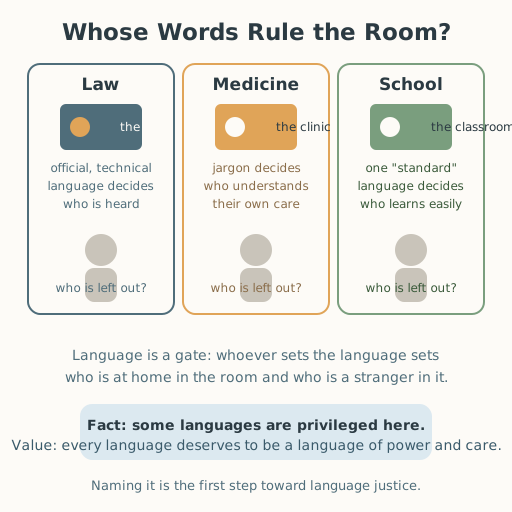
Lesson 14 — Language and Power: Whose Words Rule?
Summary
Learners analyze how language and power interact, examining law, medicine, and school to see whose language is used, whose is left out, and what that decides about who is heard, trusted, and included. They connect this to home language, multilingualism as wealth, and the idea of language justice — holding the analysis as description plus values, not a single verdict.
Objectives
- Analyze how language and power interact, such as whose language is used in law, medicine, and school. (D04.S4.10.01)
Connection
Stand where you cannot understand the words that decide things about you — a clinic form, a court notice, a school rule — and you feel it: language is not only for talking, it is for gatekeeping. Whoever sets the language sets who is at home in the room and who is a stranger in it. In a hospital, a courtroom, or a classroom, the language that is “official” is often one group’s language, and everyone else must translate themselves into it just to be heard. Naming that — seeing whose words rule — is the first step toward a world where every language gets to be the language of power and care.
Materials
- Language-and-power map (law / medicine / school)
- Short example texts (optional)
- Reading journal
Preparation
- Copy the map and any example texts (keep them short and real — a legal notice, a medical instruction, a school notice in formal or technical language).
- Retrieval: from Lesson 4, recall register and formality. Today we ask who set the register, and whom it excludes.
- Prepare one worked example: read one formal notice and translate it into plain home language, noticing the gap.
Facilitator note
This lesson is written to the learner (“you”). The idea to land: language carries power — in law, medicine, and school, the language that is official, technical, or “standard” is one group’s language, and everyone else must translate themselves into it; so language is a gate that includes some and excludes others, and noticing it is the first step toward language justice. This is analysis plus values: the factual claim is that official and technical language privileges certain speakers; the value is that every language deserves to be a language of power and care. The curriculum holds multilingualism as wealth and home language first (S-019): globally, about 40 per cent of people do not have access to education in a language they speak or understand (S-019). Writers from colonized contexts have named this directly — Ngũgĩ wa Thiong’o argues that being made to write in the colonizer’s language distanced him from his home world (S-424), and Gloria Anzaldúa describes living between languages and the demand to “tame” one’s tongue (S-425) — present these as lived arguments to reflect on, not verdicts to adopt. Languages shape habitual thought in moderate, well-supported ways (the Sapir–Whorf tradition, held in its moderate form, S-168), which is why whose language is used matters.
Model the skill once, then let learners practice (worked example → guided practice → independent work; S-011). The egalitarian lens is the spine: ask of every setting who is at home here and who is made a stranger? The ethics lens: using jargon to keep people out is a quiet harm; making communication accessible is a quiet good. The global lens: official-language policies differ worldwide, and multilingual states, Indigenous language revitalization, and everyday code-switching all show there is no single “right” arrangement — describe many, rank none. The technology lens: machine translation and voice tools can lower the gate — but they are uneven, often favoring dominant languages, and can reproduce exclusion (S-281). The critical-thinking lens: distinguish the factual claim (this language is privileged here) from the value (that is unjust, and here is what would be fairer). Preview: Lesson 15 closes the unit with politeness and address — the everyday face of the same question.
Procedure
- Recall (5 min). From Lesson 4, who sets the “formal” register in a room? Today you ask that question of the three biggest rooms: law, medicine, and school.
- Meet the map (15 min). Look at the language-and-power map: three columns — law, medicine, school — and two questions for each: whose language is used here? and who is left out? Watch a worked example: read a formal notice together, then say it in plain home language. Notice the gap — the formal version is not “clearer,” it is someone’s language wearing the clothes of authority.
- Fill the columns (15 min). For each setting, write whose language is used (official, technical, “standard”), who is at home in it, and who must translate themselves. Draw on real examples you have seen or heard.
- Hear the lived arguments (10 min). Learn how writers have named this: Ngũgĩ wa Thiong’o, made to write in a colonizer’s language, felt distanced from his home world (S-424); Gloria Anzaldúa wrote of living between languages and the demand to tame her tongue (S-425). In your journal, write one sentence on your own experience — including being monolingual, if that is you — of feeling at home or a stranger in a language.
- Name the value (7 min). Separate fact from value: it is a fact that some languages are privileged in these rooms; it is a value that every language deserves to be a language of power and care. Write one sentence of each.
- Close (3 min). Remember: language is a gate, and you now know how to see it. Next time, we practice the everyday courtesy that can open a small door in any of these rooms.
Differentiation
- Support: Focus on one setting (school) and use a provided plain-language translation to compare; name one person who is left out.
- Extension: Analyze a real language policy (an official-language law or a medium-of-instruction rule) for its effects on equity and inclusion, and argue for one change.
Assessment
- Formative (self): Can the learner name whose language is used in one of the three settings, who is left out, and distinguish the factual claim from the value judgment?
- Portfolio artifact (unit): The language-and-power map plus the fact/value sentences, added to the portfolio as the “language-and-power analysis.”
Home connection
Ask an adult you trust: have you ever been in a clinic, a court, or a school where the language used was not yours — and how did it feel? Listen for one moment where being heard mattered, and how the language helped or blocked it.
Resources
- On multilingualism as wealth and the 40% figure: UNESCO, International Mother Language Day, https://www.unesco.org/en/days/mother-language (S-019).
- On language, culture, and the colonizer’s language: Ngũgĩ wa Thiong’o, Decolonising the Mind (1986) (S-424).
- On living between languages: Gloria Anzaldúa, Borderlands/La Frontera (1987) (S-425).
- On the moderate form of linguistic relativity: Sapir (1929) and Whorf (1956) (S-168).
- On unequal access to digital tools: World Bank, World Development Report 2016: Digital Dividends (S-281).
- On modeling + guided practice before independent work: Kirschner, Sweller & Clark (2006), https://doi.org/10.1207/s15326985ep4102_1 (S-011).