Lesson 01 — Exponents and the Power Rules
Learners recall whole-number exponents from earlier grades and formalize the five power rules — product, quotient, power, zero, and negative — using worked examples and guided practice. They connect exponents to the huge and tiny numbers they meet every day (cells, distances, doubling), then practice simplifying expressions and checking each other's work.
Objectives
Objectives
- D05.S1.10.01 Use properties of exponents and roots to simplify expressions and solve problems involving exponential growth and decay.
Essential question
How do the power rules turn repeated multiplication into a language I can read and use, and where do I already meet huge and tiny numbers every day?
Key vocabulary
Materials
Standard materials
- Power-rules summary card · 1 per learner One card with the five rules (product, quotient, power, zero, negative) and a worked example of each
- Math journal · 1 per learner
Low-tech / no-cost
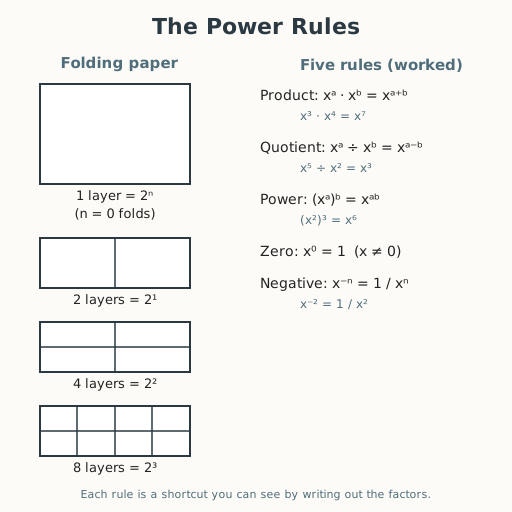
- Paper folded in half, and again Folding a page 1, 2, 3, 4 times shows layers double — 2, 4, 8, 16 — a body-size picture of an exponent
- Voice and fingers Count doublings aloud; use held-up fingers to track repeated factors
Enriched / lab & device
- Calculator or spreadsheet · 1 per learner or pair To compute 2^10, 2^20, and compare growth to a flat line
Works in different contexts
- large-group Model the five rules once whole-class with one shared example each, then learners practice in pairs and check each other's work
- multi-age Younger learners use the rules on small whole-number powers; older learners extend to fractional and negative exponents and preview Lesson 2
- self-directed A learner works the worked examples, then self-checks each rule against the summary card before the independent set
- level-grouped Group by mastery of the rules, not age; a group that has the rules moves to negative and zero exponents early
- outdoor-only Count real doublings outdoors — leaves on a branch, steps in a doubling walk — and write each as a power
Lesson 1 — Exponents and the Power Rules
Summary
Learners recall what an exponent means (repeated multiplication) and formalize the five power rules — product, quotient, power, zero, and negative — through worked examples and guided practice. They connect exponents to real huge and tiny numbers, then simplify expressions and check each other’s work.
Objectives
- Use properties of exponents to simplify expressions — beginning with the five power rules, applied with confidence and justified. (D05.S1.10.01)
Connection
Fold a sheet of paper in half once: 2 layers. Fold it again: 4. Again: 8. A stack of paper 10 folds thick would have over a thousand layers, and 20 folds would reach further than the height of a house — all from doubling a small number of times. The same “doubling” language describes a colony of cells growing, a savings account growing, and even how a rumor or a disease can spread. Exponents are the shorthand that lets us read that speed of growth instead of writing a long row of multiplications. The power rules are the grammar of that shorthand — the same five small moves that make any repeated multiplication manageable.
Materials
- Power-rules summary card
- Math journal
Preparation
- Copy or draw the power-rules summary card.
- Retrieval: from Grade 8, recall integer exponents and scientific notation (D05.S1.08.02) — a cell is on the order of 10–30 micrometres across (about 2 × 10⁻⁵ m) (S-356), and the Sun is about 1.5 × 10⁸ km from Earth (S-047). Today we extend those powers to the full set of rules.
- Prepare one worked example for each of the five rules.
Facilitator note
This lesson is written to the learner (“you”). The idea to land: an exponent is repeated multiplication, and the five power rules (product, quotient, power, zero, negative) let us rewrite and simplify those repetitions honestly — each rule is a shortcut, not a new kind of magic. Teach the rules with explicit worked examples and guided practice before independent work; the evidence is clear that novices learn foundational procedures this way (S-011). Model once, then let learners practice and check each other (worked example → guided practice → independent work).
The intellectual lens is the spine: every rule can be shown by writing out the multiplications, so a learner who forgets a rule can rebuild it. The critical-thinking lens: ask learners to verify a rule by expansion rather than trust it. The technology lens: exponents are how we express the enormous (carbon in the atmosphere, data storage) and the microscopic (cell size, virus size) — a single notation reaches across those scales. The egalitarian lens: scientific notation and the power rules are shared tools, free to everyone, that let any person read numbers about the whole Earth — not a gate kept for a few. Preview: Lesson 2 turns to roots — the “undo” of a power — and the numbers that sit between the fractions.
Procedure
- Recall (5 min). From Grade 8: what does 2⁵ mean? (Five 2s multiplied together.) What does 10⁻² mean? (One divided by ten, twice.) Name one very large and one very small thing you have seen described with powers of ten.
- Meet the rules (15 min). Look at the summary card. Each rule is a shortcut you
can see by writing out the factors:
- Product rule: xᵃ · xᵇ = xᵃ⁺ᵇ (x³ · x⁴ = x⁷).
- Quotient rule: xᵃ ÷ xᵇ = xᵃ⁻ᵇ (x⁵ ÷ x² = x³).
- Power rule: (xᵃ)ᵇ = xᵃᵇ ((x²)³ = x⁶).
- Zero exponent: x⁰ = 1 (for x ≠ 0).
- Negative exponent: x⁻ⁿ = 1/xⁿ. Watch one worked example of each, written out longhand, so you can see why the rule holds.
- Guided practice (15 min). With a partner, simplify: (a) x² · x⁵; (b) x⁷ ÷ x³; (c) (x³)²; (d) x⁰; (e) x⁻². For each, write the expansion next to it as a check. Then compare answers and agree before moving on.
- Independent practice (15 min). In your journal, simplify a mixed set of ten expressions, including negative and zero exponents. After each, self-check against the summary card; mark any you are unsure of with “not yet” and try again.
- Close (5 min). Explain in one sentence: why does x⁰ = 1 (for x ≠ 0)? Why does a negative exponent mean “one over”? Next time, we undo powers with roots.
Differentiation
- Support: Offer a smaller set of whole-number-only powers and a half-filled expansion to complete (“x³ · x² = (x·x·x)·(x·x) = ___”).
- Extension: Simplify expressions with multiple rules at once, e.g. (x²y)³ ÷ (xy²)², and justify each step by naming the rule.
Assessment
- Formative (peer + self): Can the learner simplify with all five rules and justify each step by expansion?
- Portfolio artifact (unit): The summary card, corrected and annotated, as the opening page of the unit’s “number toolkit.”
Home connection
Ask an adult: what in our lives grows or shrinks by doubling or halving? (A recipe halved, a loan, a crop, a battery charge.) Write one example as a power, and show them how the power rules simplify it.
Resources
- On worked examples and guided practice for novice learners: Kirschner, Sweller & Clark (2006), https://doi.org/10.1207/s15326985ep4102_1 (S-011).
- On the size of a typical cell (for the “very small” anchor): Encyclopaedia Britannica, “Cell (biology),” https://www.britannica.com/science/cell-biology (S-356).
- On the Sun’s distance (for the “very large” anchor): NASA Space Place, “All About the Sun,” https://spaceplace.nasa.gov/all-about-the-sun/en/ (S-047).