Lesson 02 — Roots, Rational Exponents, and the Numbers In Between
Learners see a root as the "undo" of a power, discover that √2 is not a fraction by reasoning about a unit square's diagonal, and learn that rational exponents reveal roots and powers as one operation. They convert between radical and rational-exponent form and simplify, ending by placing roots on a number line.
Objectives
Objectives
- D05.S1.10.01 Use properties of exponents and roots to simplify expressions and solve problems involving exponential growth and decay.
Essential question
What does a root "undo," and how do rational exponents reveal that roots and powers are one thing, not two?
Key vocabulary
Materials
Standard materials
- Root-and-exponent bridge chart · 1 per learner Two columns showing ⁿ√a ↔ a^(1/n) and (ⁿ√a)^m ↔ a^(m/n), with examples
- Number-line strip · 1 per learner A line from 0 to 4 to place √2, √3, and √4 by reasoning about squares
- Math journal · 1 per learner
Low-tech / no-cost
- A square drawn in the ground or on paper A square with side 1 has a diagonal you can walk and measure — the concrete picture of √2
- String or rope Cut a length equal to a unit square's diagonal and compare it to the side; it is longer than 1 and shorter than 2
Enriched / lab & device
- Calculator with a square-root key · 1 per learner or pair To approximate √2 and compare to 1.414213...
- Compass and straightedge · 1 per pair To construct the diagonal of a unit square and transfer √2 onto a number line
Works in different contexts
- large-group Build the number line once whole-class, then learners place roots in pairs and compare placements
- multi-age Younger learners find whole-number square roots by listing squares; older learners convert between radical and rational-exponent forms and simplify
- self-directed A learner draws the unit square, measures its diagonal, then converts a list of radicals to rational exponents and back, self-checking
- level-grouped Group by fluency with the exponent rules from Lesson 1; a group ready to extend simplifies expressions like x^(2/3) · x^(1/3)
- outdoor-only Find or draw a square outdoors, pace its side and diagonal, and reason about what number its diagonal must be
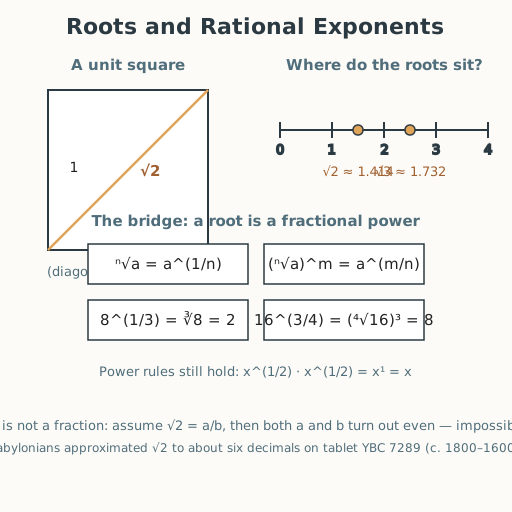
Lesson 2 — Roots, Rational Exponents, and the Numbers In Between
Summary
Learners meet the root as the inverse of a power, encounter irrational numbers through the diagonal of a unit square, and learn that rational exponents unify roots and powers. They convert between radical and rational-exponent form, simplify, and place roots on the number line.
Objectives
- Use properties of exponents and roots to simplify expressions — extending the power rules to roots and rational exponents, and explaining the two as one operation. (D05.S1.10.01)
Connection
Draw a square with each side exactly one unit. The straight line across it — the diagonal — is longer than the side but shorter than two sides. If you measure it carefully you get about 1.4142… but the decimals never settle into a repeating pattern and never stop. That length is √2, and it is a real, walkable distance that no fraction can ever pin down exactly. The people who first studied this — in ancient Greece, in Mesopotamia, in India — were discovering that numbers are richer than fractions alone. Roots are how we hold those numbers, and rational exponents are how we see that a root and a power are really one idea from two sides.
Materials
- Root-and-exponent bridge chart
- Number-line strip
- Math journal
Preparation
- Copy or draw the bridge chart and number-line strip.
- Retrieval: from Lesson 1, the power rules; from Grade 8, rational vs. irrational numbers (D05.S1.08.01). Today we meet the source of many irrationals: roots.
- Prepare a unit square to draw, and a way to measure or reason about its diagonal.
Facilitator note
This lesson is written to the learner (“you”). The idea to land: a root undoes a power, and a rational exponent like a^(1/n) or a^(m/n) shows that a root is just a fractional power — one operation, not two. Teach the conversion with worked examples (S-011), then let learners practice. The historical note belongs to the global lens: the diagonal of a unit square was studied in many places — the Babylonian tablet YBC 7289 (c. 1800–1600 BCE) carries a sexagesimal approximation of √2 good to about six decimal places (S-430), and as legend tells it the irrationality of √2 was discovered in the Pythagorean circle (traditionally attributed to Hippasus, 5th century BCE) (S-353). Teach the proved fact (√2 is irrational) and the legend (priority) as distinct. The intellectual lens: reasoning by contradiction — assume √2 = a/b, then show it breaks — is a reusable tool. The critical-thinking lens: “the decimals never end” is not the same as “irrational”; the proof is the reason. The egalitarian lens: these numbers are shared human discoveries, not the property of one culture — India, Mesopotamia, and Greece each contributed (S-240). Preview: Lesson 3 uses roots to solve growth and decay problems.
Procedure
- Recall (5 min). What undoes addition? Subtraction. What undoes multiplication? Division. What might undo squaring? Write what you think a “square root” does.
- Meet the root (10 min). A square root asks: what number, multiplied by itself, gives this? 3² = 9, so √9 = 3. A cube root asks the same for three factors: 2³ = 8, so ∛8 = 2. In general, the nth root ⁿ√a is the number whose nth power is a. Draw the unit square; measure its diagonal. It is √2, because by the Pythagorean relationship, (diagonal)² = 1² + 1² = 2.
- See that √2 is not a fraction (10 min). Watch a proof by contradiction: suppose √2 = a/b in lowest terms. Then 2 = a²/b², so a² = 2b², so a² is even, so a is even; write a = 2k, then a² = 4k² = 2b², so b² = 2k², so b is even too — but then a and b share a factor of 2, contradicting “lowest terms.” So √2 is not a fraction. It is an irrational number. The Babylonians had a fine approximation of it long ago (S-430).
- Meet rational exponents (15 min). Watch the bridge: a^(1/n) = ⁿ√a, and a^(m/n) = (ⁿ√a)^m = ⁿ√(a^m). Worked examples: 8^(1/3) = ∛8 = 2; 16^(3/4) = (⁴√16)³ = 2³ = 8. The power rules still work: x^(1/2) · x^(1/2) = x¹ = x.
- Practice (10 min). Convert and simplify: (a) √x as x^(1/2); (b) ∛(x²) as x^(2/3); (c) 27^(2/3); (d) x^(2/3) · x^(1/3). Self-check, then place √2 and √3 on the number line (between 1 and 2; between 1 and 2) and explain why.
- Close (5 min). Say in your own words why “root” and “fractional power” are the same idea. Next time, we use roots to solve growth and decay.
Differentiation
- Support: List perfect squares to 144 and find roots of perfect squares only; complete a half-written conversion.
- Extension: Simplify expressions that combine rational exponents, e.g. (x^(1/3))⁶ ÷ x, and rationalize a denominator like 1/√2.
Assessment
- Formative (self + peer): Can the learner convert between radical and rational-exponent form and simplify correctly, and place √2 and √3 on a number line with reasoning?
- Portfolio artifact (unit): The bridge chart with the number-line placements, added to the number toolkit.
Home connection
Find a square at home — a tile, a window, a book cover. Measure its side, then measure its diagonal and divide the two. What number do you get close to? Show someone and explain why the diagonal of a unit square is √2.
Resources
- On the Babylonian tablet approximating √2: Wikipedia, “YBC 7289,” https://en.wikipedia.org/wiki/YBC_7289 (S-430).
- On the discovery of the irrationals (told as legend): MacTutor, “The real numbers: Pythagoras to Stevin,” https://mathshistory.st-andrews.ac.uk/HistTopics/Real_numbers_1/ (S-353).
- On worked examples for novices: Kirschner, Sweller & Clark (2006), https://doi.org/10.1207/s15326985ep4102_1 (S-011).