Lesson 09 — Trigonometric Ratios from Similar Triangles
Learners discover through similar triangles that a right triangle's side ratios depend only on the angle, then formalize the three trigonometric ratios — sine, cosine, and tangent — and use them to find missing sides and angles. They meet the word "sine" and its journey across languages.
Objectives
Objectives
- D05.S3.10.01 Use trigonometric ratios and the Pythagorean theorem to solve right-triangle problems in real contexts such as surveying or navigation.
Essential question
How do the ratios of a right triangle's sides depend only on the angle, and how does that let me find any side or angle from a few knowns?
Key vocabulary
Materials
Standard materials
- SOH-CAH-TOA chart · 1 per learner A right triangle with opposite, adjacent, and hypotenuse labeled, and the three ratio definitions
- Ruler and protractor · 1 per pair To measure sides and angles of a drawn triangle and compute the ratios
- Math journal · 1 per learner
Low-tech / no-cost
- A drawn right triangle in the ground Measure its sides by pacing and compute the ratios with no tools
- Body shadows Compare your height to your shadow to feel a ratio that depends on the Sun's angle
Enriched / lab & device
- Scientific calculator with sin/cos/tan · 1 per learner or pair To find ratios from an angle and angles from a ratio
Works in different contexts
- large-group Build one large right triangle and measure it whole-class, then learners compute ratios in pairs and compare
- multi-age Younger learners identify opposite, adjacent, and hypotenuse and form the fractions; older learners solve for missing sides and angles
- self-directed A learner draws and measures two similar triangles, computes the ratios, and confirms they match, then solves a set of triangle problems
- level-grouped Group by comfort with fractions and ratios; a ready group extends to finding an angle from a ratio using the inverse functions
- outdoor-only Measure a real object's shadow and its height to form a tangent ratio and find the Sun's angle
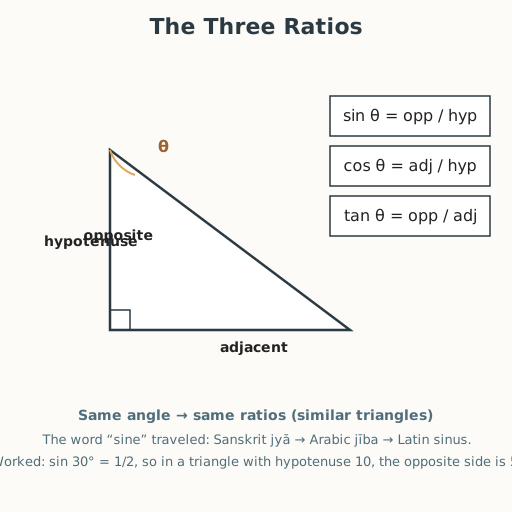
Lesson 9 — Trigonometric Ratios from Similar Triangles
Summary
Learners discover through similar triangles that a right triangle’s side ratios depend only on the angle, then formalize the three trigonometric ratios — sine, cosine, and tangent — and use them to find missing sides and angles. They meet the word “sine” and its journey across languages.
Objectives
- Use trigonometric ratios and the Pythagorean theorem to solve right-triangle problems in real contexts — beginning with the three ratios themselves. (D05.S3.10.01)
Connection
Hold your hand out flat, then tilt it upward as if shading your eyes from the Sun. The steeper you tilt, the longer your shadow would be if a light shone from the side. A ramp, a roof, a ladder against a wall, a hill you climb — all of these are the same shape: a right triangle, where the angle decides the shape, and the shape decides the ratios of its sides. Measure any two sides of a right triangle and you can find every angle; know one angle and one side and you can find every other side. That single idea — that an angle fixes the side ratios — is all of trigonometry’s power, and it has been used for thousands of years to measure things too big or too far to reach with a rope.
Materials
- SOH-CAH-TOA chart
- Ruler and protractor
- Math journal
Preparation
- Copy or draw the SOH-CAH-TOA chart.
- Retrieval: from Grade 8, the Pythagorean theorem (D05.S3.08.02); from Grade 7/8, similar triangles. Today we use similarity to discover the trig ratios.
- Prepare two similar right triangles to measure.
Facilitator note
This lesson is written to the learner (“you”). The idea to land: because similar triangles keep the same side ratios, each angle has fixed ratios — sine (opposite/hypotenuse), cosine (adjacent/hypotenuse), tangent (opposite/adjacent) — and these let us find any side or angle of a right triangle from a few knowns. Teach the definitions with worked examples (S-011), but first let learners discover that the ratios are the same across similar triangles by measuring.
The global lens: trigonometry is a shared human achievement. The word “sine” is a chain of translation — the Indian mathematician Aryabhata (5th century) tabulated half-chords (S-240), the Sanskrit jyā became the Arabic jība, and later the Latin sinus — a reminder that the mathematics is a gift from many cultures, not one. The intellectual lens: the ratios are the same number for the same angle because of similarity — the proof is the reason, not the memory. The critical-thinking lens: choose the right ratio by asking “which two sides do I know or want?” The egalitarian lens: trigonometry was developed to measure land, build, and navigate — tools for ordinary work, available to everyone. Preview: Lesson 10 applies these ratios to real surveying and navigation.
Procedure
- Recall (5 min). From Grade 8, what does the Pythagorean theorem say? What does it mean for two triangles to be similar?
- Discover the ratios (15 min). Draw two right triangles with the same acute angle but different sizes (e.g. a 30°–60°–90° triangle and a scaled-up copy). Measure all three sides of each. Compute, for each, the fractions opposite/hypotenuse, adjacent/hypotenuse, and opposite/adjacent. Compare: for the same angle, the fractions match — similarity keeps ratios constant, even as sizes change.
- Name the ratios (15 min). On the SOH-CAH-TOA chart:
- sine θ = opposite / hypotenuse
- cosine θ = adjacent / hypotenuse
- tangent θ = opposite / adjacent Worked example: in a triangle with a 30° angle and hypotenuse 10, sin 30° = 1/2, so the opposite side is 5; cos 30° ≈ 0.866, so the adjacent side is about 8.66.
- Find a missing side (10 min). Guided practice: a ladder 12 m long leans against a wall at 40° to the ground. How high does it reach? (sin 40° ≈ 0.643; height ≈ 12 × 0.643 ≈ 7.7 m.) Check with a partner.
- Close (5 min). Say in one sentence why the trig ratios are the same for a given angle, and where the word “sine” traveled from.
Differentiation
- Support: Identify opposite/adjacent/hypotenuse on several drawn triangles first; use a ratio table instead of a calculator.
- Extension: Find an angle given two sides (using inverse sine/cosine/tangent) and explain your choice of ratio.
Assessment
- Formative (peer + self): Can the learner set up and solve a right-triangle problem using the correct trig ratio, and explain why the ratios are angle-only?
- Portfolio artifact (unit): The measured similar triangles with their matching ratios and the SOH-CAH-TOA chart, added to the geometry toolkit.
Home connection
Measure your own height and your shadow at a fixed time of day. Divide the two — that is the tangent of the Sun’s angle. Try it tomorrow at the same time and see if the angle matches.
Resources
- On the history of the sine and Aryabhata’s table (as a shared, translated achievement): MacTutor History of Mathematics Archive, https://mathshistory.st-andrews.ac.uk/ (S-240).
- On worked examples and guided practice: Kirschner, Sweller & Clark (2006), https://doi.org/10.1207/s15326985ep4102_1 (S-011).