Lesson 11 — Circles and Coordinate Geometry
Learners prove and apply circle theorems — the inscribed angle is half the central angle, an angle in a semicircle is right, and a tangent is perpendicular to the radius — then use coordinate geometry to describe circles and figures with numbers. They connect both to the long, global history of measuring circles and places.
Objectives
Objectives
- D05.S3.10.02 Prove and apply theorems about circles and use coordinate geometry to describe and analyze figures.
Essential question
What do the theorems of a circle prove about angles and tangents, and how does coordinate geometry let me describe and analyze figures with numbers?
Key vocabulary
Materials
Standard materials
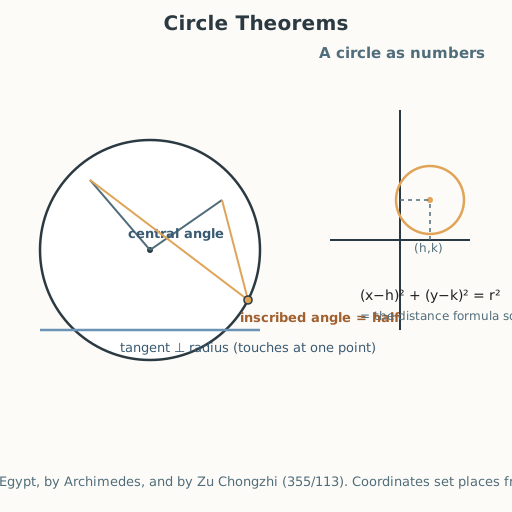
- Circle-and-coordinate chart · 1 per learner A circle with central and inscribed angles and a tangent labeled, beside the circle equation and distance/midpoint formulas
- Graph paper and a compass · 1 per learner or pair To draw a circle on axes and test the theorems by measurement
- Math journal · 1 per learner
Low-tech / no-cost
- A circle drawn in the ground with a peg and string Use a stick as the center and a string as the radius to draw and reason about a real circle
- String and a straight edge Stretch a string across a circle (a chord) and a second from the center to a point (a radius) to test tangents
Enriched / lab & device
- Geometry software or a graphing tool · 1 per learner or pair To construct a circle and drag points, watching the inscribed-angle relationship hold
Works in different contexts
- large-group Prove one theorem whole-class on a board, then learners test it by measurement in pairs and compare
- multi-age Younger learners draw a circle, name radius/diameter/chord/tangent, and find the center; older learners prove the inscribed-angle and tangent theorems and derive the circle equation
- self-directed A learner follows the worked proof, then tests the theorem by drawing and measuring, and derives the circle equation
- level-grouped Group by comfort with coordinates; a ready group extends to finding the center and radius from an expanded circle equation
- outdoor-only Draw a large circle with peg and string outdoors, mark central and inscribed angles, and measure them to verify the theorem
Lesson 11 — Circles and Coordinate Geometry
Summary
Learners prove and apply circle theorems — the inscribed angle is half the central angle, an angle in a semicircle is right, and a tangent is perpendicular to the radius — then use coordinate geometry to describe circles and figures with numbers. They connect both to the long, global history of measuring circles and places.
Objectives
- Prove and apply theorems about circles and use coordinate geometry to describe and analyze figures. (D05.S3.10.02)
Connection
A wheel, a water tank, a round field, a dome, a full moon — circles are everywhere, and so are the questions we ask about them: what angle does a corner make when it sits on a circle? Why does a line that just grazes a wheel point straight away from its hub? And how do we describe a circle’s place and size precisely enough to build or map it? The answers are a few tight, provable truths — and a coordinate system that turns “this circle, here, this big” into an equation anyone can check. The same coordinates that describe a circle describe every shape, and they began as a way to describe the world itself.
Materials
- Circle-and-coordinate chart
- Graph paper and a compass
- Math journal
Preparation
- Copy or draw the circle-and-coordinate chart.
- Retrieval: from Lesson 10, the Pythagorean theorem and right triangles; from Grade 9, coordinates and proof (D05.S3.09.01). Today we prove circle facts and describe figures with coordinates.
- Prepare a compass and straightedge demonstration.
Facilitator note
This lesson is written to the learner (“you”). The idea to land: a circle’s theorems are provable truths — an inscribed angle is half the central angle on the same arc, an angle in a semicircle is right, and a tangent is perpendicular to the radius — and coordinate geometry turns “this figure, here, this size” into numbers: the circle (x − h)² + (y − k)² = r², and the distance and midpoint formulas. Teach the proofs explicitly (S-011), then let learners verify by measurement.
The global lens: both tools are shared human inventions. The number π — the ratio of a circle’s circumference to its diameter — was approximated in Egypt (256/81), by Archimedes (between 3 10/71 and 3 1/7), and by the Chinese mathematician Zu Chongzhi (355/113, accurate to six decimal places) (S-291). Coordinates set places in proportion as early as Ptolemy’s latitude/longitude (2nd century) (S-299), and the 12th-century geographer al-Idrisi made a celebrated world map with places located by position (S-298); the modern coordinate system associated with Descartes is one chapter in a longer story (S-240). The intellectual lens: a proof explains why the inscribed angle is always half — not just that it looks so. The critical-thinking lens: test each theorem by measurement, and ask whether the measurement is a proof or an example. The egalitarian lens: these are tools for fair building, mapping, and dividing land — shared knowledge for everyone.
Procedure
- Recall (5 min). From Lesson 10, what does the Pythagorean theorem let you find? From Grade 9, how do coordinates describe a point’s place?
- Prove circle theorems (20 min). On the chart, watch and then retrace:
- Inscribed angle: a central angle has its vertex at the center; an inscribed angle has its vertex on the circle. Draw both on the same arc and show (using isosceles triangles formed by radii) that the inscribed angle is half the central angle.
- Angle in a semicircle: if the arc is a semicircle, the central angle is 180°, so the inscribed angle is 90° — any angle on a semicircle is a right angle.
- Tangent–radius: a tangent touches the circle at one point; the radius to that point is perpendicular to the tangent (if it were not, the line would cut the circle twice). Test each by drawing and measuring.
- Coordinate geometry (15 min). A circle with center (h, k) and radius r has the equation (x − h)² + (y − k)² = r², which is just the distance formula squared. The distance formula and midpoint formula let you find lengths and centers from coordinates. Worked example: the circle with center (2, −1) and radius 3 is (x − 2)² + (y + 1)² = 9.
- Guided practice (10 min). With a partner: (a) write the equation of a circle with center (0, 0) and radius 5, and name three points on it; (b) find the distance between (−1, 2) and (3, 5), and the midpoint of the segment joining them.
- Close (5 min). Say in one sentence how an inscribed angle relates to its central angle, and what the circle equation really is (the distance formula in disguise).
Differentiation
- Support: Draw and measure one theorem at a time; name radius/diameter/chord/ tangent before proving.
- Extension: Given an expanded equation like x² + y² − 4x + 6y = 12, complete the squares to find the center and radius.
Assessment
- Formative (peer + self): Can the learner state and justify the inscribed-angle, semicircle, and tangent–radius theorems, and write the equation of a circle from its center and radius?
- Portfolio artifact (unit): The circle-and-coordinate chart with the measured verifications and the worked circle equation, added to the geometry toolkit.
Home connection
Find a circle at home — a plate, a clock, a lid. Trace it, draw an angle with its corner on the edge and both sides through the ends of a diameter, and measure it. Is it a right angle? Explain why to someone.
Resources
- On π approximations across cultures: MacTutor, “A history of Pi,” https://mathshistory.st-andrews.ac.uk/HistTopics/Pi_through_the_ages/ (S-291).
- On Ptolemy’s coordinates: Encyclopaedia Britannica, “Ptolemy,” https://www.britannica.com/biography/Ptolemy (S-299).
- On al-Idrisi’s world map: Encyclopaedia Britannica, “Muhammad al-Idrisi,” https://www.britannica.com/biography/Muhammad-al-Idrisi (S-298).
- On worked examples and guided practice: Kirschner, Sweller & Clark (2006), https://doi.org/10.1207/s15326985ep4102_1 (S-011).