Lesson 12 — Probability Rules and Compound Events
Learners formalize the rules for combining probabilities — the addition rule for "or" (watching for overlap) and the multiplication rule for "and" — and lay out compound events with two-way tables and tree diagrams so nothing is missed or double-counted. They meet the long history of reasoning about games of chance.
Objectives
Objectives
- D05.S4.10.02 Use probability rules to compute probabilities of compound events and interpret expected value in everyday decisions.
Essential question
How do the addition and multiplication rules combine the chances of "this or that" and "this and that," and how do I lay out a compound event so nothing is missed or double-counted?
Key vocabulary
Materials
Standard materials
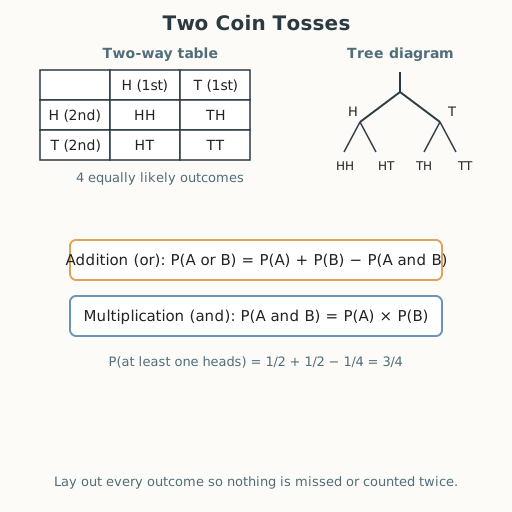
- Probability-rules chart · 1 per learner The addition rule (with and without overlap), the multiplication rule, and a two-way table and tree diagram example
- Two dice or spinners · 1 set per pair To generate compound events by hand
- Math journal · 1 per learner
Low-tech / no-cost
- Pebbles, seeds, or coins Toss two coins many times and tally outcomes to feel a compound event by hand
- A two-way table drawn in the ground Mark rows and columns for two events and fill cells by tossing found objects
Enriched / lab & device
- A spreadsheet or calculator · 1 per learner or pair To simulate many trials of a compound event and compare the frequency to the computed probability
Works in different contexts
- large-group Build the two-way table whole-class, then learners toss in pairs and compare their tallies to the computed probabilities
- multi-age Younger learners list outcomes of two coins and count; older learners apply the addition and multiplication rules and handle overlap
- self-directed A learner follows the worked examples, then computes and simulates a compound event and compares frequency to probability
- level-grouped Group by comfort with fractions; a ready group extends to three events and to the general addition rule with overlap
- outdoor-only Toss found objects (two different seeds, two coins) outdoors and tally compound outcomes on a ground-drawn table
Lesson 12 — Probability Rules and Compound Events
Summary
Learners formalize the rules for combining probabilities — the addition rule for “or” (watching for overlap) and the multiplication rule for “and” — and lay out compound events with two-way tables and tree diagrams so nothing is missed or double-counted. They meet the long history of reasoning about games of chance.
Objectives
- Use probability rules to compute probabilities of compound events. (D05.S4.10.02)
Connection
If it rains on 30% of days and is windy on 20% of days, what is the chance of a rainy or windy day? You cannot just add 30% and 20% — days that are both would be counted twice. And what is the chance that a coin and a die come up “heads” and “six”? These “or” and “and” questions are everywhere: the chance of one treatment working or another, the chance of two machines both failing, the chance a bet pays off. The rules that answer them are two small, careful moves — and the habit of laying every outcome out so you can see what you are counting is what keeps the answer honest.
Materials
- Probability-rules chart
- Two dice or spinners
- Math journal
Preparation
- Copy or draw the probability-rules chart.
- Retrieval: from Grade 7/8, simple and compound events (D05.S4.07.02); from Grade 9, two-way tables (D05.S4.09.02). Today we formalize the “or” and “and” rules.
- Prepare worked examples for the addition rule (with and without overlap) and the multiplication rule.
Facilitator note
This lesson is written to the learner (“you”). The idea to land: the addition rule P(A or B) = P(A) + P(B) − P(A and B) handles “or” (subtracting the overlap), the multiplication rule handles “and” (for independent events, P(A and B) = P(A) × P(B)), and two-way tables and tree diagrams lay out compound events so the count is honest. Teach the rules with worked examples (S-011), then let learners compute and simulate.
The global lens: reasoning about chance has a long, human history. Dice are ancient — found in Egypt, India, and Mesopotamia, used across many cultures (S-300); and the careful study of chance began with questions from games in 17th-century Europe, answered in the correspondence of Pascal and Fermat (S-301). Hold that as one starting point among the many peoples who gambled, divided, and predicted before and since. The intellectual lens: the rules are counting, done carefully — the subtraction in the addition rule is just “don’t count the overlap twice.” The critical-thinking lens: always lay out the sample space before computing, and ask whether the events overlap or not. The ethics lens: the same rules that keep a game fair can be hidden inside a rigged one; reading probability honestly protects people from being cheated. Preview: Lesson 13 turns to conditional probability and why order and information change the odds.
Procedure
- Recall (5 min). From earlier grades, what is the probability of rolling a 6 on one fair die? Of tossing heads on one coin? What does it mean for outcomes to be equally likely?
- Meet the addition rule (15 min). The sample space is every possible outcome; an event is a set of outcomes. For “A or B”: P(A or B) = P(A) + P(B) − P(A and B). If A and B cannot both happen (mutually exclusive), the overlap is 0. Worked example: one die — P(even or ≥ 5) = P(even) + P(≥5) − P(even and ≥5) = 3/6 + 2/6 − 1/6 = 4/6 = 2/3.
- Meet the multiplication rule (10 min). For “A and B” when the events do not affect each other (independent — previewed fully next lesson): P(A and B) = P(A) × P(B). Worked example: a coin and a die — P(heads and six) = (1/2)(1/6) = 1/12.
- Lay it out (15 min). Build a two-way table for two coin tosses (HH, HT, TH, TT — four equally likely outcomes) and a tree diagram for the same. Use them to find P(at least one heads) = 3/4, and check it against the addition rule (P(first heads) + P(second heads) − P(both) = 1/2 + 1/2 − 1/4 = 3/4). Then toss two coins 20 times and tally — does the frequency approach the probability?
- Close (5 min). Say in one sentence what the subtraction in the addition rule is for, and when the multiplication rule applies.
Differentiation
- Support: List all four outcomes of two coins first and count directly before using the formulas.
- Extension: Compute P(sum of two dice is 7 or 11), laying out the 36 outcomes in a table to avoid double-counting.
Assessment
- Formative (peer + self): Can the learner apply the addition and multiplication rules correctly and lay out a compound event in a table or tree without missing or double-counting?
- Portfolio artifact (unit): The probability-rules chart with the two-coin experiment and tally, added to the data-and-chance toolkit.
Home connection
Play a small game of chance at home with two coins or dice. Before playing, compute the probability of each outcome, then compare your predictions to what happens. Explain the “or” and “and” rules you used.
Resources
- On the antiquity of dice: Encyclopaedia Britannica, “Dice,” https://www.britannica.com/topic/dice (S-300).
- On the origin of probability theory in games of chance (Pascal and Fermat): Encyclopaedia Britannica, “Probability and statistics,” https://www.britannica.com/science/probability (S-301).
- On worked examples and guided practice: Kirschner, Sweller & Clark (2006), https://doi.org/10.1207/s15326985ep4102_1 (S-011).