Lesson 09 — Force and Work: A Quantitative Language for Motion
Learners meet force and work quantitatively: force in newtons, work as force times displacement (W = F × d) measured in joules. They solve worked examples and practice problems, and notice that direction matters — carrying something horizontally does no work against gravity.
Objectives
Objectives
- D06.S3.10.01 Explain motion, force, and energy quantitatively in everyday and engineered systems (such as work, power, and momentum).
Essential question
How do I measure force and work quantitatively, and why do the units matter in everyday machines?
Key vocabulary
Materials
Standard materials
- Work worksheet · 1 per learner A worked W = F × d example (lifting a bucket, pushing a cart) plus practice problems with units
- Science journal · 1 per learner
Low-tech / no-cost
- A bag or bucket and a distance Lift or push a real object a measured distance and estimate the force and work by feel and count
- Voice and counting steps Count pushes along a floor to feel work as "force over distance"
- Seated / no-motor option Slide a small object (a book or stone) across a desk a measured distance, or watch a partner lift while you read the numbers aloud and compute — no whole-body lifting or pushing needed
Enriched / lab & device
- Spring scale or force meter · 1 per group Measure force in newtons and distance in metres to compute work directly
Works in different contexts
- large-group Solve the worked example whole-class on a shared board, then learners compute in pairs and check each other's units
- multi-age Younger learners estimate work by counting pushes; older learners compute W = F × d with units and convert
- self-directed A learner follows the worked example, self-checks practice problems against the key, and writes the "why direction matters" reflection
- level-grouped Group by comfort with algebra, not age; a ready group solves multi-step problems and previews power in Lesson 10
- outdoor-only Push or lift a real object outdoors over a measured distance and estimate force, then compute work
Lesson 9 — Force and Work: A Quantitative Language for Motion
Summary
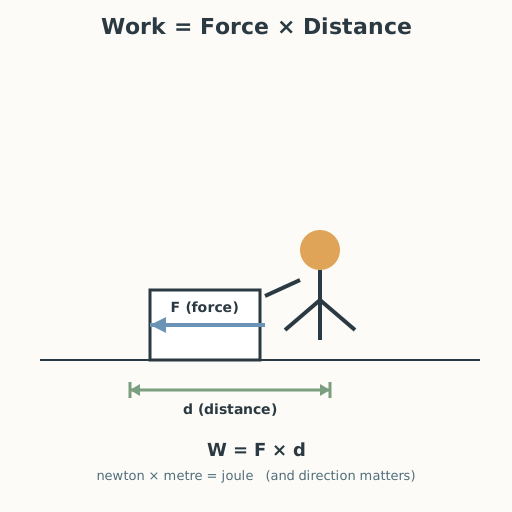
Learners meet force and work quantitatively. Force is measured in newtons, and work is the force applied along a distance: W = F × d, measured in joules. They solve worked examples and practice problems, and notice that direction matters — carrying something sideways does no work against gravity.
Objectives
- Explain motion, force, and energy quantitatively in everyday and engineered systems (such as work, power, and momentum). (D06.S3.10.01)
Connection
Lift a full bucket of water: you have done work against gravity. Push a stalled cart along the road: more work. Work is not just “effort” — it is a precise, measurable thing: how much force you apply, over how much distance, in the direction you push or lift. Knowing that number tells an engineer how big a motor to build, a farmer how much a pump must lift, and you how much a task will actually cost your muscles.
Materials
- Work worksheet
- Science journal
Preparation
- Copy or draw the work worksheet.
- Retrieval: from Grade 7, force, mass, and acceleration (D06.S3.07.01); from Grade 6, balanced and unbalanced forces (D06.S3.06.02). Today we add the quantitative measure of work.
- Prepare one worked example and practice problems.
Facilitator note
This lesson is written to the learner (“you”). The idea to land: force is measured in newtons; work = force × displacement in the direction of the force (W = F·d), in joules; and direction matters — perpendicular force does no work. Teach the formula with a worked example and unit discipline (S-011), then let learners practice and check. Watch the common error: students multiply force by total path length even when the force and motion are not aligned — model the “force in the direction of motion” step explicitly.
The intellectual lens: work is defined so that energy is conserved and transferable — the definition is a tool, not an arbitrary rule. The technology lens: every machine, from a hand pump to a crane, is a work calculation in physical form; the units (newtons, joules) are the shared language engineers use worldwide. The egalitarian lens: measuring work precisely is what lets us design tools that reduce human toil — the same force that once took many hands can be done by a motor, freeing people’s labor (though whether that freedom is shared fairly is a separate question). The ethics lens: who does the hardest work, and who gets the benefit of machines that do it instead? A work calculation is neutral; its use is not. Preview: Lesson 10 adds power (how fast the work happens) and momentum (motion in collisions).
Procedure
- Recall (5 min). From Grade 7, what is force, and what does a net force do to motion? Name one task you did this week that felt like “work.”
- Meet work (15 min). Force is measured in newtons (N). Work = force ×
distance moved in the direction of the force:
- Worked example: you lift a 100 N bucket straight up 2 m. W = 100 N × 2 m = 200 J (joules).
- Direction matters: if you carry the bucket 10 m horizontally at constant height, the upward force does no work (the force and the motion are perpendicular).
- A push example: you push a cart with 50 N of force for 4 m. W = 50 N × 4 m = 200 J.
- Guided practice (15 min). With a partner, solve: (a) lift 40 N up 3 m; (b) push 80 N for 2.5 m; (c) carry 60 N horizontally 10 m — how much work against gravity? Show units on every step. Compare and agree before moving on.
- Independent practice (15 min). In your journal, write one real task you did today, estimate the force (in newtons, comparing to a 10 N ≈ 1 kg feel) and the distance, and compute the work. Then explain in one sentence why direction matters in the definition of work.
- Close (5 min). In one sentence: what is work, what are its units, and why does direction matter?
Differentiation
- Support: Use a bag or bucket to feel force and distance first; give a pre-set formula with blanks to fill.
- Extension: Solve a multi-step problem: find the work to push a 200 N crate up a 5 m ramp, then discuss why ramps (not straight lifts) reduce the needed force.
Assessment
- Formative (peer + self): Can the learner compute W = F × d with correct units, and explain why perpendicular force does no work?
- Portfolio artifact (unit): The completed work worksheet, added to the physical-systems section.
Home connection
Ask someone at home about a lifting or pushing task they do often. Estimate the force and distance together and compute the work.
Resources
- On force and motion as background: Newton, Principia Mathematica (1687) (S-302); and Khan Academy, forces and Newton’s laws, https://www.khanacademy.org/science/physics/forces-newtons-laws (S-241).
- On worked examples and guided practice: Kirschner, Sweller & Clark (2006), https://doi.org/10.1207/s15326985ep4102_1 (S-011).