Lesson 08 — Evaluating Responses to Ecosystem Harm
Learners evaluate four kinds of response to ecosystem harm — restoration, protected areas, regulation, and biosecurity — using a simple rubric of effectiveness, fairness, cost, and side effects. They practice weighing trade-offs and learn that "does it work?" is inseparable from "works for whom?"
Objectives
Objectives
- D06.S2.10.02 Analyze how human activity (such as land use, pollution, and introduced species) affects ecosystems and evaluate responses.
Essential question
Once an ecosystem is harmed, what can we do — and how do I judge whether a response actually works?
Key vocabulary
Materials
Standard materials
- Response-evaluation sheet · 1 per learner A set of four real response options (restoration, protected area, regulation, biosecurity) with a simple evaluation rubric: effective? fair? affordable? side effects?
- Science journal · 1 per learner
Low-tech / no-cost
- A decision table drawn on paper or ground Score each response with tally marks for "works / fair / cheap / safe" and total them
- Voice and debate Argue for and against each response aloud before scoring it
Enriched / lab & device
- A case study with data (e.g., a restoration project) · 1 per group Evaluate a documented response using real outcomes and costs
Works in different contexts
- large-group Model scoring one response whole-class, then groups score the other three and defend their totals
- multi-age Younger learners use a simple "helps or harms?" vote per response; older learners use the full four-criteria rubric and debate trade-offs
- self-directed A learner scores all four responses with the rubric, then writes a one-paragraph recommendation with reasons
- level-grouped Group by comfort with evaluation; a ready group designs its own response and scores it
- outdoor-only Discuss which response would fit a real local site, and score it together in the field
Lesson 8 — Evaluating Responses to Ecosystem Harm
Summary
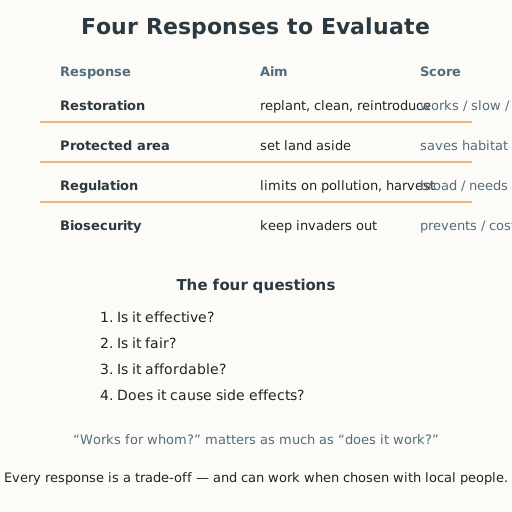
Learners evaluate four kinds of response to ecosystem harm — restoration (repairing damaged systems), protected areas, regulation (rules and limits), and biosecurity (keeping new invaders out) — using a simple rubric: is it effective, fair, affordable, and does it have side effects? They practice weighing trade-offs and learn that “does it work?” is inseparable from “works for whom?”
Objectives
- Analyze how human activity (such as land use, pollution, and introduced species) affects ecosystems and evaluate responses. (D06.S2.10.02)
Connection
When a field is degraded, a river polluted, or an invader spreading, people do not just stand by — they fence land, pass rules, replant trees, and guard borders. But every response has a cost, and some “solutions” help one group while hurting another. Judging a response well means asking not only “does it fix the problem?” but “who benefits, who pays, and what else breaks?” That is the difference between a gesture and a genuine repair.
Materials
- Response-evaluation sheet
- Science journal
Preparation
- Copy or draw the response-evaluation sheet.
- Retrieval: from Lesson 7, the three human drivers; from Grade 9, biodiversity and why it matters (D06.S2.09.02). Today we turn from the problem to the response.
- Prepare the four response cards and the rubric.
Facilitator note
This lesson is written to the learner (“you”). The idea to land: responses to ecosystem harm — restoration, protected areas, regulation, and biosecurity — can be evaluated on effectiveness, fairness, cost, and side effects, and every response is a trade-off; good evaluation asks “works for whom?” not just “does it work?” Model the scoring of one response (S-011), then let learners score the rest and defend their judgments. Keep hope attached: the point is agency, not despair — responses exist and can work, especially when they are chosen with the people who live there.
The ethics lens: a response that saves a species but displaces a community is not a clean win — evaluation must include human consequences. The egalitarian lens: the people who depend on an ecosystem must have a voice in deciding its fate; top-down “conservation” that fences people out of their own land has a painful history and a better alternative in community-based stewardship. The environment lens: responses are real and can succeed — damaged systems do recover, often surprisingly, when given time and protection. The global lens: every region has its own versions of these responses, from village-managed forests to international treaties, and we can learn across them. Preview: Lesson 9 moves to the physical world — force, work, and the quantitative language of motion.
Procedure
- Recall (5 min). From Lesson 7, name the three human drivers of ecosystem harm. What is one response you have heard of — a rule, a fence, a replanting?
- Meet the four responses (15 min). Read the four cards:
- Restoration: replanting, reintroducing a species, cleaning a river.
- Protected area: setting land aside from development.
- Regulation: limits on pollution, harvest, or trade.
- Biosecurity: quarantine and border checks against invaders. For each, note the aim and the likely cost.
- Score one together (10 min). Score “restoration” with the rubric: effective? fair? affordable? side effects? Model the judgment aloud, then note the trade-off — restoration is slow and costly but can bring a system back.
- Score the rest (15 min). With a partner, score protected area, regulation, and biosecurity. For each, name who benefits and who pays. Then pick one response and write a one-paragraph recommendation with reasons.
- Close (5 min). In one sentence: what four questions should you ask before trusting that a response “works”?
Differentiation
- Support: Use a simple “helps or hurts, and for whom?” two-column note per response instead of the full rubric.
- Extension: Research one documented restoration or reintroduction project and evaluate it against all four criteria with evidence.
Assessment
- Formative (peer + self): Can the learner score a response on the four criteria, name a trade-off, and say who benefits and who pays?
- Portfolio artifact (unit): The scored response sheet with the written recommendation, added to the living-systems section.
Home connection
Ask someone at home about a rule or project in your area meant to protect land, water, or wildlife. Evaluate it together with the four questions.
Resources
- On biodiversity and the case for responses: IPBES, Global Assessment Report (2019), https://www.ipbes.net/global-assessment (S-437).
- On ecosystems and interdependence as background: National Geographic Education, “Ecosystem,” https://education.nationalgeographic.org/resource/ecosystem/ (S-152).
- On worked examples: Kirschner, Sweller & Clark (2006), https://doi.org/10.1207/s15326985ep4102_1 (S-011).