Lesson 11 — Energy Generation: Renewable and Nonrenewable
Learners explain how energy generation works: nonrenewable sources (fossil fuels, nuclear fission) and renewable sources (solar, wind, hydro, geothermal, biomass), and the central trick most share — spinning a turbine to turn a generator that makes electricity.
Objectives
Objectives
- D06.S3.10.02 Explain how energy generation (renewable and nonrenewable) works and evaluate its environmental and social trade-offs.
Essential question
Where does the energy that powers our lives actually come from, and how is it converted into electricity?
Key vocabulary
Materials
Standard materials
- Energy-sources sheet · 1 per learner A table of sources — coal, oil, natural gas, nuclear, solar, wind, hydro, geothermal, biomass — with how each is converted to electricity
- Science journal · 1 per learner
Low-tech / no-cost
- A hand-cranked or drawn "generator" Spin a handle (or imagine spinning magnets in a coil) to feel motion becoming electricity
- Voice and drawing Draw the sun → water → turbine → generator chain for hydro, and the burning → steam → turbine chain for coal
Enriched / lab & device
- A small solar cell, wind toy, or generator model · 1 per group See energy converted directly in the room
Works in different contexts
- large-group Work the source table whole-class once, then groups each take one source and teach how it generates electricity
- multi-age Younger learners sort sources into "runs out" vs. "comes back"; older learners explain the turbine/generator step and nuclear fission
- self-directed A learner completes the source table, self-checks against the key, and writes the "where my electricity comes from" reflection
- level-grouped Group by comfort with energy concepts; a ready group traces the full energy chain for one source, including losses
- outdoor-only Find sunlight, moving water, or wind outdoors and trace how each could become electricity
Lesson 11 — Energy Generation: Renewable and Nonrenewable
Summary
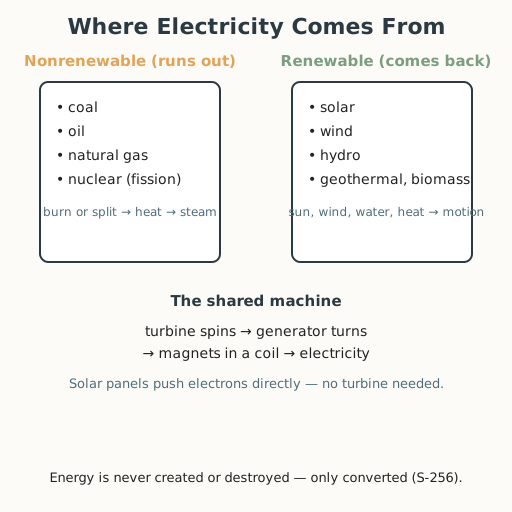
Learners explain how energy generation works. Nonrenewable sources — coal, oil, natural gas, and nuclear fission — and renewable sources — solar, wind, hydro, geothermal, and biomass — are compared, with attention to the central trick most share: spinning a turbine to turn a generator that produces electricity.
Objectives
- Explain how energy generation (renewable and nonrenewable) works and evaluate its environmental and social trade-offs. (D06.S3.10.02)
Connection
Flick a switch and a light comes on — but where did that electricity come from? Somewhere, almost certainly, something was spinning: a turbine turned by steam from burning coal, by falling water, or by wind. Or sunlight struck a panel and pushed electrons directly. The difference between “runs out” and “comes back” is the difference between nonrenewable and renewable — and knowing how each works is the first step to choosing among them.
Materials
- Energy-sources sheet
- Science journal
Preparation
- Copy or draw the energy-sources sheet.
- Retrieval: from Grade 6 and 9, forms of energy and conservation of energy (D06.S3.06.01, D06.S3.09.01); from Grade 3, renewable vs. nonrenewable resources (D06.S3.03.01 context). Today we explain how each source becomes electricity.
- Prepare the source table and the turbine/generator diagram.
Facilitator note
This lesson is written to the learner (“you”). The idea to land: energy is never created or destroyed, only converted; most electricity comes from spinning a turbine to turn a generator; nonrenewable sources burn stored fuels or split atoms, while renewable sources tap flows that keep coming (sun, wind, water, Earth’s heat, biomass). Teach the turbine→generator step explicitly (S-011) and have learners trace the chain for each source. Keep it faithful: renewables are “flow-limited” and not without cost (a point for Lesson 12), but they do not run out the way fuels do (S-095).
The technology lens: the generator — magnets moving in a coil — is the shared machine behind nearly all electricity (S-360); photovoltaics are the direct-conversion exception. The environment lens: whether a source is renewable shapes its environmental footprint, which Lesson 12 weighs in full. The egalitarian lens: about one person in every ten on Earth still lives without electricity, and energy access is a justice question — who gets light, cooking fuel, and power, and who is left in the dark. The global lens: the same physics works everywhere, but what a region uses depends on what it has — sun, rivers, wind, coal, or uranium — so energy systems look different around the world. Preview: Lesson 12 turns to the trade-offs.
Procedure
- Recall (5 min). From Grade 9, what is the law of conservation of energy? From Grade 6, name the forms of energy. Where does the electricity in your home come from?
- Meet the generator (10 min). Most power plants do the same thing: something makes a turbine spin, and the spinning turbine turns a generator (magnets moving inside a coil of wire), which pushes electrons — electricity (S-360). What differs is what makes it spin.
- Meet the sources (15 min). On the sheet, trace each:
- Nonrenewable: coal, oil, natural gas are burned to boil water into steam that spins the turbine; nuclear splits atoms (fission) to make the same heat. These fuels take millions of years to form and can be used up (S-095).
- Renewable: hydro uses falling water; wind uses moving air; solar uses sunlight — either to heat a fluid or, in photovoltaic panels, to push electrons directly with no turbine at all; geothermal uses Earth’s heat; biomass burns or ferments recently grown plant matter. These flows keep coming (S-095).
- Guided practice (15 min). With a partner, sort the nine sources into nonrenewable and renewable, and for three of them write the full chain (source → heat or motion → turbine → generator → electricity). Compare and agree.
- Independent practice (10 min). In your journal, write: where does my region’s electricity most likely come from, and which step in the chain does it share with almost every other source?
- Close (5 min). In one sentence each: what is the difference between nonrenewable and renewable, and what single machine do most sources share?
Differentiation
- Support: Sort picture cards of sources into two piles first, then label the shared turbine step.
- Extension: Trace the full energy chain for one source including conversion losses (heat, friction) and explain why efficiency is never 100%.
Assessment
- Formative (peer + self): Can the learner sort sources into nonrenewable and renewable, and trace how three of them produce electricity?
- Portfolio artifact (unit): The completed energy-sources sheet, added to the physical-systems section.
Home connection
Ask someone at home where the household’s energy comes from (grid, generator, solar, wood, gas). Trace that source back through the chain together.
Resources
- On renewable and nonrenewable sources: EIA Energy Kids, “Renewable and Nonrenewable Energy Sources,” https://www.eia.gov/kids/energy-sources/renewable/ (S-095).
- On electricity generation via magnets and generators: BBC Bitesize (KS3), “Electromagnetism,” https://www.bbc.co.uk/bitesize/topics/zx3fkqt (S-360).
- On forms of energy and conservation: EIA Energy Kids, “Forms of Energy” and “Laws of Energy,” https://www.eia.gov/kids/energy-sources/ (S-255, S-256).