Lesson 12 — Energy Trade-Offs: Environmental and Social
Learners evaluate the environmental and social trade-offs of energy sources — emissions, air and water impacts, land use, waste, cost, and who bears the burden. They practice weighing benefits against costs and learn that "cleanest" and "fairest" are not always the same question.
Objectives
Objectives
- D06.S3.10.02 Explain how energy generation (renewable and nonrenewable) works and evaluate its environmental and social trade-offs.
Essential question
Every energy source has costs and benefits — how do I weigh them fairly, for people and for the planet?
Key vocabulary
Materials
Standard materials
- Trade-off matrix · 1 per learner A table scoring energy sources on emissions, air/water impacts, land use, waste, cost, and who bears the burden
- Science journal · 1 per learner
Low-tech / no-cost
- A drawn balance scale Place "benefit" and "burden" cards on each side for one source and see which way it tips
- Voice and debate Argue two sides of one source aloud before scoring it
Enriched / lab & device
- A life-cycle or cost data sheet · 1 per group Evaluate a source using real emissions and cost figures
Works in different contexts
- large-group Score one source whole-class, then groups score the others and defend their rankings
- multi-age Younger learners weigh one "good" and one "bad" of each source; older learners use the full matrix and the justice question
- self-directed A learner completes the matrix, self-checks reasoning, and writes a one-paragraph "fairest energy future" argument
- level-grouped Group by comfort with evaluation; a ready group compares two sources on full life-cycle data
- outdoor-only Discuss which source would best suit your local climate and community, and score it together in the field
Lesson 12 — Energy Trade-Offs: Environmental and Social
Summary
Learners evaluate the environmental and social trade-offs of energy sources — greenhouse-gas emissions, air and water impacts, land use, waste, cost, and who bears the burden. They practice weighing benefits against costs and learn that the “cleanest” source and the “fairest” source are not always the same, and that energy choices are also questions of justice.
Objectives
- Explain how energy generation (renewable and nonrenewable) works and evaluate its environmental and social trade-offs. (D06.S3.10.02)
Connection
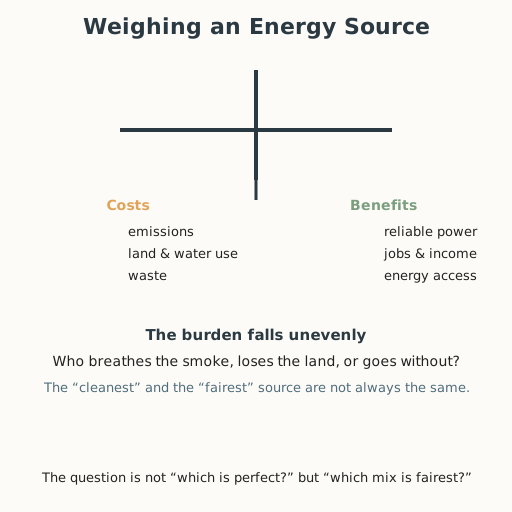
Coal lights a city but smokes its air. A dam gives clean power but floods a valley and displaces the people who lived there. A wind farm makes no smoke but changes a skyline and takes land. Every energy source gives something and takes something — the question is never “which is perfect?” but “which mix is fairest, for everyone, over time?” Weighing that honestly is what this lesson is for.
Materials
- Trade-off matrix
- Science journal
Preparation
- Copy or draw the trade-off matrix.
- Retrieval: from Lesson 11, how each source generates electricity. Today we weigh their costs and benefits.
- Prepare the matrix and the scoring rubric.
Facilitator note
This lesson is written to the learner (“you”). The idea to land: every energy source has environmental and social trade-offs — emissions, air and water quality, land, waste, cost, and who bears the burden; evaluating a source means weighing all of these, and the burden falls unevenly, which makes energy a justice question. Model scoring one source (S-011), then let learners score the rest and defend their rankings. Keep the tone honest but not despairing: the point is informed choice and agency.
The environment lens: burning fossil fuels is the main human driver of the added greenhouse gases changing the climate (S-438, S-005). The ethics lens: a choice that poisons someone else’s air or home is a moral choice, not just an efficiency one. The egalitarian lens: the costs of energy fall hardest on the poor — households breathing indoor smoke from cooking fires, communities downwind of plants, and the hundreds of millions still without electricity — while the benefits often flow to others; that mismatch is the heart of environmental justice (S-483). The global lens: no single source fits every place; a fair energy future is a mix chosen locally — sun where it shines, wind where it blows, rivers where they run — not one answer imposed everywhere. Preview: Lesson 13 turns from energy to the cosmos — the Big Bang model and its evidence.
Procedure
- Recall (5 min). From Lesson 11, name three renewable and three nonrenewable sources. What single machine do most share?
- Meet the trade-offs (15 min). On the matrix, each source is scored on:
- Emissions (greenhouse gases that warm the climate),
- Air and water (smoke, particulates, spills, acid drainage),
- Land use (mines, dams, farms, panels),
- Waste (ash, spent fuel, discarded panels),
- Cost (to build and to run),
- Who bears the burden (who breathes the smoke, loses the land, or goes without). Burning fossil fuels adds greenhouse gases (S-438, S-005); household air pollution from cooking fuels harms millions of people (S-219); renewables cut emissions but still need land and materials.
- Score one together (10 min). Score coal with the rubric: low cost, high emissions, heavy air and water burden, and a burden that falls on nearby communities. Note the trade-off plainly.
- Score the rest (15 min). With a partner, score solar, wind, hydro, and nuclear. For each, name one benefit and one burden, and say who bears the burden. Then write one paragraph: which mix seems fairest for your region, and why?
- Close (5 min). In one sentence: what makes an energy source’s trade-off a question of justice, not only of engineering?
Differentiation
- Support: Use a simple two-column “one good / one bad” note per source instead of the full matrix.
- Extension: Compare two sources on full life-cycle data (emissions per unit of energy, water use, cost) and defend a ranking.
Assessment
- Formative (peer + self): Can the learner name the environmental and social trade-offs of at least two sources, and explain why the burden falls unevenly?
- Portfolio artifact (unit): The completed trade-off matrix with the “fairest mix” paragraph, added to the physical-systems section.
Home connection
Ask someone at home what energy your household relies on and what they see as its one biggest benefit and one biggest cost. Weigh them together.
Resources
- On the greenhouse effect and human strengthening of it: NASA, “What Is the Greenhouse Effect?” https://science.nasa.gov/kids/earth/what-is-the-greenhouse-effect/ (S-438); and IPCC, https://www.ipcc.ch/ (S-005).
- On household air pollution and health: WHO, “Household air pollution fact sheet,” https://www.who.int/news-room/fact-sheets/detail/household-air-pollution-and-health (S-219).
- On renewable and nonrenewable sources: EIA Energy Kids, https://www.eia.gov/kids/energy-sources/renewable/ (S-095).