Lesson 15 — Origins as Stories: Model, Evidence, and Many Ways of Knowing
Learners close the unit by holding the scientific accounts of origins — the Big Bang model and the evidence for evolution — alongside the many cultural and spiritual stories people tell, distinguishing evidence from values and ranking none above the others. They synthesize the unit's learning into a portfolio and a considered position.
Objectives
Objectives
- D06.S4.10.01 Explain the Big Bang model and the evidence that supports it, and distinguish a model from revealed truth.
- D06.S4.10.02 Analyze human impacts on Earth systems and evaluate responses to environmental change with hope and agency.
Essential question
How do I hold the scientific account of origins alongside the many other stories people tell — without ranking one above another, and without giving up on evidence?
Key vocabulary
Materials
Standard materials
- Origins-stories sheet · 1 per learner A side-by-side frame: the scientific model (Big Bang, evolution) beside space for a cultural or spiritual account, with a column for 'what each offers'
- Unit portfolio · 1 per learner Gather the unit's artifacts (worksheets, reflections) for a closing synthesis
Low-tech / no-cost
- A shared circle and voices Each person names one origin story they know; no equipment needed
- Paper and drawing Draw the scientific account and a cultural account side by side
Enriched / lab & device
- A short anthology or reading of origin stories from several cultures · 1 per group Read and compare accounts across traditions
Works in different contexts
- large-group Hold a guided circle where learners share the stories they know, then pair to fill the side-by-side sheet
- multi-age Younger learners retell one story they know; older learners complete the side-by-side comparison and the synthesis reflection
- self-directed A learner fills the side-by-side sheet alone, then writes the synthesis: how scientific and other accounts can relate respectfully
- level-grouped Group by comfort with the distinction; a ready group writes a short essay holding several accounts in relation
- outdoor-only Gather outdoors and share origin stories under the open sky, then fill the sheet back inside
Lesson 15 — Origins as Stories: Model, Evidence, and Many Ways of Knowing
Summary
Learners close the unit by holding the scientific accounts of origins — the Big Bang model and the evidence for how life diversified — alongside the many cultural and spiritual stories people tell about beginnings. They practice distinguishing evidence from values, ranking no account above the others, and synthesizing the unit’s learning into a portfolio and a considered position.
Objectives
- Explain the Big Bang model and the evidence that supports it, and distinguish a model from revealed truth. (D06.S4.10.01)
- Analyze human impacts on Earth systems and evaluate responses to environmental change with hope and agency. (D06.S4.10.02)
Connection
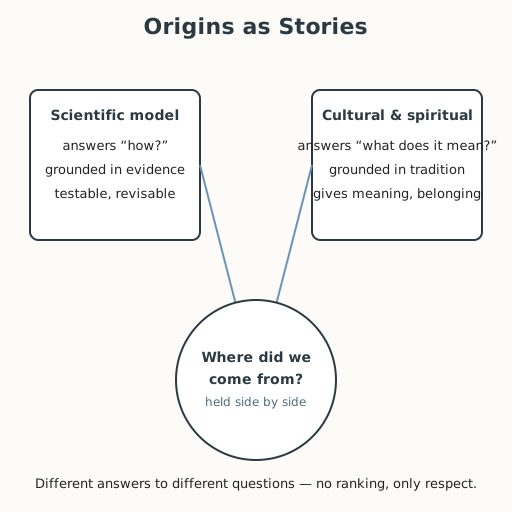
Almost every people on Earth has asked, “where did we come from?” — and almost every people has answered with a story. The scientific story (a universe expanding from a hot dense state; life diversifying over deep time) is one of these, distinguished by being built from publicly checkable evidence. A spiritual story answers a different kind of question — not “how?” but “what does it mean, and how should we live?” These are not rivals for the same seat; they are different kinds of answers to different questions. Holding them side by side, without ranking, is the mark of a mature mind.
Materials
- Origins-stories sheet
- Unit portfolio (the artifacts gathered across the unit)
Preparation
- Copy or draw the origins-stories sheet.
- Retrieval (spaced, across the whole unit): from Lesson 13, the Big Bang model and its evidence; from Lessons 4–5, inheritance and variation; from Lessons 7–8 and 14, human impacts and responses. Today we synthesize and hold accounts in relation.
- Prepare the side-by-side frame and the portfolio list.
Facilitator note
This lesson is written to the learner (“you”). This is the unit’s capstone, and its heart is philosophy §11: origins are held as stories grounded in evidence, among many others — never as dogma. The idea to land: the scientific account is a model grounded in evidence (testable and revisable), not a revealed truth; cultural and spiritual accounts answer meaning-and-value questions that evidence alone cannot; and a mature person holds them side by side, distinguishing evidence from values without ranking one above another. Model that holding, gently, and let learners articulate their own considered position — there is no single “correct” answer to require, only thoughtfulness to encourage.
The global lens: every culture has origin stories; the point of the lesson is plurality, not a contest. The ethics lens: treating another person’s sacred story with respect is itself an ethical act; so is not pretending evidence and belief are the same thing. The critical-thinking lens: the disciplined distinction — “this is evidence; this is a value” — is the unit’s capstone skill. The egalitarian lens: no tradition outranks another by birth or geography; knowledge belongs to everyone. Close by returning to the unit’s first question — how do we know, and why should we trust it — now answered with the whole toolkit.
Procedure
- Gather (5 min). In a circle or alone, name one story of beginnings you know — scientific, cultural, or spiritual. There are no wrong answers.
- Side by side (15 min). On the sheet, place the scientific model on one side and a cultural or spiritual account on the other. For each, note: what question does it answer (how? or what does it mean?), what evidence or authority grounds it, and what it offers a person. Notice they are not answering the same question.
- Evidence and values (15 min). With a partner, mark each statement you wrote as evidence (checkable, revisable) or value (about meaning, worth, or how to live). Discuss: why is it honest to keep these two separate, and why is it also fine to hold both at once?
- Synthesize (15 min). Gather your unit portfolio — the data-and-evidence toolkit, the living-systems and physical-systems sheets, and the Earth-and-origins reflections. Write a short closing statement: how do I now understand where everything came from, and why do I trust — and question — what I know? Hold the scientific account and the stories you grew up with side by side, and say how they relate for you.
- Close (5 min). Share one sentence of your synthesis, or keep it in your journal. The unit ends with wonder, not a verdict.
Differentiation
- Support: Use the two-column sheet and fill only “what question does it answer?” and “what does it offer?”
- Extension: Write a short essay articulating how scientific and other ways of knowing can relate respectfully, citing one piece of evidence and one value.
Assessment
- Formative (self + peer): Can the learner place two accounts side by side, distinguish evidence from value, and articulate a considered position without ranking?
- Portfolio artifact (unit): The completed origins-stories sheet and the closing synthesis statement, as the capstone of the unit portfolio.
Home connection
Ask someone at home to tell you their story of beginnings, and share yours. Wonder together how the scientific story and theirs can both be true in different ways.
Resources
- On the Big Bang model and its evidence: NASA, “The Big Bang,” https://science.nasa.gov/universe/the-big-bang/ (S-002).
- On the evidence for life’s diversification: Darwin, On the Origin of Species (1859) (S-303).
- On the Big Bang told for learners: NASA Space Place, “What Is the Big Bang?,” https://spaceplace.nasa.gov/big-bang/en/ (S-018).