Lesson 14 — Human Impacts on Earth Systems and Responses
Learners analyze how human activity changes Earth's coupled systems — atmosphere, ocean, land, and ice — through added greenhouse gases, land change, and pollution. They evaluate responses (mitigation and adaptation) and connect the science to hope and agency rather than despair.
Objectives
Objectives
- D06.S4.10.02 Analyze human impacts on Earth systems and evaluate responses to environmental change with hope and agency.
Essential question
How is human activity changing the Earth's connected systems, and what can we actually do about it — with hope and agency?
Key vocabulary
Materials
Standard materials
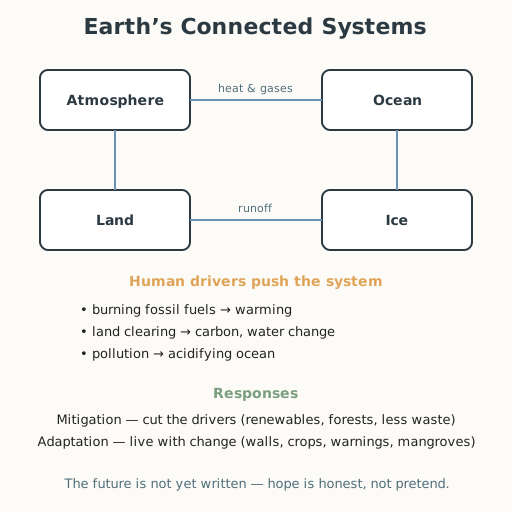
- Earth-systems impact sheet · 1 per learner A diagram of the coupled atmosphere-ocean-land-ice system with human drivers and a response column (mitigation and adaptation)
- Science journal · 1 per learner
Low-tech / no-cost
- A drawn Earth-system diagram Arrows connecting air, ocean, land, and ice, with human changes added in one color
- Voice and discussion Talk through the connections and responses aloud
Enriched / lab & device
- A climate data dashboard or graph · 1 per group Read a real temperature or carbon-dioxide record and connect it to the drivers
Works in different contexts
- large-group Build the coupled-systems diagram whole-class, then groups each take one response and teach it back
- multi-age Younger learners trace one connection (e.g., burning fuel warms the air); older learners analyze mitigation vs. adaptation and the justice question
- self-directed A learner completes the diagram, self-checks against the key, and writes the "what I can do" reflection with hope and agency
- level-grouped Group by comfort with systems; a ready group reads a real data record and connects it to a specific response
- outdoor-only Observe weather, water, plants, and soil outdoors and discuss which Earth systems you can see and how humans touch each
Lesson 14 — Human Impacts on Earth Systems and Responses
Summary
Learners analyze how human activity changes Earth’s coupled systems — atmosphere, ocean, land, and ice — through added greenhouse gases, land-use change, and pollution. They evaluate two broad families of response, mitigation (reducing the drivers) and adaptation (living with the changes), and connect the science to hope and agency rather than despair.
Objectives
- Analyze human impacts on Earth systems and evaluate responses to environmental change with hope and agency. (D06.S4.10.02)
Connection
The air you breathe, the water you drink, the soil your food grows in, and the ice at the poles are not separate things — they are one connected Earth system, and a change in one ripples through the rest. Burn coal and the air holds more heat-trapping gas, the ocean warms and turns more acidic, ice melts, and the weather shifts — all linked. This can sound overwhelming, which is exactly why the second half of the lesson matters: there are real responses, and the future is not yet written.
Materials
- Earth-systems impact sheet
- Science journal
Preparation
- Copy or draw the Earth-systems impact sheet.
- Retrieval: from Grade 9, the greenhouse effect and human climate influence (D06.S4.09.01); from Grade 7, how atmosphere, ocean, and land shape climate (D06.S4.07.01). Today we bring the systems together and turn to responses.
- Prepare the coupled-systems diagram.
Facilitator note
This lesson is written to the learner (“you”). The idea to land: Earth’s systems are coupled; human activity — burning fossil fuels, changing land, polluting — pushes them out of balance (warming air, acidifying and warming oceans, melting ice); and we can respond with mitigation (cut the drivers) and adaptation (cope with the changes), which is where hope and agency live. Keep the emotional frame honest and hopeful: name the seriousness, but always attach agency — there are real, working responses, and learners are part of them (development.md 9–12 band).
The environment lens: added greenhouse gases trap heat near the surface, changing the whole coupled system (S-438, S-005, S-309). The ethics lens: the people who contributed least to the problem are often hit hardest by it — a moral fact that demands fairness in every response. The egalitarian lens: responses must not ask the poor to bear the cost of a problem made by the wealthy; climate action is a justice project (S-124). The global lens: this is a planetary, shared problem with no single country’s answer — and solutions are emerging everywhere, from mangrove restoration to solar villages, not from one place alone. Preview: Lesson 15 closes the unit by holding the scientific accounts of origins and change alongside other ways of knowing.
Procedure
- Recall (5 min). From Grade 9, how do greenhouse gases warm the climate? Name one way the atmosphere, ocean, and land are connected.
- Meet the coupled system (15 min). On the sheet, trace the arrows:
- Atmosphere: burning fossil fuels adds heat-trapping gases → warming (S-438).
- Ocean: it absorbs heat and carbon dioxide → warming and acidification (S-309).
- Land: clearing and farming change how the land stores carbon and water.
- Ice: warming melts ice, raising sea levels and changing weather. Each arrow leads to another — one system, many doors.
- Meet the responses (15 min). Two families:
- Mitigation: reduce the drivers — renewable energy, protecting forests, using less. These slow the change at its source.
- Adaptation: live with the change — sea walls, drought-tolerant crops, early warning systems, restoring mangroves that buffer coasts. These protect people now.
- Evaluate (10 min). With a partner, list two mitigations and two adaptations suited to your region, and for each ask: who benefits, who pays, and is it fair?
- Independent practice (10 min). In your journal, write one concrete thing you — or your community — can do, and say whether it is mitigation or adaptation. End with one sentence of hope that is honest: what is still possible?
- Close (5 min). In one sentence each: name one human driver, one Earth-system effect, and one response — and why hope is not the same as pretending.
Differentiation
- Support: Trace a single chain (burning fuel → warming air → melting ice) before the full diagram.
- Extension: Read a real carbon-dioxide or temperature record and connect its shape to specific drivers and a specific response.
Assessment
- Formative (peer + self): Can the learner trace a human driver to an Earth-system effect, distinguish mitigation from adaptation, and name a fair, hopeful response?
- Portfolio artifact (unit): The completed Earth-systems sheet with the “what I can do” reflection, added to the Earth-and-origins section.
Home connection
Ask someone at home what changes they have noticed in weather, water, or seasons over their lifetime, and what people around you are already doing to respond.
Resources
- On the greenhouse effect and human strengthening of it: NASA, “What Is the Greenhouse Effect?” https://science.nasa.gov/kids/earth/what-is-the-greenhouse-effect/ (S-438).
- On the climate system and the greenhouse effect: IPCC, https://www.ipcc.ch/ (S-005); and NOAA Climate, https://www.climate.gov/ (S-309).
- On climate change and human health/justice: WHO, “Climate change and health topic,” https://www.who.int/health-topics/climate-change (S-124).