Lesson 01 — A Body of Work: Finding My Creative Voice
Learners begin the unit's visual portfolio by choosing a recurring idea or motif and making several variations of it, discovering that a personal style emerges across a body of work rather than from a single piece.
Objectives
Objectives
- D07.S1.10.01 Develop a personal style by making a body of work and explain how it reflects their ideas and influences.
Essential question
How does a personal style grow out of a body of work, and how do I begin my own?
Key vocabulary
Materials
Standard materials
- Sketchbook or bound paper journal · 1 per learner Blank pages for a running visual record; any bound paper works
- Drawing tools (pencil, pen, and one color medium) · 1 set per learner Whatever is at hand — graphite, ink, crayon, pastel, charcoal
- Portfolio folder or sleeve · 1 per learner To collect the unit's visual work; can be a folded sheet of stiff paper
Low-tech / no-cost
- Scrap or reused paper stapled into a booklet A handmade sketchbook from any clean paper
- One drawing tool (pencil, charred stick, or pen) A single mark-making tool is enough to begin
Enriched / lab & device
- Tablet or camera phone for a digital sketchbook (optional) · 1 per learner Digital layers let learners save every version of a motif and compare them
- Shared device to view a curated set of one artist's series (optional) · 1 per group To see a real body of work side by side
Works in different contexts
- large-group Whole-class modeling of one motif in three variations, then independent sketchbook time with a brief gallery walk at the end
- multi-age Younger learners vary one simple shape; older learners add a written note on what changes and why
- self-directed A learner works alone, setting a recurring idea and making three variations, then writes a sentence naming what stayed and what changed
- level-grouped Learners ready to extend compare two real artists' bodies of work and name the through-line of each
- outdoor-only Use found objects (leaves, stones, twigs) as the recurring motif, drawn or arranged on the ground and recorded in words
Lesson 1 — A Body of Work: Finding My Creative Voice
Summary
Learners start the unit’s visual portfolio by choosing one recurring idea or motif and drawing it several ways, discovering that a personal style grows out of a body of work — many versions of a recurring concern — rather than from any single piece. This lesson opens the whole unit: every strand that follows (music, movement, design) builds the same habit of making many things around one idea.
Objectives
- Develop a personal style by making a body of work, and begin explaining how the work reflects ideas and influences. (D07.S1.10.01)
Connection
A cook does not invent a dish once and call it their style; their style is the dozen meals they return to, each a little different, shaped by who taught them and what they love. A runner’s stride, a gardener’s rows, a storyteller’s favorite phrases — all are recognizable because they repeat and vary. Your creative voice works the same way: it is not hidden inside one perfect drawing waiting to be found; it shows up across the many things you make, again and again. Today you start the record of yours.
Materials
- Sketchbook or bound paper journal
- Drawing tools (pencil, pen, one color)
- Portfolio folder or sleeve
Preparation
- Retrieval: from Grade 9, recall making a digital or mixed-media artwork and reflecting on the choices technology made possible. Today we add the next step — making a series, not a single piece.
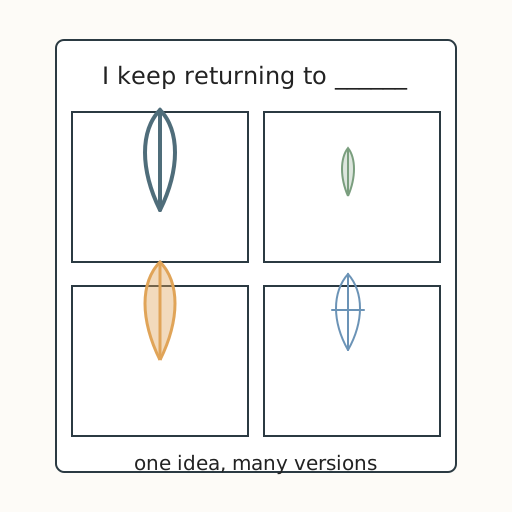
- Prepare one worked example: a single simple motif (a leaf, a hand, a house, a wave) drawn three ways, so learners see “same idea, different decisions.”
Facilitator note
This lesson is written to the learner (“you”). The idea to land: a personal style is not a flash of genius; it is a pattern that appears when you make many works around a recurring idea or concern, and it reflects your influences and choices. Style is observable — in the motifs you return to, the marks you make, the questions you keep asking — so learners can notice their own style forming rather than waiting to be “talented” enough to have one. This is the unit’s through-line: every strand asks learners to make a body of work, not a one-off.
The ethics lens appears as the honesty of the artist’s record — keeping every version, not hiding the “failed” ones, because the arc is the point. The egalitarian lens: there is no gate to having a voice; style belongs to everyone, not to those with expensive materials (hence the low-tech path). The global lens: across cultures, artists have always worked in series — repeated motifs in Akan adinkra and kente cloth (S-084), Māori kōwhaiwhai rafter patterns (S-115), and Jacob Lawrence’s 60-panel Migration Series (S-363) all show how a body of work carries a vision. The technology lens: digital tools let learners keep every variation and watch their style emerge side by side — but paper does too. The environment lens: a sketchbook made of reused paper is itself a small act of care; art materials carry a footprint worth noticing. Preview: Lesson 2 turns to the ethics of engaging with other people’s visual traditions.
Procedure
- Recall (5 min). Think back: what did you make in Grade 9, and what did you notice about your own choices? Today you stop making one-off pieces and start a body of work.
- Meet the idea (10 min). A body of work is many pieces around a recurring idea. Watch a worked example: one leaf drawn three ways — large and rough, small and careful, colored and not. The leaf is the motif; the differences are variation. Notice what stays and what changes.
- Choose your motif (5 min). Pick one thing you are drawn to — a shape, an object, a place, a person, a feeling, a question. Write it at the top of a sketchbook page: “I keep returning to ______.”
- Make variations (20 min). Draw your motif at least three times, each version making a different decision — bigger or smaller, light or dark, one color or many, close-up or far away, calm or restless. Keep every version; none are mistakes.
- Notice your style (10 min). Look at your three versions. Write one sentence naming what stayed the same across them and one sentence naming what changed. That recurring sameness is the first glimpse of your style.
- Close (5 min). Add the page to your portfolio. Remember: one drawing is an attempt; many drawings around one idea are a voice. You will return to this motif all unit long.
Differentiation
- Support: Provide the motif already chosen (a hand, a house) and ask only for two variations of size or darkness.
- Extension: Look up Jacob Lawrence’s Migration Series (S-363) or an artist you admire, and name the recurring motif that runs through their body of work.
- Non-visual path (blind or low vision): Make the motif and its variations from found objects — stones, leaves, string, cloth, seed pods — arranged by touch so the “same idea, different decisions” pattern is felt, then describe each version in one spoken sentence. A partner can record the descriptions in words; the body of work is the spoken-and-arranged record, not the drawing.
- Motor path: Build the motif by placing and moving objects (no fine drawing required), or direct a partner who draws while you name each change.
- Neurodivergent support: Offer the motif choice as a short visual or spoken menu rather than an open prompt, keep the routine predictable (recall → example → choose → make → notice → close), and let learners work with a repeated, calming mark or movement if novelty is overloading.
Assessment
- Formative (self): Can the learner make three variations of one motif and name, in a sentence, one thing that stayed the same and one that changed?
- Portfolio artifact (unit): The first sketchbook page (motif + three variations
- a reflection sentence), added as the opening entry of the visual body of work.
Home connection
Ask a grown-up at home what they make, cook, or grow again and again, and what makes their way of doing it recognizable. Tell them the motif you chose and why.
Resources
- On a body of work carrying a vision: The Phillips Collection, Jacob Lawrence, The Migration Series (1940–41), https://www.phillipscollection.org/collection/migration-series (S-363).
- On repeated motifs as living visual language: Smithsonian National Museum of African Art, kente cloth, https://africa.si.edu/ (S-084); Te Papa Tongarewa, Māori arts, https://www.tepapa.govt.nz/ (S-115).
- On the elements of art used deliberately in a series: J. Paul Getty Museum, “Understanding Formal Analysis,” https://www.getty.edu/education/teachers/building_lessons/formal_analysis.html (S-365).
- On worked examples and guided practice before independent work: Kirschner, Sweller & Clark (2006), https://doi.org/10.1207/s15326985ep4102_1 (S-011).