Lesson 02 — Appreciation, Not Appropriation: Honoring Living Visual Traditions
Learners sort scenarios to distinguish cultural appreciation from appropriation in visual art, learning that honoring a living tradition means asking, learning context, crediting makers, and sharing benefit — never taking a people's sacred or meaningful forms as decoration or profit.
Objectives
Objectives
- D07.S1.10.02 Distinguish cultural appreciation from appropriation in art, citing examples, and explain how to honor living traditions respectfully.
Essential question
How do I tell cultural appreciation from appropriation in visual art, and how do I honor living traditions respectfully?
Key vocabulary
Materials
Standard materials
- Appreciation-or-appropriation card set · 1 set per pair Four short scenarios, each describing a person using another culture's visual art, for learners to sort and discuss
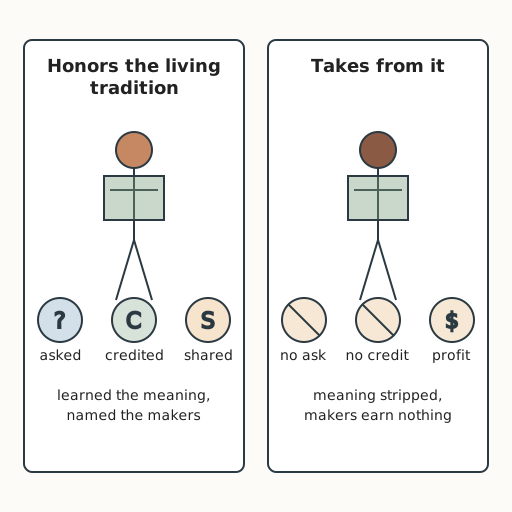
- Two-column reflection sheet · 1 per learner Headings "Honors the living tradition" and "Takes from it" with room to write reasons
- Portfolio folder · 1 per learner
Low-tech / no-cost
- Four scenarios told aloud by the facilitator The same four situations described by voice, with no printed cards
- Any paper for the two-column reflection Drawn by hand
Enriched / lab & device
- Shared device to view images of kente/adinkra, Māori carving, and Day of the Dead ofrendas (optional) · 1 per group To see the real traditions being discussed, with their meanings named
- A recorded interview with a living artist about their tradition (optional) · 1 per group To hear appreciation from the community's own voice
Works in different contexts
- large-group Sort two scenarios whole-class with think-pair-share, then pairs sort the remaining two and report one reason each
- multi-age Younger learners identify "asked permission or not" and "credited or not"; older learners add the power-and-benefit question
- self-directed A learner sorts all four scenarios alone, writing a reason for each, then checks against a short answer guide
- level-grouped Learners ready to extend research one real example of a tradition copied without credit and propose a fairer path
- outdoor-only Discuss the four scenarios in a circle using only voice; record reasons on the ground or in a shared spoken summary
Lesson 2 — Appreciation, Not Appropriation: Honoring Living Visual Traditions
Summary
Learners sort four scenarios to tell cultural appreciation from appropriation in visual art. They learn that honoring a living tradition means asking, learning the context, crediting the makers, and sharing benefit — while appropriation takes a people’s meaningful or sacred forms as decoration, costume, or profit, with no permission, credit, or return. The arts of other cultures are met as living traditions to honor with respectful questions, never as specimens.
Objectives
- Distinguish cultural appreciation from appropriation in art, citing examples, and explain how to honor living traditions respectfully. (D07.S1.10.02)
Connection
Imagine someone copied the family recipe your grandmother taught only you, sold it as their own, and never mentioned her. You would not object to their liking the food; you would object to their taking the thing that carried your family’s story, stripping it of where it came from, and profiting alone. That feeling is the seed of the whole distinction today. Loving another culture’s art is not the problem — how you take it, credit it, and share it is.
Materials
- Appreciation-or-appropriation card set
- Two-column reflection sheet
- Portfolio folder
Preparation
- Retrieval: from Lesson 1, recall your motif and what you noticed about your own style. Today we look outward — at how to engage with other people’s visual traditions.
- Prepare the four scenarios (see Facilitator note) and the two-column sheet.
Facilitator note
This lesson is written to the learner (“you”). The idea to land: appreciation and appropriation differ in permission, context, credit, and benefit — not in whether you admire something. Appreciation means learning from the living people who make the art — asking when something is owned or sacred, understanding what it means, naming the makers, and sharing benefit (paying, supporting, or amplifying them). Appropriation takes without those things: copying a form while stripping its meaning, wearing sacred or ceremonial designs as fashion, or profiting while the community who created it earns nothing. Because the difference is about power and consent, it is not a neat two-column rule but a set of respectful questions.
Keep this concrete and specific, never a cartoon of any culture. Ground examples in real, living traditions and their documented meanings: Akan kente and adinkra cloth of Ghana and Côte d’Ivoire, whose named patterns and colors encode proverbs and values and are worn at important occasions (S-084); Māori kōwhaiwhai painted rafter patterns, whakairo carving, and the koru (unfurling fern) spiral, tied to whakapapa — belonging through ancestry (S-115); and Mexico’s Day of the Dead, an Indigenous festivity that commemorates the return of deceased loved ones and fuses pre-Hispanic rites with Catholic feasts — not a costume theme (S-448). The UNESCO Universal Declaration on Cultural Diversity (S-389) and the living-heritage frame (S-056) support treating arts as practices communities own and pass on, not free material.
The ethics lens is the spine: what is right when we borrow? The egalitarian lens: appropriation usually flows uphill — from the less powerful to the more powerful — so credit and shared benefit matter. The global lens: traditions are people’s, not “the world’s”; they live in communities who still make them. The technology lens: copying and remixing are one click away now, which makes permission and credit more, not less, important. The environment lens: a tradition often carries knowledge of materials and place (plant dyes, local fibers) that mass copying erases. Preview: Lesson 3 asks learners to write the artist’s explanation that names influences honestly — the skill they are building here.
Four scenarios to use (adapt to your place; keep them specific and respectful):
- A designer visits a weaving community, learns the patterns’ meanings from the weavers, pays them, and credits them on the label. 2. A brand prints a sacred ceremonial design on T-shirts without asking and sells them without credit or payment. 3. A student paints a motif inspired by another culture, names the culture and the artist they learned from, and says “I am a beginner borrowing with permission.” 4. A shop sells “tribal-style” stickers made by no one from that culture, flattening many distinct peoples into one stereotype.
Procedure
- Recall (5 min). From Lesson 1: your motif is yours. Now ask — what is not mine, and how do I honor it?
- Meet the distinction (10 min). Watch a worked example: a designer who visits a weaving community, learns the meanings, pays, and credits them — versus a brand that prints the same pattern on T-shirts with no permission or payment. One honors; one takes. Notice the four questions: did they ask? did they learn the context? did they credit? did they share benefit?
- Sort the scenarios (15 min). With a partner, read the four cards. Place each under “Honors the living tradition” or “Takes from it,” and write one reason using the four questions.
- Name the pattern (10 min). What do the “takes from it” cases have in common? (No permission, no context, no credit, no shared benefit — often taking sacred or ceremonial forms as decoration or profit.) What do the “honors” cases share?
- Write your rule (10 min). On your reflection sheet, write your own two-sentence rule for engaging with another culture’s visual art respectfully. Start: “I will honor a living tradition by ______.”
- Close (5 min). Add the sheet to your portfolio. Remember: admiration is not the problem; how you take, credit, and share is. Next time, you write the artist’s explanation for your own body of work.
Differentiation
- Support: Give the four questions as a checklist to run on each scenario, and ask only “asked permission — yes or no?”
- Extension: Research one real instance of a tradition copied without credit and write a short proposal for a fairer path (permission, credit, shared profit).
- Non-visual / low-literacy path: Read each scenario aloud (or play it from the facilitator’s voice) and have learners answer aloud — “honors” or “takes,” plus one reason spoken — instead of reading and writing. The reflection can be recorded in voice or transcribed by a partner rather than written.
- Language: Learners may write or speak their two-sentence rule in their home language first; a translation to a shared classroom language can follow. The four questions (ask, context, credit, benefit) translate readily and can be posted in multiple languages.
Assessment
- Formative (self): Can the learner sort each scenario correctly and give one reason (permission, context, credit, or benefit) for at least two of them?
- Portfolio artifact (unit): The two-column reflection sheet with the learner’s own two-sentence rule, added to the portfolio.
Home connection
With someone at home, name one thing your family or community makes that carries meaning. Ask: what would need to happen for an outsider to use it respectfully?
Resources
- On living traditions and their documented meanings: Smithsonian National Museum of African Art, kente cloth, https://africa.si.edu/ (S-084); Te Papa Tongarewa, Māori arts, https://www.tepapa.govt.nz/ (S-115); UNESCO, “Indigenous Festivity Dedicated to the Dead,” https://ich.unesco.org/en/RL/indigenous-festivity-dedicated-to-the-dead-00054 (S-448).
- On arts as living heritage passed between generations: UNESCO, Intangible Cultural Heritage, https://ich.unesco.org/ (S-056).
- On cultural diversity as a value to protect, not a resource to mine: UNESCO, Universal Declaration on Cultural Diversity, https://www.unesco.org/en/legal-affairs/unesco-universal-declaration-cultural-diversity (S-389).
- On worked examples before independent work: Kirschner, Sweller & Clark (2006), https://doi.org/10.1207/s15326985ep4102_1 (S-011).