Lesson 12 — Responsible or Harmful? Judging Design — and My Portfolio
Learners judge designs against four questions — who it helps, who it harms, what it costs the Earth, and whether it could be done better — distinguishing responsible from harmful design, then review their full creative portfolio and write a closing reflection that closes the unit.
Objectives
Objectives
- D07.S4.10.02 Distinguish responsible and sustainable design from design that harms people or the environment, citing examples.
Essential question
How do I tell responsible, sustainable design from design that harms people or the environment — and how do I close out my whole creative portfolio?
Key vocabulary
Materials
Standard materials
- Design-judgment sheet · 1 per learner Four questions — who does it help, who does it harm, what does it cost the Earth, and could it be done better — with room for evidence
- The learner's full unit portfolio · 1 per learner Visual, music, movement, and design artifacts from Lessons 1–12
Low-tech / no-cost
- Any paper for the judgment sheet and reflection Drawn and written by hand
- The learner's own artifacts Already made across the unit
Enriched / lab & device
- Shared device to view one well-documented real design comparison (optional) · 1 per group To ground the responsible-vs-harmful judgment in evidence
- A digital way to assemble and present the portfolio (optional) · 1 per learner To curate the unit's work for a final showing
Works in different contexts
- large-group Judge one example whole-class with evidence, then learners judge their own and a peer's design, then a final gallery walk of portfolios
- multi-age Younger learners answer "who does it help and harm" for one object; older learners run all four questions with evidence and lead the portfolio showing
- self-directed A learner judges two real designs (one responsible, one harmful) with evidence, then reviews their own portfolio and writes a closing reflection
- level-grouped Learners ready to extend evaluate the full life cycle of a designed object and propose concrete improvements
- outdoor-only Judge a real object in the immediate environment against the four questions, then gather in a circle for the portfolio sharing
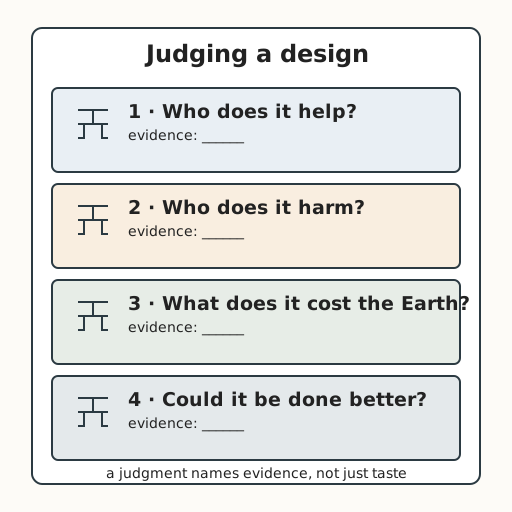
Lesson 12 — Responsible or Harmful? Judging Design — and My Portfolio
Summary
Learners judge designs against four questions — who it helps, who it harms, what it costs the Earth, and whether it could be done better — distinguishing responsible from harmful design, then review their full creative portfolio and write a closing reflection. This closes the making-and-design strand and the whole unit.
Objectives
- Distinguish responsible and sustainable design from design that harms people or the environment, citing examples. (D07.S4.10.02)
Connection
A thing can look beautiful and work perfectly for you and still be a bad design if it poisons a river downstream or is made by someone who is not paid. Judging design is not a matter of taste — it is a matter of consequences, which you can look up, measure, and name. Today you become the judge, then step back and look at everything you made this unit.
Materials
- Design-judgment sheet
- Your full unit portfolio
Preparation
- Retrieval: from Lesson 11, recall the life cycle and your sustainability-and-fairness rationale. Today you turn that into a general judgment — and then review the whole unit.
- Prepare one worked example of judging a design with evidence (e.g., a single-use item versus a repairable one).
Facilitator note
This lesson is written to the learner (“you”). The idea to land: responsible design is judged by consequences, not appearance — four questions: who does it help, who does it harm, what does it cost the Earth, and could it be done better. The same evidence base from Lesson 11 applies: e-waste toxicity (S-397), cobalt supply-chain abuses (S-398), the circular-economy alternative (S-452), universal design (S-369), and the Brundtland definition of sustainability (S-395). A judgment that names evidence is the difference between an opinion and a defended conclusion — the unit’s capstone in critical thinking.
Then the lesson turns inward: the portfolio is the unit’s real product, and the closing reflection lets each learner see their own arc across all four strands — a body of visual work and an artist’s explanation, a composed-and-recorded piece, a devised-and-performed piece, and a documented design — each one carrying the appreciation-not-appropriation and responsible-not-harmful distinctions they practiced.
The ethics lens: judging design is an ethical act — naming harm is the first step to preventing it. The egalitarian lens: always ask who is helped and who is left out; that question is the fairness test. The global lens: consequences cross borders — the harm and the benefit are distributed unevenly across the world. The technology lens: technology can serve or harm, and the designer (and the judge) decides which. The environment lens is the spine: the Earth’s cost is real and measurable, and it is always on the sheet. The community lens: the portfolio sharing is a community act — each learner’s work seen and honored by peers who want them to succeed. This is a summative close, kept low-stakes and celebratory (mastery, not ranking).
Procedure
- Recall (5 min). You have designed for a need and asked what it costs. Today you judge design in general — and then look back at everything you made.
- Meet the four questions (10 min). Watch a worked example: a single-use item judged against a repairable one. The four questions: who does it help? who does it harm? what does it cost the Earth? could it be done better? Notice that every judgment names evidence.
- Judge two designs (15 min). On your sheet, judge your own design from Lessons 10–11 and one other real design you have seen — an object, a building, a product. Answer all four questions with at least one concrete fact or observation each.
- Write the verdict (5 min). For each, write one sentence: responsible, harmful, or in between — and the single strongest piece of evidence.
- Review your portfolio (15 min). Lay out your full portfolio: visual body of work and statement, composed-and-recorded piece, devised-and-performed piece, and documented design. Notice the one idea or concern that runs through all four.
- Write the closing reflection (5 min). Finish this sentence and keep it in your portfolio: “Across this unit, I kept returning to ______, and I learned to honor other people’s work by ______.”
Differentiation
- Support: Answer only “who does it help” and “who does it harm” for one design, and write a one-sentence portfolio reflection.
- Extension: Evaluate the full life cycle of a designed object and propose three concrete improvements, with evidence for each.
- Non-writing / non-visual path: The judgment and the closing reflection can be spoken and recorded in voice or transcribed by a partner; the four questions are the same whether answered aloud or in writing, and the portfolio can be described and presented orally.
- Language: The closing reflection may be written or spoken in the learner’s home language first, then translated to a shared language for the portfolio sharing; naming one’s own through-line and rule for honoring others is the point, in whichever language carries it most truly.
Assessment
- Summative (portfolio + self): The learner judges at least one design against all four questions with a concrete fact or observation for each, states a responsible/harmful verdict with evidence, and writes a closing reflection naming their through-line and their rule for honoring others’ work.
- Self-assessment: The learner reviews the mastery checklist for all eight unit objectives, marking each “on my own” or “can teach someone else,” and notes anything still “not yet.”
Home connection
Show someone at home your full portfolio — the art, the music, the movement, the design — and tell them the one idea that runs through all of it.
Resources
- On judging design by consequence and sustainability: World Commission on Environment and Development, Our Common Future (Brundtland Report, 1987), https://www.are.admin.ch/are/en/home/media/publications/sustainable-development/brundtland-report.html (S-395); Ellen MacArthur Foundation, “The Circular Economy,” https://ellenmacarthurfoundation.org/ (S-452).
- On harm in the life cycle: WHO, “Electronic waste (e-waste) fact sheet,” https://www.who.int/news-room/fact-sheets/detail/electronic-waste-%28e-waste%29 (S-397); Amnesty International (2016), “This Is What We Die For,” https://www.amnesty.org/en/latest/news/2016/01/child-labour-behind-smart-phone-and-electric-car-batteries/ (S-398).
- On universal design and fairness: The Center for Universal Design, “The Principles of Universal Design,” https://design.ncsu.edu/research/center-for-universal-design/ (S-369).
- On worked examples before independent work: Kirschner, Sweller & Clark (2006), https://doi.org/10.1207/s15326985ep4102_1 (S-011).