Lesson 11 — Sustainability and Fairness: Designing with the Whole System
Learners run their design through a life-cycle analysis — materials, making, use, and end-of-life — asking who is affected and what each stage costs the Earth, then revise one choice for sustainability or fairness and document the decision.
Objectives
Objectives
- D07.S4.10.01 Design and make something that serves a community need with attention to sustainability and fairness, and document the decisions.
Essential question
How do I design with attention to sustainability and fairness — the whole life of a thing and everyone it touches?
Key vocabulary
Materials
Standard materials
- Life-cycle sheet · 1 per learner A diagram with stages — materials, making, use, end-of-life — each with a line for "who is affected" and "what it costs the Earth"
- The learner's design log and prototype from Lesson 10 · 1 per learner
- Making materials to revise the prototype · shared
Low-tech / no-cost
- Any paper for the life-cycle sheet Drawn by hand
- The learner's existing prototype Already made
Enriched / lab & device
- Shared device to trace one material's origin (optional) · 1 per group To see where a common material comes from and who mines or makes it
- A short article on the circular economy (optional) · 1 per group To ground the repair-reuse-return idea
Works in different contexts
- large-group Work one example life cycle whole-class, then learners run their own and share one fairness or sustainability finding
- multi-age Younger learners name what the thing is made of and where it goes when broken; older learners trace the supply chain and who is affected
- self-directed A learner runs the life-cycle sheet on their own design, revises one choice, and writes the reason
- level-grouped Learners ready to extend compare two materials for the same job and argue which is fairer and more sustainable
- outdoor-only Use a natural object as the example, trace its life in place, and apply the same four questions to the learner's prototype
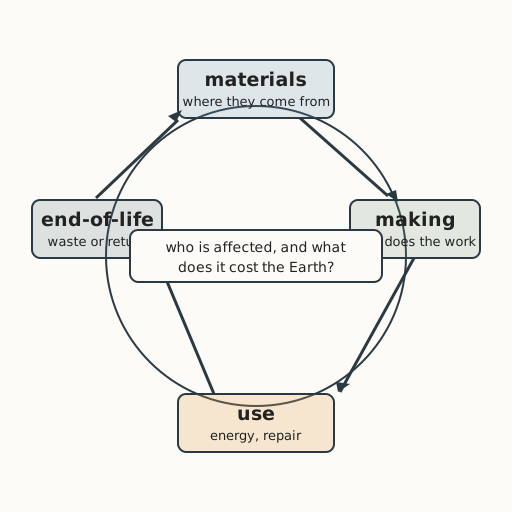
Lesson 11 — Sustainability and Fairness: Designing with the Whole System
Summary
Learners run their design through a life-cycle analysis — materials, making, use, and end-of-life — asking who is affected and what each stage costs the Earth, then revise one choice for sustainability or fairness and document the decision. This completes the making-and-design objective begun in Lesson 10.
Objectives
- Design and make something that serves a community need with attention to sustainability and fairness, and document the decisions. (D07.S4.10.01)
Connection
A thing you buy has a whole life you never see: the mineral dug from the ground, the hands that made it, the ship that carried it, the landfill it becomes. A responsible design asks about all of it — not just “does it work for me?” but “who was affected, and what did it cost the Earth, at every step?” Today you ask those questions about your own design.
Materials
- Life-cycle sheet
- Your design log and prototype from Lesson 10
- Making materials to revise the prototype
Preparation
- Retrieval: from Lesson 10, recall your need, your idea, and your documented decision. Today you test that idea against the whole system.
- Prepare one worked example: a simple object (e.g., a phone or a plastic container) traced through materials, making, use, and end-of-life, naming who is affected at each stage.
Facilitator note
This lesson is written to the learner (“you”). The idea to land: sustainability and fairness are the same question asked twice — what does it cost the Earth, and who bears that cost? The life cycle (materials → making → use → end-of-life) is the concrete frame. Sustainability means the thing can keep going without exhausting the systems it depends on — the Brundtland definition of meeting present needs without compromising future generations (S-395). Fairness means the burdens and benefits are shared justly — not, for example, the profit going to the rich while the mining poison goes to the poor.
Ground the facts: discarded electronics are hazardous when dumped or informally recycled, releasing toxic substances and involving child labor (S-397); cobalt for batteries has been mined with documented human-rights abuses and child labor in the Democratic Republic of the Congo (S-398); the circular economy designs out waste so materials never become waste and nature is regenerated (S-452); universal design asks that a thing work for the widest range of people, not the “average” user (S-369). An Indigenous teaching voices the same care: take only what you need and give back (S-427). Accessibility is a fairness issue too — the UN Convention on the Rights of Persons with Disabilities affirms the right to take part in cultural life and to have places and things be usable (S-100).
The environment lens is the spine: the life cycle makes the Earth’s cost visible at every stage. The ethics lens: a designer is responsible for consequences beyond the point of sale. The egalitarian lens: ask who is affected and who benefits — burdens fall unevenly, and good design flattens that, not widens it. The global lens: supply chains are worldwide, so fairness is a global question — the minerals, the labor, the waste all cross borders. The technology lens: technology can amplify either harm (faster extraction, more waste) or repair (repairable design, shared tools) — the designer chooses. The community lens: the best designs are made with the people they affect. Preview: Lesson 12 turns to judging design — responsible versus harmful — and gathers the whole unit’s portfolio.
Procedure
- Recall (5 min). You have a design for a real need. Today you ask what it costs the Earth — and who pays that cost.
- Meet the life cycle (10 min). Watch a worked example: a phone traced through four stages — materials (minerals mined, sometimes by children, S-398), making (factories, shipping), use (energy, repair), end-of-life (toxic e-waste, S-397). At each stage: who is affected, and what does it cost the Earth?
- Run your own (15 min). Put your prototype through the same four stages on your life-cycle sheet. For each stage write one effect on people and one on the Earth. What is your thing made of, and where will it go when it breaks?
- Revise one choice (10 min). Change one thing to be fairer or more sustainable — a material that is reused or renewable, a design that is repairable or usable by more people, an end-of-life that returns to the loop rather than the dump (S-452). Update your prototype.
- Document it (10 min). In your design log, write the change, the reason, and what it improves for people or the Earth. This is your sustainability-and-fairness rationale.
- Close (5 min). Keep the log and revised prototype in your portfolio. Next: judging design — and your whole portfolio.
Differentiation
- Support: Answer only two stages (materials and end-of-life) and make one small revision with a one-sentence reason.
- Extension: Compare two materials for the same job and argue in writing which is fairer and more sustainable, citing the life-cycle effects of each.
- Non-writing / non-visual path: The life-cycle sheet can be completed aloud and transcribed by a partner or recorded in voice; the “revise one choice” step can be a spoken decision with the prototype updated by a partner under the designer’s direction.
- Language: The life-cycle reasoning may be given in the learner’s home language, with the four stages (materials, making, use, end-of-life) posted in multiple languages; the sustainability-and-fairness rationale translates cleanly.
Assessment
- Summative (portfolio): The learner presents a life-cycle sheet naming one effect on people and one on the Earth for at least three stages, and a documented revision with a sustainability-or-fairness reason.
- Self-assessment: The learner self-places on the mastery checklist for D07.S4.10.01 and notes the next improvement.
Home connection
Pick one object at home and trace where it came from and where it will go when it breaks. Tell someone one thing that surprised you.
Resources
- On sustainability defined: World Commission on Environment and Development, Our Common Future (Brundtland Report, 1987), https://www.are.admin.ch/are/en/home/media/publications/sustainable-development/brundtland-report.html (S-395).
- On the circular economy: Ellen MacArthur Foundation, “The Circular Economy,” https://ellenmacarthurfoundation.org/ (S-452).
- On e-waste and its harms: WHO, “Electronic waste (e-waste) fact sheet,” https://www.who.int/news-room/fact-sheets/detail/electronic-waste-%28e-waste%29 (S-397).
- On fairness in supply chains: Amnesty International (2016), “This Is What We Die For,” https://www.amnesty.org/en/latest/news/2016/01/child-labour-behind-smart-phone-and-electric-car-batteries/ (S-398).
- On universal design and accessibility: The Center for Universal Design, “The Principles of Universal Design,” https://design.ncsu.edu/research/center-for-universal-design/ (S-369); UN CRPD, Article 30, https://www.un.org/development/desa/disabilities/convention-on-the-rights-of-persons-with-disabilities.html (S-100).
- On care and reciprocity with the living world: Robin Wall Kimmerer, Braiding Sweetgrass (S-427).
- On worked examples before independent work: Kirschner, Sweller & Clark (2006), https://doi.org/10.1207/s15326985ep4102_1 (S-011).