Lesson 01 — Many Ways to Count the Years
Learners compare how different societies measured and recorded time — solar, lunar, lunisolar, and seasonal calendars — and begin to weigh how each system shaped its people's sense of the past.
Objectives
Objectives
- D08.S1.10.01 Compare how different societies measured and recorded time and weigh how those systems shaped their sense of the past.
Essential question
How have different societies measured and recorded time, and how did each system shape the way its people saw the past?
Key vocabulary
Materials
Standard materials
- Calendar comparison chart · 1 per learner One page with five calendar systems side by side (Gregorian, Hijri, Chinese, Maya, and a seasonal calendar) and what each is anchored to
- History journal · 1 per learner
Low-tech / no-cost
- Hand-drawn sky chart Draw the Sun, Moon, and stars yourself; no printed chart needed
- Voice and body Count a lunar month by the Moon's phases aloud and act out the seasons with movement
Enriched / lab & device
- Device or atlas · 1 per pair A calendar or moon-phase app to see a current Hijri and Chinese date alongside the Gregorian one
Works in different contexts
- large-group Project or hold the comparison chart large enough for all to see; have five small groups each "own" one calendar and teach it back in two sentences
- multi-age Younger learners match each calendar to what it watches (Sun, Moon, both, seasons); older learners weigh how each shapes a sense of the past
- self-directed A learner completes the chart, then writes one paragraph comparing two calendars of their choice and how each shapes a sense of the past
- level-grouped Group by readiness to compare, not age; a ready group moves early to the "weigh how it shapes the past" question
- outdoor-only Use the actual sky — Sun's path, Moon's phases, seasonal plants — as the "chart" and mark the current season together
Lesson 1 — Many Ways to Count the Years
Summary
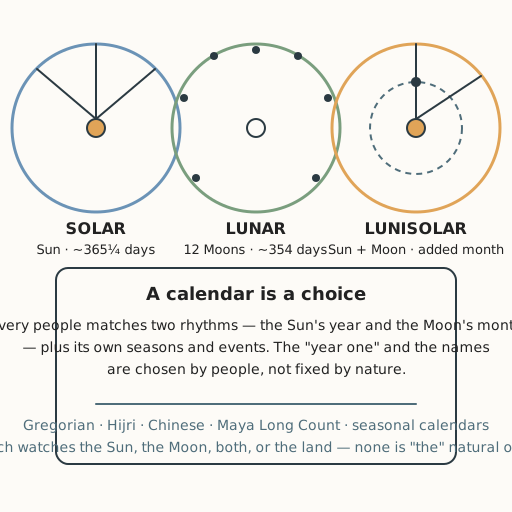
Learners compare how different societies have measured and recorded time — the solar, lunar, lunisolar, and seasonal systems used around the world — and begin to weigh how each system shaped the way its people saw the past. This opens the unit’s first question: time is counted many ways, and no single calendar is the “natural” one.
Objectives
- Compare how different societies measured and recorded time, and weigh how those systems shaped their sense of the past. (D08.S1.10.01)
Connection
Think about the calendar you check every day. It says “January” and “2026” and tells you when school starts and when a festival falls. But those names and numbers are one people’s way of counting — chosen, not given by nature. A person living by the Moon, by the monsoon, or by the ripening of a crop counts the year differently and remembers a different past. Counting time is a choice about what matters, made everywhere, in many ways.
Materials
- Calendar comparison chart (Gregorian, Hijri, Chinese, Maya, and a seasonal calendar)
- History journal
Preparation
- Copy or draw the calendar comparison chart.
- Retrieval: from Grade 7, recall that a year is the time for Earth to travel once around the Sun (about 365¼ days) and a month began as the Moon’s cycle (about 29½ days), and that these do not divide evenly into each other (S-315).
Facilitator note
This lesson is written to the learner (“you”). The idea to land: a calendar is a chosen way of matching two rhythms — the Sun’s year and the Moon’s month — plus a people’s seasons and events, and every society solved the mismatch differently (S-315). Teach the difference between solar (Sun), lunar (Moon), and lunisolar (both, with an added month) with the worked chart before independent comparison; novices learn this kind of conceptual structure best through explicit modeling and guided practice (S-011).
The global lens is the spine: the Gregorian (solar, year 1 tied to a religious reckoning), the Islamic Hijri (lunar, year 1 = the 622 CE Hijra), the Chinese (lunisolar, adding a month so festivals stay in season), and the Maya Long Count (counting days from a fixed creation epoch, with a 365-day Haab’ and a 260-day Tzolk’in running together) are each held as valid, none above another (S-315, S-378, S-204). The ethics lens: asking whose calendar became the world’s default and whose was sidelined is a question of power, not of accuracy. The critical-thinking lens: a calendar’s “year one” is a choice, not a fact of nature. Preview: Lesson 2 turns from how time is counted to what each system made its people remember.
Procedure
- Recall (5 min). From Grade 7: about how many days are in a year? In a lunar month? Why can’t twelve lunar months simply fill a year? (Twelve months is about 354 days; the solar year is about 365¼ — an 11-day gap that grows every year.)
- Meet the chart (15 min). Look at the comparison chart. Each system anchors
time to something:
- Solar (Gregorian): follows the Sun’s year of about 365¼ days; leap years keep it steady; year 1 tied to a religious reckoning.
- Lunar (Islamic Hijri): follows twelve Moons, about 354 days; the year “drifts” through the seasons over a person’s lifetime; year 1 = the Hijra (622 CE).
- Lunisolar (Chinese): follows both — twelve Moons, with an extra month added in some years so the New Year stays near spring planting.
- Long Count (Maya): counts days from a fixed creation epoch; a 365-day Haab’ and a 260-day Tzolk’in run side by side and meet every 52 years (S-378, S-204).
- Seasonal: many peoples mark the year by the environment — the monsoon, the salmon run, the first frost — so the calendar is the land. Watch one worked example: mark today’s date on each system and notice they do not agree.
- Guided practice (15 min). In pairs, answer: what does each system watch — the Sun, the Moon, both, or the land? What would you miss if you lived only by each one? Compare answers and agree on the main idea before moving on.
- Independent work (15 min). In your journal, pick two systems. Write one paragraph each on how that system would shape what a people remembers and celebrates — and what it might let fade.
- Close (5 min). Say in one sentence: why is there no single “natural” calendar? Next time: what each system makes a people remember.
Differentiation
- Support: Use only two systems (solar and lunar) and a half-filled chart to complete.
- Extension: Research one more system (e.g., the Hindu lunisolar calendar, the Inka seasonal calendar tied to the horizon, or the Jewish lunisolar calendar) and add it to the comparison.
- Access (blind / low vision): Read the systems aloud as a spoken list — solar (Sun, about 365¼ days), lunar (twelve Moons, about 354 days), lunisolar (both, with an added month), seasonal (the land) — and offer three loops of yarn (Sun, Moon, Sun + Moon) with knots or beads for days, so the comparison is felt as well as seen.
Assessment
- Formative (peer + self): Can the learner correctly say what each system watches (Sun, Moon, both, land) and give one way each shapes a sense of the past?
- Portfolio artifact (unit): The two-paragraph journal comparison, as the first page of the unit’s “time and memory” section.
Home connection
Ask an adult: what marks the year in our family — a festival, a season, a harvest? Together, find one event your calendar and another calendar would place at different points in the year, and say why.
Resources
- On solar, lunar, and lunisolar calendars and the many systems in use (Gregorian, Islamic, Chinese, Maya, Hindu, Jewish): Encyclopaedia Britannica, “Calendar,” https://www.britannica.com/science/calendar (S-315).
- On the Maya calendar and its cycles: Encyclopaedia Britannica, “Maya,” https://www.britannica.com/topic/Maya-people (S-378), and the Smithsonian’s overview of Maya astronomy (S-204).