Lesson 02 — Time and the Sense of the Past
Learners weigh how a society's way of picturing time — cyclical or linear, spoken or written — shaped what it remembered as its past, comparing oral traditions, dynastic annals, and calendars.
Objectives
Objectives
- D08.S1.10.01 Compare how different societies measured and recorded time and weigh how those systems shaped their sense of the past.
Essential question
How did the way a society counted and recorded time shape what it remembered, and what it let go?
Key vocabulary
Materials
Standard materials
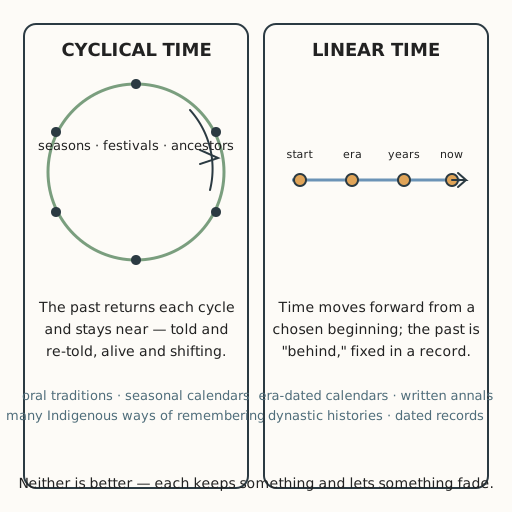
- Cycle and arrow diagram · 1 per learner One page contrasting cyclical (circle/spiral) and linear (arrow) ways of picturing time, with examples of societies that leaned each way
- History journal · 1 per learner
Low-tech / no-cost
- Drawn spiral and arrow Draw a circle and a straight arrow; no printed diagram needed
- Voice and memory Tell one family memory aloud, then write it, and notice what changes in the telling
Enriched / lab & device
- Device or library · 1 per pair A short oral-history or dynastic-annals excerpt to compare a spoken and a written record of the same span
Works in different contexts
- large-group Draw a big spiral and arrow on the board; invite the group to place examples (oral history, dynastic cycles, calendars) on each
- multi-age Younger learners act out the seasons repeating (cycle) versus a life story moving from birth to now (arrow); older learners weigh what each preserves
- self-directed A learner writes the comparison alone, using the diagram, and self-checks against the two example societies
- level-grouped Group by readiness to weigh; a ready group compares a cyclical and a linear record of the same event
- outdoor-only Use the visible cycle of the seasons and the growth of a plant or animal from young to old as the two pictures of time
Lesson 2 — Time and the Sense of the Past
Summary
Learners weigh how the shape a society gives to time — a returning circle or a forward arrow, a spoken story or a written record — changes what it remembers as its past. They compare oral traditions, dynastic annals, and calendars, and ask what each keeps and what each lets go.
Objectives
- Compare how different societies measured and recorded time and weigh how those systems shaped their sense of the past. (D08.S1.10.01)
Connection
Ask yourself what you remember about last year. You probably remember it as a line — “first this happened, then that” — moving from your birth toward now. But imagine remembering instead as a circle: the same rains, the same festival, the same ancestors returning each year, so that “now” always touches “then.” The shape you give to time decides what you remember. Different peoples have chosen different shapes.
Materials
- “Cycle and arrow” diagram
- History journal
Preparation
- Copy or draw the cycle-and-arrow diagram.
- Retrieval: from Lesson 1, recall that a calendar matches the Sun’s year and the Moon’s month to a people’s seasons, and that each system watches something different (S-315).
Facilitator note
This lesson is written to the learner (“you”). The idea to land: the shape a people gives to time — a returning cycle that keeps ancestors near, or a forward line from a fixed beginning — shapes what its history remembers, and both shapes are real, living ways of holding the past. Model the contrast with two worked examples before independent work (S-011).
The global lens: many Indigenous peoples hold time as cycles that carry ancestors and land forward together (a living, recurring relationship rather than a finished line); Chinese dynastic historiography recorded time as repeating dynastic cycles rise-and-fall while keeping continuous written annals; the Islamic Hijri calendar marks a community’s shared era from the Hijra (622 CE); a linear “era” that counts forward from one founding moment is itself a choice, not a universal (S-315, S-378). The technology lens: writing changes memory — an oral tradition lives by re-telling and shifts with each teller, while a written annal fixes one version and can be kept for centuries, each with its own losses and gains. The ethics lens: whose record was written down and kept, and whose was carried in speech and often ignored, is a question of power. The critical-thinking lens: neither shape is “better”; each preserves something and lets something else fade — hold both.
Procedure
- Recall (5 min). From Lesson 1: name one calendar and what it watches. Now think: does your memory of your own life feel like a line or a circle?
- Meet the diagram (15 min). Look at the cycle-and-arrow diagram.
- Cyclical time: time returns — seasons, festivals, ancestors; the past is always near, renewed each cycle. Many Indigenous calendars and oral traditions work this way.
- Linear time: time moves forward from a fixed beginning toward now; the past is “behind” us. Era-dated calendars and written annals work this way.
- Spoken vs. written: an oral tradition is re-told and stays alive and shifting; a written annal fixes a record that outlives any single voice. Watch one worked example: the same event (a founding, a harvest, a ruler’s reign) told as a returning story versus recorded as a dated entry — notice what each preserves.
- Guided practice (15 min). In pairs, answer: what does a cyclical record keep that a linear one might let fade? What does a linear record keep that a cyclical one might not? Agree on one answer for each before moving on.
- Independent work (15 min). In your journal, write two short entries: one memory told as a circle (something that returns each year), one as a line (something that happened once, in order). Then write one sentence on how the shape changed what you chose to include.
- Close (5 min). Say in one sentence: how does the shape of time change the sense of the past? Next time: how we divide the long human story into periods.
Differentiation
- Support: Use only the circle/line contrast, with a half-written example to finish.
- Extension: Compare a cyclical and a linear record of the same real event (e.g., a dynastic annal vs. a seasonal/ceremonial account) and argue what each loses.
- Access (blind / low vision): Give the learner a closed loop of string (cyclical — seasons return, the past always near) and a straight string (linear — a line from a fixed beginning to now) to hold while you describe each; the contrast is tactile, not only drawn.
Assessment
- Formative (peer + self): Can the learner name one thing cyclical time keeps and one thing linear time keeps, and link each to a society’s way of recording?
- Portfolio artifact (unit): The two journal entries (circle and line) with the one-sentence reflection.
Home connection
Ask an adult: in our family, what returns every year that keeps the past close — a holiday, a visit, a food, a story? Write it as a circle, then as a line, and notice the difference.
Resources
- On calendars and the eras they mark (solar, lunar, and the choice of a “year one”): Encyclopaedia Britannica, “Calendar,” https://www.britannica.com/science/calendar (S-315).
- On the Maya calendar as a living system of cycles: Encyclopaedia Britannica, “Maya,” https://www.britannica.com/topic/Maya-people (S-378).