Lesson 11 — Survivor Responses and Remembrance
Learners examine how survivors respond and endure, and how genocide is remembered — through testimony, memorials, museums, days of remembrance, and justice — and practice holding remembrance with accuracy and dignity.
Objectives
Objectives
- D08.S4.10.01 Analyze a case of genocide or mass violence with care, examining its causes, the responses of survivors, and how it is remembered.
Essential question
How did survivors respond and endure, and how is a genocide remembered — with accuracy, dignity, and justice?
Key vocabulary
Materials
Standard materials
- Remembering with dignity sheet · 1 per learner One page listing how a genocide is remembered — testimony, memorials, museums, days of remembrance, justice — with one named survivor's words in brief, dignified summary
- History journal · 1 per learner
Low-tech / no-cost
- Hand-copied sheet Write the remembrance list and the survivor's words on paper or a board; no printed sheet needed
- Voice and silence Read the survivor's words aloud slowly, then hold a minute of shared quiet
Enriched / lab & device
- Device or library · 1 per pair A short survivor testimony (audio or written) from a memorial institution, chosen for dignity and no graphic detail
Works in different contexts
- large-group Read one survivor's words aloud once, slowly, then let learners write before any discussion; keep exit options open
- multi-age Younger learners focus on one remembrance practice and one survivor's words; older learners compare testimony, memorial, and justice as forms of remembrance
- self-directed A learner reads the sheet at their own pace, writes a short reflection, and may choose a quiet pause whenever needed
- level-grouped Group by readiness to engage, not age; a ready group compares two forms of remembrance and their different purposes
- outdoor-only Read the survivor's words in a quiet outdoor circle and mark a minute of silence together, each person free to be still
Lesson 11 — Survivor Responses and Remembrance
Summary
Learners examine how survivors respond and endure, and how a genocide is remembered — through testimony, memorials, museums, days of remembrance, and justice. They practice holding remembrance with accuracy and dignity, and meet survivors as agents, not only as the harmed.
Objectives
- Analyze a case of genocide or mass violence with care, examining its causes, the responses of survivors, and how it is remembered. (D08.S4.10.01)
Connection
Think of how your own family keeps someone who has died: a photograph, a story told at a certain table, a name spoken on a certain day. Remembrance is how the living refuse to let the dead and the harmed be forgotten. For a genocide, that work is done at the scale of a whole people — through testimony and memorials and museums and days of remembrance — and it is always, at bottom, the same human act: keeping a name.
Materials
- “Remembering with dignity” sheet
- History journal
Preparation
- Copy or write the remembrance sheet.
- Retrieval: from Lesson 10, recall the care rules and the three study questions (causes, survivors, remembrance). Today we dwell on the last two — survivors and remembrance — with care.
Facilitator note
This lesson is written to the learner (“you”). The idea to land: survivors respond and endure in countless ways — through witness, rebuilding, and carrying memory — and remembrance takes many forms (testimony, memorials, museums, days of remembrance, justice), all of which exist to keep individuals and peoples from being forgotten. Model the forms of remembrance with a worked example before learners reflect (S-011).
Emotional safety (non-negotiable): (1) Warning and opt-out: re-state that learners may step out, pass, or write privately at any time. (2) Referral: name the trusted adult or support line again. (3) Grounding: open and close with a slow breath or a minute of quiet. (4) No graphic images or gratuitous detail: use brief, dignified summaries and one survivor’s words chosen for dignity, never for shock. (5) Agency and hope: survivors are met as agents — people who bore witness, rebuilt families and communities, and chose how to carry memory (S-495).
The ethics lens is the spine: remembrance is a duty to the truth and to the dignity of the dead and the harmed. The egalitarian lens: memorials and justice exist because every person’s life counts equally. The global lens: remembrance takes many forms across peoples — days of remembrance, museums, and testimony exist for cases across continents, and the duty to remember is not one people’s alone (S-491, S-494). The critical-thinking lens: different forms of remembrance serve different purposes — testimony preserves a voice, a museum teaches, a court seeks accountability — and none replaces the others. Preview: Lesson 12 turns to the ordinary people who resisted and sheltered others.
Procedure
- Ground (3 min). Breathe once, slowly. Recall that you may pause or step away at any time.
- Meet remembrance (20 min). Look at the remembrance sheet.
- How survivors respond: bearing witness, rebuilding family and community, teaching, and carrying memory forward.
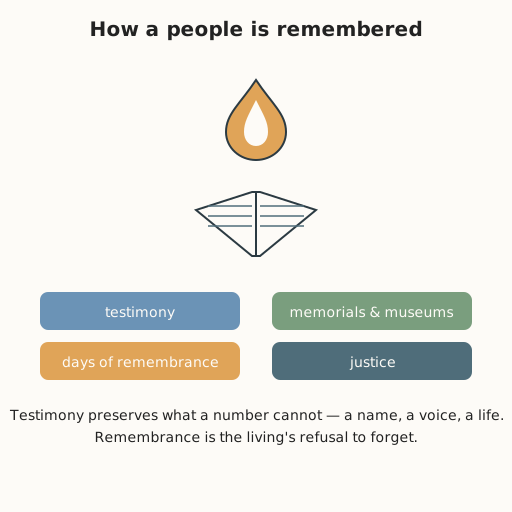
- How it is remembered: testimony (a survivor’s own words), memorials and museums, days of remembrance, and justice (courts and accountability). Watch one worked example: read one named survivor’s words, in brief and dignified summary, and notice what testimony preserves that a statistic cannot.
- Guided practice (15 min). In pairs, ask: what does testimony preserve that a number cannot? and why do we need both a memorial and a court? Share one answer each.
- Independent work (10 min). In your journal, write one paragraph: how would you want a harmed people to be remembered — and what would you do to help carry that memory?
- Close and ground (5 min). Breathe once more. Next time: the ordinary people who resisted and sheltered others — the hope inside the truth.
Differentiation
- Support: Focus on one remembrance practice and one survivor’s words.
- Extension: Compare testimony and a court of justice as two forms of remembrance — what each can do, and what each cannot.
- Access (blind / low vision): Describe the symbol once aloud (a steady flame above a book of names), then teach from the spoken list of remembrance forms; the image is illustrative, and the list is the lesson.
Assessment
- Formative (self): Can the learner name at least three forms of remembrance and say, in their own words, what testimony preserves that a number cannot?
- Portfolio artifact (unit): The remembrance paragraph, kept private unless shared by choice.
Home connection
With a trusted adult, talk about one way your family or community remembers people who are gone — and one reason remembrance matters. (No one is required to discuss the events themselves outside class.)
Resources
- On the case and its remembrance: United States Holocaust Memorial Museum, “Introduction to the Holocaust” (S-490); on remembrance across cases, the United Nations genocide-prevention framework (S-491).
- On teaching with dignity: US Holocaust Memorial Museum, “Guidelines for Teaching about the Holocaust” (S-495); on naming individuals, not numbers: Paul Slovic, “If I Look at the Mass I Will Never Act” (S-414).