Lesson 12 — Ordinary People: Resistance and Shelter
Learners analyze how ordinary people resisted oppression and sheltered others during genocide and mass violence, meeting them as agents who chose courage at great risk, and asking what remembrance and justice require of us.
Objectives
Objectives
- D08.S4.10.02 Analyze how ordinary people have resisted oppression, sheltered others, and rebuilt after atrocity, and what remembrance and justice require.
Essential question
How did ordinary people resist oppression and shelter others, and what does that tell us about human agency in the worst of times?
Key vocabulary
Materials
Standard materials
- Ordinary people case cards · 1 set per pair Three short cases of ordinary people who resisted or sheltered others, told in brief, dignified summary with names
- History journal · 1 per learner
Low-tech / no-cost
- Told cases Tell the three cases aloud in brief, dignified summary; no printed cards needed
- Voice and circle In a circle, each person names one small act of shelter or courage they have seen, without names if they prefer
Enriched / lab & device
- Device or library · 1 per pair A short account of a rescuer or resister from a memorial institution, chosen for dignity and no graphic detail
Works in different contexts
- large-group Present the three cases briefly, then small groups each take one and report the person's choice and its cost, keeping names and dignity central
- multi-age Younger learners focus on one person's act of shelter; older learners analyze the choices, risks, and the line between bystander and upstander
- self-directed A learner reads the cases at their own pace and writes one paragraph on what made an ordinary act extraordinary
- level-grouped Group by readiness to engage, not age; a ready group weighs why some sheltered and others did not, without judging
- outdoor-only Discuss the cases in a quiet circle; invite learners to speak or pass in turn, holding a stone to mark the speaker
Lesson 12 — Ordinary People: Resistance and Shelter
Summary
Learners analyze how ordinary people resisted oppression and sheltered others during genocide and mass violence. They meet rescuers and resisters as agents who chose courage at great risk, and begin to ask what remembrance and justice require of us.
Objectives
- Analyze how ordinary people have resisted oppression, sheltered others, and rebuilt after atrocity, and what remembrance and justice require. (D08.S4.10.02)
Connection
Most of the people who resisted or sheltered others in the worst of times were not heroes from a story — they were neighbors, farmers, teachers, and students who made a choice at a moment when choosing was dangerous. Their acts were often small: a door left open, a child hidden, a warning passed, a truth told. Studying them reminds us that courage is not a rare gift but an ordinary human possibility, taken up one choice at a time.
Materials
- “Ordinary people” case cards
- History journal
Preparation
- Copy or write the three case cards.
- Retrieval: from Lessons 10–11, recall the care rules and the three study questions. Today we turn to the hope inside the truth: the people who resisted and sheltered.
Facilitator note
This lesson is written to the learner (“you”). The idea to land: ordinary people — neighbors, strangers, whole communities — resisted and sheltered others during genocide, and their choices show that agency and courage lived even inside atrocity; remembrance and justice honor that agency. Model one case before learners study the rest (S-011).
Emotional safety (non-negotiable): (1) Warning and opt-out: re-state that learners may step out, pass, or write privately at any time. (2) Referral: name the trusted adult or support line. (3) Grounding: open and close with a slow breath. (4) No graphic images or gratuitous detail: tell the cases in brief, dignified summary, focused on the choice and its cost, never on violence. (5) Agency and hope: this lesson is the agency-and-hope turn — center the ordinary people who chose courage (S-495).
The ethics lens is the spine: sheltering is an ethical act — choosing another’s life over one’s own safety — and studying it asks what we ourselves would count as a duty. The egalitarian lens: rescuers came from every background, which teaches that dignity and courage are not the property of any rank or class. The global lens: ordinary people sheltered and resisted in many places and eras — the Righteous Among the Nations, honored by Yad Vashem, are non-Jews across Europe who risked their lives to rescue Jews (S-492), and Rwandans who sheltered neighbors are honored in Rwanda’s remembrance (S-494). The critical-thinking lens: ask why some chose courage and others did not — not to judge, but to understand how choices are made under pressure. Preview: Lesson 13 turns to rebuilding and what justice requires.
Procedure
- Ground (3 min). Breathe once, slowly. Recall you may pause or step away.
- Meet the cases (20 min). Look at the case cards — three ordinary people who resisted or sheltered others. For each, notice: the choice they made, the risk they took, and the ordinary fact of who they were. Watch one worked example: a neighbor who hid a family in a small room, or passed a warning, or refused an order — a choice made at great cost, by someone no more extraordinary than anyone else.
- Guided practice (15 min). In pairs, take one case. Name the choice, the risk, and one reason the person might have given for acting. Compare and agree.
- Independent work (10 min). In your journal, write one paragraph: what makes an “ordinary” act extraordinary, and what would you hope you would choose?
- Close and ground (5 min). Breathe once more. Next time: rebuilding, and what justice requires.
Differentiation
- Support: Focus on one case and two questions (what did they choose, what did it cost).
- Extension: Compare two forms of resistance — sheltering another and openly refusing an order — and analyze the different risks and effects of each.
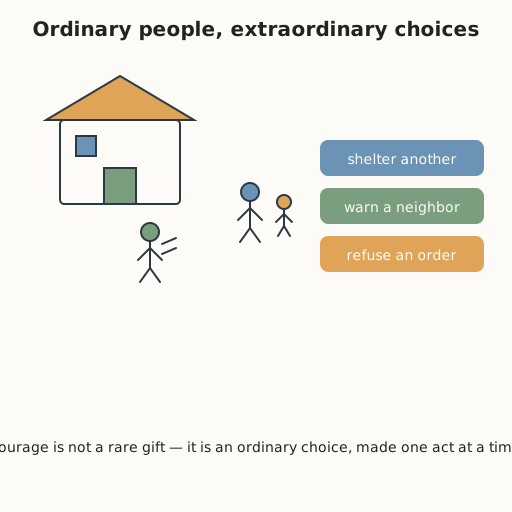
- Access (blind / low vision): Describe the scene once aloud (a family welcomed through an open door, hands passing food), then teach from the spoken cases; the image illustrates, the cases carry the lesson.
Assessment
- Formative (peer + self): Can the learner name an ordinary person’s choice to resist or shelter, the risk, and why it mattered?
- Portfolio artifact (unit): The “ordinary and extraordinary” paragraph.
Home connection
With a trusted adult, talk about one ordinary act of courage or kindness you have seen or heard of — and what made it brave. (No one is required to discuss the events themselves outside class.)
Resources
- On rescuers honored by name: Yad Vashem, “The Righteous Among the Nations” (S-492).
- On the case and its people: United States Holocaust Memorial Museum, “Introduction to the Holocaust” (S-490); on remembrance across cases, United Nations (S-491).
- On teaching with dignity: US Holocaust Memorial Museum, “Guidelines for Teaching about the Holocaust” (S-495).