Lesson 09 — Arguing for Protections
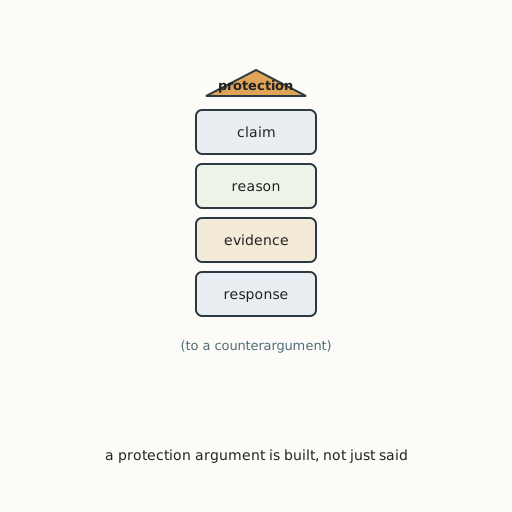
Learners build a reasoned argument that a right such as privacy should be protected, and to what degree. Using a four-part scaffold — claim, reason, evidence, response to a counterargument — they argue for a specific protection, then test it against a partner's challenge.
Objectives
Objectives
- D09.S2.10.02 Evaluate how technology and data can expand or limit rights, such as privacy, and argue for protections.
Essential question
How do I build a reasoned argument that a right such as privacy should be protected — and to what degree?
Key vocabulary
Materials
Standard materials
- Protection argument scaffold · 1 per learner A sheet with the four parts of a rights argument — claim, reason, evidence, response to a counterargument
- Worked-example card · 1 per learner A model of one protection argument built step by step
Low-tech / no-cost
- A shared board or large paper Build the argument together, part by part, on the board
- Voice Say the argument aloud and test it against a friend's counterargument
Enriched / lab & device
- Two contrasting proposals to argue about · 1 per group One stronger and one weaker privacy protection, to argue for and against
- A shared digital document · 1 A shared argument builder each group can edit
Works in different contexts
- large-group Model one argument whole-class, then groups build arguments for different protections and present
- multi-age Younger learners give one reason for protecting privacy; older learners write the full four-part argument
- self-directed A learner builds the argument, self-checks against the scaffold, and revises
- level-grouped Learners ready to extend respond to a counterargument and refine their claim's degree
- outdoor-only Argue for protecting a shared outdoor place from a specific harm, using the same four parts
Lesson 9 — Arguing for Protections
Summary
Learners build a reasoned argument that a right such as privacy should be protected, and to what degree. Using a four-part scaffold — claim, reason, evidence, response to a counterargument — they argue for a specific protection, then test it against a partner’s challenge.
Objectives
- Argue for protections of rights such as privacy, with a claim, reasons, evidence, and a response to a counterargument. (D09.S2.10.02)
Connection
Saying “privacy matters” is easy; saying what should be protected, how much, and why is the real work. If a school, an app, or a government wants to collect data about you, a good protection argument names what should be off-limits, why, and what limit is fair — because no one wants privacy without any benefit, and no one wants data with no limits. A strong argument for a protection is specific, honest about trade-offs, and able to answer the person who disagrees. Today you build one.
Materials
- Protection argument scaffold
- Worked-example card
Preparation
- Copy the scaffold and worked-example card.
- Retrieval: from Lesson 8, recall how a technology can expand and limit privacy at once. Today we argue about the limit side — what should be protected.
- Prepare one worked example of a four-part protection argument.
Facilitator note
This lesson is written to the learner (“you”). The idea to land: arguing for a protection means being specific — a claim, a reason, evidence, and an answer to a counterargument — and honest about degree. Teach the scaffold with a worked example, then guided practice (S-011). Ground the right in the Universal Declaration of Human Rights (privacy from arbitrary interference, S-149), while noting that how much protection and which trade-off is a values question, not a settled fact (philosophy §5). The ethics lens: a good argument is one a person who disagrees could still respect. The egalitarian lens: ask whose privacy is cheapest to violate — protections should not be a luxury of the powerful. The technology lens: protections must actually fit the technology — consent, proportionality (collect only what is needed), transparency, and accountability are four live ideas to draw on. The global lens: different places protect privacy differently, and none is the default; learners may argue from their own context. Keep questions open (philosophy §11). Preview: we move from arguing about rights to organizing with others — designing collective action.
Procedure
- Recall (5 min). From Lesson 8: name one way data can limit privacy. Today you argue about what to protect.
- Meet the scaffold (10 min). Look at the four-part scaffold: claim (what should be protected, and how much), reason (why it matters), evidence (a fact or example that supports it), response (your answer to someone who disagrees). Read the worked-example card.
- Worked example (10 min). Watch one argument built step by step: claim — an app should ask before it shares health data, and share only what is needed; reason — health data is deeply personal and can be used against a person; evidence — data can outlive a person’s consent and be shared in ways they never saw; response — “but sharing helps research” → so ask consent, and de-identify the data, rather than taking it silently.
- Guided practice (15 min). In a pair, build your own protection argument using the scaffold. Then swap and play the person who disagrees — give a counterargument, and have your partner answer it.
- Independent practice (10 min). In your journal, write your full four-part argument and add one sentence on degree — what is too little protection, and what is too much. Mark “not yet” if a part is missing.
- Close (5 min). Read your claim and response aloud to a partner. Which part was hardest, and why?
Differentiation
- Support: Provide a half-built argument (claim and reason filled) to complete with evidence and a response.
- Extension: Strengthen the argument by answering a second, stronger counterargument, and sharpening the claim’s degree.
- Expression: Learners who do not speak aloud can write the four parts, underline each, or have a partner read their written argument — no step requires the voice.
Assessment
- Formative (peer + self): Can the learner produce a claim, a reason, evidence, and a response to a counterargument, and specify a degree?
- Portfolio artifact (unit): The four-part argument, added to the “technology and rights” section.
Home connection
Argue for one protection in your home or school (e.g., “my room’s door should be knocked before opening”). Give a claim, a reason, and an answer to a counterargument.
Resources
- On privacy as a recognized right: UN, Universal Declaration of Human Rights, https://www.un.org/en/about-us/universal-declaration-of-human-rights (S-149).
- On worked examples and guided practice: Kirschner, Sweller & Clark (2006), https://doi.org/10.1207/s15326985ep4102_1 (S-011).
- On asking “who made this and why” of any message: NAMLE, “Key Questions,” https://namle.org/resources/key-questions/ (S-151).