Lesson 08 — Data and the Shape of Privacy
Learners evaluate how technology and data expand or limit the right to privacy. Using a spectrum, they place technologies from "privacy limited" to "privacy expanded," analyze a case where the same data both helps and exposes people, and argue for where protections are needed.
Objectives
Objectives
- D09.S2.10.02 Evaluate how technology and data can expand or limit rights, such as privacy, and argue for protections.
Essential question
How do technology and data expand or limit rights such as privacy — for whom, and in which directions?
Key vocabulary
Materials
Standard materials
- Privacy spectrum sheet · 1 per learner A sheet with a line from "privacy limited" to "privacy expanded," with technologies to place along it
- Privacy case study · 1 per learner A short, sourced case of data use that both helps and exposes people, in a specific place
Low-tech / no-cost
- A shared board or large paper Draw the spectrum and place technologies along it together
- Voice Discuss the case aloud, naming where privacy is expanded and where limited
Enriched / lab & device
- Sourced cases of surveillance and inclusion · 1 per group Two contrasting cases — one where data helped people, one where it exposed them — to compare
- A shared digital document · 1 A shared spectrum each group can annotate
Works in different contexts
- large-group Place technologies on a whole-class spectrum, then groups analyze the two contrasting cases
- multi-age Younger learners name what they would keep private; older learners write the expand/limit analysis
- self-directed A learner reads the case, places technologies on the spectrum, and writes one paragraph on expand vs. limit
- level-grouped Learners ready to extend analyze a technology that both expands and limits privacy at once, and say for whom
- outdoor-only Discuss who can see you and what they know in a shared outdoor space, and how "privacy" works there
Lesson 8 — Data and the Shape of Privacy
Summary
Learners evaluate how technology and data expand or limit the right to privacy. Using a spectrum, they place technologies from “privacy limited” to “privacy expanded,” analyze a case where the same data both helps and exposes people, and argue for where protections are needed.
Objectives
- Evaluate how technology and data can expand or limit rights such as privacy, and identify who is affected differently. (D09.S2.10.02)
Connection
The same technology can be a door or a window. A phone lets you reach a doctor and send money to a relative far away — it expands what you can do. But the same phone records where you are, what you search, and whom you speak to — and when that data is collected without your say, or used to watch you, your privacy shrinks. Privacy is not one switch; it is a spectrum, and every tool sits somewhere on it, often in two places at once. Seeing where — and for whom — is the first step to arguing about what should be protected.
Materials
- Privacy spectrum sheet
- Privacy case study
Preparation
- Copy the spectrum sheet and the case study.
- Retrieval: from Grade 9, recall that human rights are honored or denied unequally depending on power and access. Today we apply that to privacy and data.
- Prepare one worked example of placing a technology on the spectrum and explaining why.
Facilitator note
This lesson is written to the learner (“you”). The idea to land: technology and data do not have a single effect on privacy — they expand it for some and limit it for others, often at once; the skill is seeing which and for whom. Frame privacy as a real, recognized right: the Universal Declaration of Human Rights affirms protection from arbitrary interference with privacy, family, home, and correspondence (S-149). Keep the facts hedged and non-panicky: data tools genuinely help (mobile money where banks are scarce, S-211; remote care; connection), and genuinely risk exposure (surveillance, data that outlives consent). The technology lens is the spine. The egalitarian lens: the people whose privacy shrinks are often the least powerful — and the digital divide means some are excluded from the benefits while others are over-exposed (S-281). The global lens: privacy is understood differently across cultures, and protections differ by law and custom — none is the default. Distinguish evidence (what data is collected) from values (what should be protected) (philosophy §5), and hold questions open (philosophy §11). Preview: next lesson we build an argument for protections.
Procedure
- Recall (5 min). From Grade 9: what does it mean that rights are honored or denied unequally? Give one example.
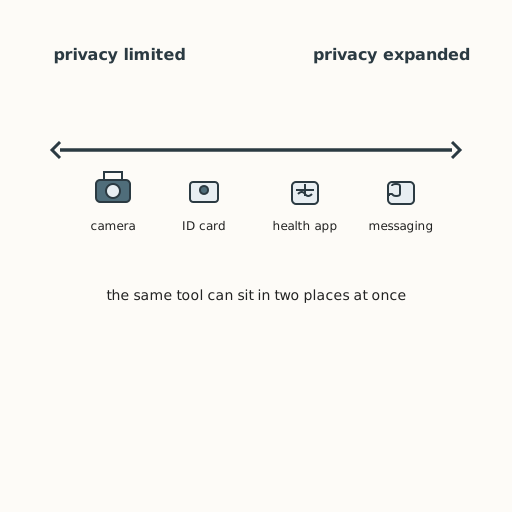
- Meet the spectrum (10 min). Look at the spectrum sheet — a line from privacy limited on the left to privacy expanded on the right. Read the technologies listed and where each might sit.
- Worked example (10 min). Watch one placement done step by step for a health app: (a) how it expands privacy — it can give care at home without anyone else in the room; (b) how it limits privacy — it records your body’s data, which may be stored or shared without your say; (c) for whom — a rural patient gains care, a monitored worker may lose control of their data. Place it mid-spectrum and say why.
- Guided practice (15 min). In a pair, read the case study — a data use that both helps and exposes people. Mark where it expands and where it limits privacy, and for whom. Place two more technologies on the spectrum and agree.
- Independent practice (10 min). In your journal, choose one technology and write: how it expands privacy, how it limits it, for whom, and where on the spectrum it sits. Mark “not yet” if you only named one direction.
- Close (5 min). Share one placement. Notice how often the same tool sits in two places at once — that doubling is the point.
Differentiation
- Support: Provide a half-filled spectrum (one technology already placed) and sentence starters.
- Extension: Find a technology that expands and limits privacy for the same person, and explain the tension.
- Expression: Learners who do not speak aloud can place printed technology cards along the spectrum, write their reasoning, or have a partner read their written explanation — no step requires the voice.
Assessment
- Formative (peer + self): Can the learner name how a technology expands and limits privacy, say for whom, and place it on the spectrum with a reason?
- Portfolio artifact (unit): The spectrum placement and explanation, as the first page of the “technology and rights” section.
Home connection
With a family member, list one app or service you use. What does it know about you, and who else can see it? Ask whether that feels like a door or a window.
Resources
- On privacy as a recognized right: UN, Universal Declaration of Human Rights, https://www.un.org/en/about-us/universal-declaration-of-human-rights (S-149).
- On uneven digital benefits and the digital divide: World Bank, World Development Report 2016, https://www.worldbank.org/en/publication/wdr2016 (S-281).
- On mobile money where banks were scarce: World Bank, “Financial Inclusion,” https://www.worldbank.org/en/topic/financialinclusion (S-211).