Lesson 11 — Evaluating the Plan: Effects and Ripples
Learners evaluate the likely effects of the collective-action plan they designed in Lesson 10 — the intended outcomes and the ripples they did not intend. Using a ripple diagram and a checklist, they name who benefits, who is harmed, what could go wrong, and how they would know it worked, then revise one step.
Objectives
Objectives
- D09.S3.10.01 Design a plan for collective action on a real community or global issue, including goals, allies, and steps, and evaluate its likely effects.
Essential question
How do I evaluate the likely effects of a collective-action plan — the intended ones and the ripples I did not intend?
Key vocabulary
Materials
Standard materials
- Ripple diagram sheet · 1 per learner A diagram of a plan's effects spreading outward — first-order, second-order, unintended — to fill in
- Evaluation checklist · 1 per learner A list of questions — who benefits, who is harmed, what could go wrong, how would we know it worked
Low-tech / no-cost
- A shared board or large paper Draw the ripple diagram and fill it together for one plan
- Voice Talk through the effects of a plan aloud, naming intended and unintended ripples
Enriched / lab & device
- A documented movement with measured effects · 1 per group A short sourced account of a movement's actual outcomes, intended and unintended, to evaluate
- A shared digital document · 1 A shared ripple diagram each group can edit
Works in different contexts
- large-group Model one evaluation whole-class, then groups evaluate their plans and present the ripples
- multi-age Younger learners name one intended and one unintended effect; older learners write the full evaluation
- self-directed A learner evaluates their own plan against the checklist and revises one step
- level-grouped Learners ready to extend predict a feedback loop — an effect that changes the plan itself — and respond
- outdoor-only Evaluate a real plan for a shared outdoor space by asking who and what would be affected downstream
Lesson 11 — Evaluating the Plan: Effects and Ripples
Summary
Learners evaluate the likely effects of the collective-action plan they designed in Lesson 10 — the intended outcomes and the ripples they did not intend. Using a ripple diagram and a checklist, they name who benefits, who is harmed, what could go wrong, and how they would know it worked, then revise one step.
Objectives
- Evaluate the likely effects of a collective-action plan, including intended and unintended consequences, and revise it. (D09.S3.10.01)
Connection
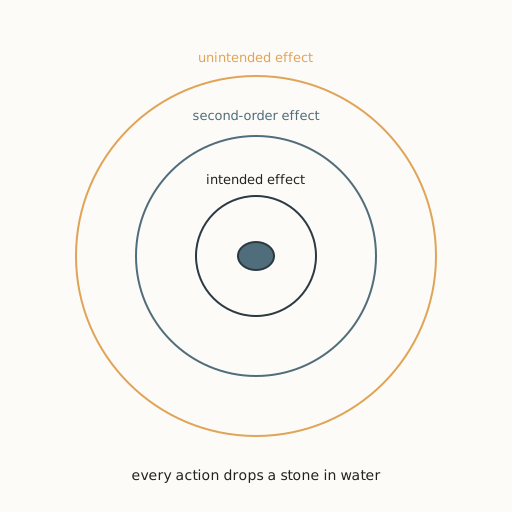
Every action drops a stone in water, and the ripples travel further than the splash. A plan to build a well gives water to a village — the intended effect — but it may also draw people from neighboring areas, change who controls the water, and lower the water table for farms downstream — ripples no one planned. A good planner does not just hope for the best; they look ahead and ask: who benefits, who is harmed, what could go wrong, and how will we know it worked? Then they revise. Today you evaluate your own plan that way.
Materials
- Ripple diagram sheet
- Evaluation checklist
Preparation
- Copy the ripple diagram and checklist.
- Retrieval: from Lesson 10, recall your plan — its goal, allies, and steps. Today we look ahead at what it would actually do.
- Prepare one worked example of tracing a plan’s ripples.
Facilitator note
This lesson is written to the learner (“you”). The idea to land: a plan is not finished when it is written — it must be evaluated for intended effects, second-order effects, and unintended ripples, then revised. Teach the ripple-tracing with a worked example, then guided practice (S-011). The critical-thinking lens is the spine: ask “and then what?” repeatedly, and ask how we would know the plan worked (what would we measure?). The egalitarian lens: a plan’s ripples are not felt equally — trace who bears each one, especially the unintended harms. The ethics lens: an unintended harm is still a harm, and a fair planner responds to it rather than ignoring it. The global lens: effects cross scales — a local plan can ripple into a regional or global system, and vice versa. Keep the evaluation honest but not paralyzing: the point is not to find the perfect plan (philosophy §11) but to see its real shape and improve it. Distinguish what we can predict from what we can only watch for (philosophy §5). Preview: next we turn to the ethics of civic technology and digital citizenship.
Procedure
- Recall (5 min). From Lesson 10: state your plan’s goal in one sentence. Today we look ahead.
- Meet the ripple diagram (10 min). Look at the ripple sheet — a stone in water, rings spreading outward: intended effect, second-order effect, unintended effect. Read the worked example and see how one plan’s ripples were traced.
- Worked example (10 min). Watch one evaluation done step by step for the well: (a) intended — clean water within reach; (b) second-order — more people come, the well is busier; (c) unintended — the water table drops and downstream farms feel it. (d) How would we know it worked? — measure how many families get water and whether the water stays clean. (e) Revise — add a step to monitor the water table and include downstream farmers as allies.
- Guided practice (15 min). In a pair, take your Lesson-10 plan and fill the ripple diagram: one intended effect, one second-order effect, one unintended ripple. Then run the checklist: who benefits, who is harmed, what could go wrong, how would you know it worked?
- Independent practice (10 min). In your journal, write your evaluation and then revise one step of your plan in response to an unintended ripple. Mark “not yet” if you found no unintended effect — look again.
- Close (5 min). Share your one revision with a partner. What did you see that you had missed yesterday?
Differentiation
- Support: Provide a half-filled ripple diagram (intended effect already written) and a menu of possible ripples.
- Extension: Predict a feedback loop — an effect that changes the plan itself — and add a step to monitor or respond to it.
- Expression: Learners who do not speak aloud can fill the ripple diagram in writing, draw the ripples, or have a partner read their written revision — no step requires the voice.
Assessment
- Formative (peer + self): Can the learner name an intended and an unintended effect, say who is affected, describe how they would know it worked, and revise one step?
- Portfolio artifact (unit): The completed ripple diagram and one revision, added to the “collective action” section.
Home connection
Ask a family member about a change your community made (a road, a rule, a shop). What was intended, and what ripples surprised people?
Resources
- On worked examples and guided practice: Kirschner, Sweller & Clark (2006), https://doi.org/10.1207/s15326985ep4102_1 (S-011).
- On the Green Belt Movement’s documented effects: Nobel Prize, “Wangari Maathai — Facts,” https://www.nobelprize.org/prizes/peace/2004/maathai/facts/ (S-059).