Lesson 12 — Civic Technology and Digital Citizenship
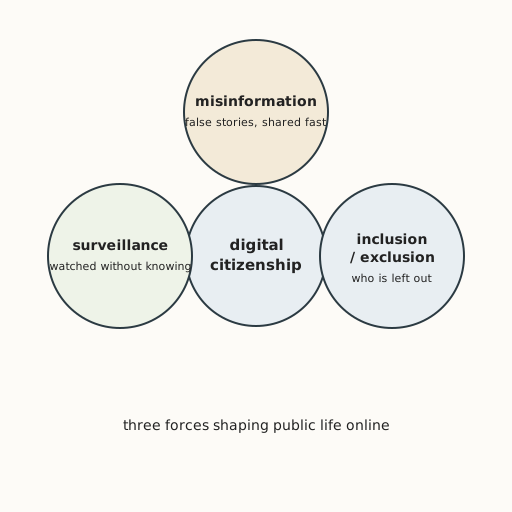
Learners analyze the ethics of civic technology and digital citizenship through three forces — misinformation, surveillance, and inclusion/exclusion. They apply media-literacy questions to real cases, weigh how digital tools both help and harm public life, and name what a responsible digital citizen does.
Objectives
Objectives
- D09.S3.10.02 Analyze the ethics of civic technology and digital citizenship, including misinformation, surveillance, and who is included or excluded.
Essential question
How do misinformation, surveillance, and digital inclusion or exclusion shape what it means to be a citizen today?
Key vocabulary
Materials
Standard materials
- Civic tech case sheet · 1 per learner A sheet laying out three forces — misinformation, surveillance, inclusion/exclusion — with a short sourced example of each
- Digital citizenship lens card · 1 per learner A card with the five media-literacy questions — who made this, why, for whom, with what evidence, and what is left out
Low-tech / no-cost
- A shared board or large paper Draw the three forces and list examples together
- Voice Discuss the three forces aloud, naming one example of each from lived experience
Enriched / lab & device
- Two sourced contrasting cases · 1 per group One where digital tools helped people organize (the Arab Spring), one where they spread misinformation or enabled surveillance, to compare
- A shared digital document · 1 A shared analysis table each group can edit
Works in different contexts
- large-group Assign each group one force to analyze, then hold a structured comparison across the three
- multi-age Younger learners answer "who made this and why"; older learners write the full analysis
- self-directed A learner reads the cases, applies the five questions, and writes one paragraph on each force
- level-grouped Learners ready to extend trace how the three forces interact in a single platform and argue for a fix
- outdoor-only Discuss how rumors, watching, and who is included work in a face-to-face community, then map the same to digital life
Lesson 12 — Civic Technology and Digital Citizenship
Summary
Learners analyze the ethics of civic technology and digital citizenship through three forces — misinformation, surveillance, and inclusion/exclusion. They apply media-literacy questions to real cases, weigh how digital tools both help and harm public life, and name what a responsible digital citizen does.
Objectives
- Analyze the ethics of civic technology and digital citizenship, including misinformation, surveillance, and who is included or excluded. (D09.S3.10.02)
Connection
A citizen today can organize a protest from a phone, check a fact in seconds, and vote in a poll without leaving home. The same tools can also flood a public square with false stories, watch people without their knowledge, and leave whole communities out because they cannot afford a connection. Being a digital citizen is not just using these tools; it is asking, about every message and every platform: who made this, why, for whom, with what evidence, and who is left out? Today you learn to ask those questions about the tools themselves.
Materials
- Civic tech case sheet
- Digital citizenship lens card
Preparation
- Copy the case sheet and lens card.
- Retrieval: from Grade 8 and 9, recall that digital tools change civic participation, with risks and benefits (organizing online, misinformation, surveillance). Today we deepen that into an ethics analysis.
- Prepare one worked example of applying the five questions to a message.
Facilitator note
This lesson is written to the learner (“you”). The idea to land: civic technology is not neutral — it can spread misinformation, enable surveillance, and include or exclude people, and a responsible digital citizen asks the five media-literacy questions of every message and platform. Keep the facts hedged and balanced: digital tools genuinely helped organize protests during the 2010–11 Arab Spring uprisings, while the same tools also spread misinformation and enabled surveillance (S-391); synthetic media can now make it hard to tell real from false (S-393); and access to the internet is uneven by cost, geography, and disability (S-281). Present these as documented, weighed risks and benefits, not a simple verdict that technology is good or bad. The technology lens is the spine. The egalitarian lens: ask who is excluded — the digital divide means the loudest voices online are not the whole public. The ethics lens: the same act (sharing a post) can help or harm, so intent and care matter. The global lens: citizenship and its digital tools look different in every country and tradition — none is the default. Use the five questions from media literacy: who made this, why, for whom, with what evidence, what is left out (S-063, S-151). Keep questions open (philosophy §11); distinguish what a platform does (evidence) from what a citizen should do (values) (philosophy §5). Preview: next we turn to repairing a specific harm — designing a restorative process.
Procedure
- Recall (5 min). From Grade 8/9: name one benefit and one risk of organizing online. Say each in a sentence.
- Meet the three forces (10 min). Read the case sheet: misinformation, surveillance, inclusion/exclusion — each with a short example. Underline who is affected in each.
- Meet the lens card (10 min). Read the five questions: who made this, why, for whom, with what evidence, what is left out? Watch one worked example of applying them to a viral claim.
- Guided practice (15 min). In a pair, choose one force and analyze its example with the five questions. Then weigh: how does this force help public life, and how does it harm it? Swap and compare.
- Independent practice (10 min). In your journal, write one paragraph on each force — one sentence on how it works, one on who is affected, one on what a responsible digital citizen does about it. Mark “not yet” if you skipped a force.
- Close (5 min). Share one thing a responsible digital citizen should always do. Notice how the same five questions recur across all three forces.
Differentiation
- Support: Provide the five questions as sentence starters and a half-analyzed example to finish.
- Extension: Trace how the three forces interact on a single platform you use, and argue for one concrete change that would make it fairer.
- Expression: Learners who do not speak aloud can write answers to the five questions, sort example slips by force, or have a partner read their written analysis — no step requires the voice.
Assessment
- Formative (peer + self): Can the learner apply the five media-literacy questions to a message, and name how misinformation, surveillance, and inclusion/exclusion each affect public life?
- Portfolio artifact (unit): The three-paragraph analysis, as the “civic technology” page of the portfolio.
Home connection
With a family member, take one message from a group chat or feed and ask the five questions together. What did you notice that you had not before?
Resources
- On digital tools, protest, misinformation, and surveillance: Encyclopaedia Britannica, “Arab Spring,” https://www.britannica.com/event/Arab-Spring (S-391).
- On synthetic media and deepfakes: WITNESS Media Lab, “Prepare, Don’t Panic,” https://lab.witness.org/projects/synthetic-media-and-deep-fakes/ (S-393).
- On the five media-literacy questions: Common Sense Education, “News & Media Literacy,” https://www.commonsense.org/education/digital-citizenship/topic/news-and-media-literacy (S-063); NAMLE, “Key Questions,” https://namle.org/resources/key-questions/ (S-151).
- On the digital divide: World Bank, World Development Report 2016, https://www.worldbank.org/en/publication/wdr2016 (S-281).