Lesson 14 — Peacebuilding: Transforming Conflict Nonviolently
Learners analyze peacebuilding — preventing and transforming conflict nonviolently — through three strategies: nonviolent resistance, dialogue and mediation, and truth and reconciliation. They study two documented cases, match strategies to settings, and write their own weighed judgment.
Objectives
Objectives
- D09.S4.10.02 Analyze peacebuilding (preventing and transforming conflict nonviolently) and weigh its strategies across different settings.
Essential question
How does peacebuilding prevent and transform conflict nonviolently — and how do I weigh its strategies across different settings?
Key vocabulary
Materials
Standard materials
- Peacebuilding strategies sheet · 1 per learner A sheet presenting three strategies — nonviolent resistance, dialogue and mediation, and truth and reconciliation — with a setting to apply each
- Two conflict case cards · 1 per learner Sourced, short accounts — the Salt March (nonviolent resistance) and South Africa's Truth and Reconciliation Commission (truth and repair) — to analyze
Low-tech / no-cost
- A shared board or large paper List the three strategies and mark where each fits best
- Voice Discuss which strategy fits each setting aloud
Enriched / lab & device
- A set of four contrasting conflicts · 1 per group Conflicts from different regions and stages, to weigh strategies against
- A shared digital document · 1 A shared strategy-setting matrix each group can edit
Works in different contexts
- large-group Assign each group one strategy to defend for a setting, then hold a structured weighing across strategies
- multi-age Younger learners name what people in a conflict need; older learners write the strategy analysis
- self-directed A learner reads the cases, matches strategies to settings, and writes one paragraph weighing two strategies
- level-grouped Learners ready to extend trace how the three strategies could be combined in one conflict and argue for the order
- outdoor-only Use a real shared-space conflict (over a path, water, or shade) and weigh how the three strategies would transform it
Lesson 14 — Peacebuilding: Transforming Conflict Nonviolently
Summary
Learners analyze peacebuilding — preventing and transforming conflict nonviolently — through three strategies: nonviolent resistance, dialogue and mediation, and truth and reconciliation. They study two documented cases, match strategies to settings, and write their own weighed judgment.
Objectives
- Analyze peacebuilding — preventing and transforming conflict nonviolently — and weigh its strategies across different settings. (D09.S4.10.02)
Connection
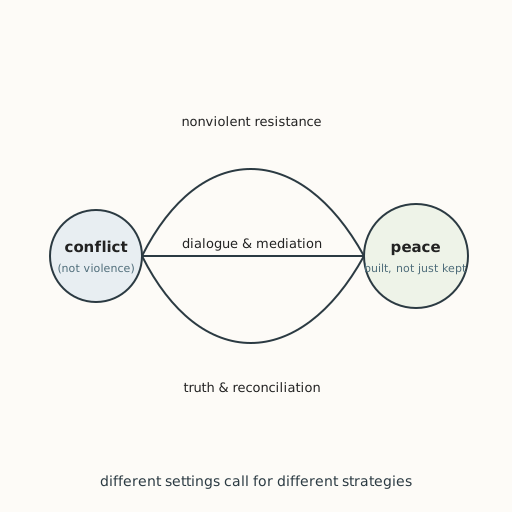
Peace is not just the absence of fighting; it is something that has to be built — a fair way to share what is scarce, a way to hear each other without violence, and a way to face old hurts honestly so they stop repeating. Some conflicts are best met by refusing to cooperate with injustice nonviolently, the way the 1930 Salt March defied an unfair salt law without lifting a hand against anyone (S-390). Others need truth-telling and repair, the way South Africa’s Truth and Reconciliation Commission invited public testimony and, in defined cases, amnesty in exchange for full disclosure (S-392). Different settings call for different strategies — and weighing which one fits is the skill of peacebuilding.
Materials
- Peacebuilding strategies sheet
- Two conflict case cards
Preparation
- Copy the strategies sheet and the case cards.
- Retrieval: from Grade 9, recall the roots of conflict (inequality, fear, scarcity) and the distinction between conflict and violence. Today we study how to transform conflict without violence.
- Prepare one worked example of matching a strategy to a setting.
Facilitator note
This lesson is written to the learner (“you”), and closes the unit. The idea to land: peace is built, not merely kept — through nonviolent resistance, dialogue and mediation, and truth and reconciliation — and different settings call for different strategies, which we weigh rather than rank. Keep the history accurate and hedged: the 1930 Salt March was a nonviolent act of civil disobedience led by Gandhi against the British salt monopoly, part of India’s independence movement (S-390); South Africa’s Truth and Reconciliation Commission (main hearings 1996–1998) invited public testimony about past abuses and, in defined cases, offered amnesty for full disclosure, alongside reparations — a real, contested attempt to trade some punishment for truth and repair (S-392). Present both as attempts with real strengths and limits, not as perfect models. Draw on Galtung’s distinction: peace is more than the absence of war — “positive peace” includes fairness, so peacebuilding also means reducing the structural violence of inequality and exclusion (S-462). The community lens is the spine: peace is made among people, in relationship. The egalitarian lens: a peace that protects the powerful and silences the harmed is not peace. The global lens: nonviolence, truth-telling, and reconciliation take different forms in every tradition — satyagraha, hózhó, ubuntu, and others — none is the default (S-205, S-161, S-465). The ethics lens: the means should match the end — a strategy that wins by humiliating others has already lost something. Close the unit by returning to its opening: all of this has been weighing — benefits and harms, for people and the planet — and questions held as questions, not answered as dogma (philosophy §11). Distinguish evidence from values throughout (philosophy §5).
Procedure
- Recall (5 min). From Grade 9: what is the difference between conflict and violence? Name one root of conflict.
- Meet the cases (10 min). Read the two case cards — the Salt March and the Truth and Reconciliation Commission. For each, underline the strategy and circle who was included.
- Meet the three strategies (10 min). Read the strategies sheet: nonviolent resistance (refusing to cooperate with injustice, without harming people), dialogue and mediation (bringing sides to listen and agree), truth and reconciliation (facing old hurts honestly and repairing them). For each, name one setting where it fits best and one where it might not.
- Worked example (10 min). Watch one weighing done step by step: for a conflict where an unfair law harms a whole community, nonviolent resistance fits — it names the injustice and withdraws cooperation — while dialogue may be premature if one side will not listen. Say why, and what would change the judgment.
- Guided practice (15 min). In a pair, choose a conflict setting (a school dispute, a community over scarce water, a society after a war) and weigh two strategies for it. Which fits, which does not, and why? Swap settings with another pair and compare.
- Independent practice (10 min). In your journal, write your weighed judgment in four sentences: the setting, the strategy you would lead with, why, and one limit. Mark “not yet” if you did not name a limit.
- Close (5 min). In a small group, recall the unit’s opening question: what does it mean to weigh benefits and harms for people and the planet? Say how peacebuilding is one more act of that same weighing.
Differentiation
- Support: Provide a half-written weighing (setting and strategy filled) to complete with a reason and a limit.
- Extension: Combine the three strategies into one sequence for a single conflict, and argue for the order.
- Expression: Learners who do not speak aloud can write or draw the strategy-setting match, or have a partner read their written judgment — no step requires the voice.
Assessment
- Formative (peer + self): Can the learner name three peacebuilding strategies, match one to a setting, and give a weighed judgment with a limit?
- Portfolio artifact (unit): The four-sentence judgment, as the closing page of the “peace and repair” section — and the final page of the unit portfolio.
Home connection
Ask a family member: in a disagreement our community has had, what made peace possible — refusing, talking, or facing the truth? Compare with the three strategies.
Resources
- On the 1930 Salt March: Encyclopaedia Britannica, “Salt March,” https://www.britannica.com/event/Salt-March (S-390); Nobel Prize, “Mahatma Gandhi, the missing laureate,” https://www.nobelprize.org/prizes/themes/mahatma-gandhi-the-missing-laureate/ (S-205).
- On South Africa’s Truth and Reconciliation Commission: Encyclopaedia Britannica, “Truth and Reconciliation Commission, South Africa,” https://www.britannica.com/topic/Truth-and-Reconciliation-Commission-South-Africa (S-392).
- On positive and negative peace: Galtung (1969), “Violence, Peace, and Peace Research” (S-462).
- On a shared commitment to peace and justice: UN Sustainable Development Goal 16, https://sdgs.un.org/goals/goal16 (S-463).