Lesson 13 — Designing a Restorative Process
Learners design a restorative process for a specific harm, deciding who should be heard, how responsibility is taken, and how repair is made. They use the three restorative questions, study a real restorative practice, and write their own design, then check it for fairness.
Objectives
Objectives
- D09.S4.10.01 Design a restorative process for a specific harm, including who should be heard, how responsibility is taken, and how repair is made.
Essential question
How do I design a restorative process for a specific harm — deciding who should be heard, how responsibility is taken, and how repair is made?
Key vocabulary
Materials
Standard materials
- Restorative design sheet · 1 per learner A sheet with the three restorative questions and space to design a process for a specific harm
- Harm case study · 1 per learner A short, age-appropriate case of a specific harm in a community, ready for a restorative design
Low-tech / no-cost
- A shared board or large paper Draw the circle and design the process together
- Voice Talk through who should be heard and how repair is made, aloud, in a real circle
Enriched / lab & device
- A documented restorative process · 1 per group A short sourced account of a real restorative practice — e.g., Indigenous peacemaking circles or a school conference — to study
- A shared digital document · 1 A shared design each group can edit
Works in different contexts
- large-group Model one design whole-class, then groups design processes for different harms and present
- multi-age Younger learners name who should be heard; older learners write the full design
- self-directed A learner designs a process for a chosen harm and checks it against a fairness list
- level-grouped Learners ready to extend weigh restorative process against punishment for the same harm and defend a choice
- outdoor-only Sit in a real circle outdoors and design a restorative process for a harm in a shared space
Lesson 13 — Designing a Restorative Process
Summary
Learners design a restorative process for a specific harm, deciding who should be heard, how responsibility is taken, and how repair is made. They use the three restorative questions, study a real restorative practice, and write their own design, then check it for fairness.
Objectives
- Design a restorative process for a specific harm, including who should be heard, how responsibility is taken, and how repair is made. (D09.S4.10.01)
Connection
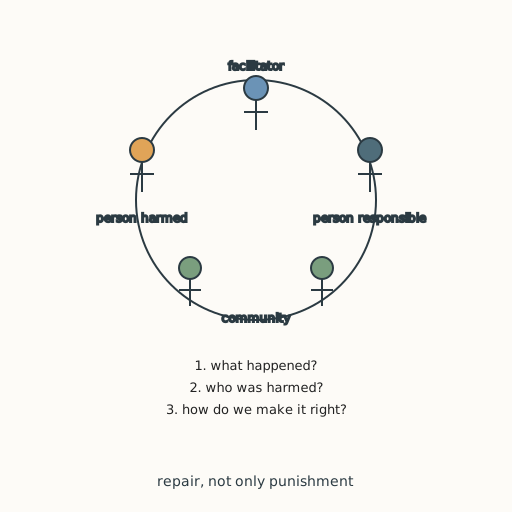
When someone is hurt, the first question is usually “what punishment do they deserve?” Restorative practice asks a different set of questions first: what happened, who was harmed, and how do we make it right? (S-022). It begins by hearing the person who was hurt, giving the person who caused the harm a real chance to understand and take responsibility, and then agreeing on repair — an apology that means something, work that restores, a change so it does not happen again. Repair, not only punishment. Today you design such a process for a real harm.
Materials
- Restorative design sheet
- Harm case study
Preparation
- Copy the design sheet and the case study.
- Retrieval: from Grade 9, recall reconciliation and restorative justice — their possibilities and limits — and the three restorative questions. Today we turn them into a design.
- Prepare one worked example of designing a restorative process.
Facilitator note
This lesson is written to the learner (“you”). The idea to land: a restorative process is designed, not improvised — it decides who should be heard, how responsibility is taken, and how repair is made, around the three questions: what happened, who was harmed, how do we make it right (S-022). Teach the design with a worked example, then guided practice (S-011). Honor the roots: restorative justice draws on long-standing Indigenous practices — peacemaking circles, the Diné (Navajo) idea of hózhó (balance and harmony), and similar traditions — not only on modern frameworks (S-161). The community lens is the spine: harm is repaired in relationship, not outside it. The egalitarian lens: the person harmed must have a real voice and real power in the process — a process designed by the powerful alone is not restorative. The social-emotional lens: this lesson touches real hurt; keep the case study age-appropriate and non-graphic, let learners choose the intensity they engage with, and always connect difficulty to agency (the process itself is the agency). The ethics lens: responsibility is taken, not forced — an apology that is coerced is not a real apology. Distinguish what a restorative process does (evidence from practice) from whether it is the right response (a values question) (philosophy §5). Preview: next and last, we analyze peacebuilding — preventing and transforming conflict nonviolently.
Procedure
- Recall (5 min). From Grade 9: what are the three restorative questions? Say them in order.
- Meet the case (10 min). Read the harm case study. Underline who was harmed and who caused the harm. Note: the point is not to judge, but to design a process.
- Meet the design sheet (10 min). Look at the three questions and the design boxes: who should be heard, how responsibility is taken, how repair is made. Read the worked example and see how one process was designed.
- Worked example (10 min). Watch one design built step by step: (a) who should be heard — the person harmed, the person responsible, people close to both, a fair facilitator; (b) how responsibility is taken — the person responsible names what they did, hears the harm, and agrees to repair; (c) how repair is made — a real apology, work that restores what was broken, and a plan so it does not repeat. Notice consent: no one is made to speak before they are ready.
- Guided practice (15 min). In a pair, design a process for the case. Fill the three boxes, then check it against the fairness list: (a) the harmed person’s voice leads; (b) responsibility is taken, not forced; (c) repair is concrete and checkable.
- Independent practice (5 min). In your journal, write your design in three sentences — one per box — and add one limit: what could this process not fix? Mark “not yet” if a box is empty.
- Close (5 min). Share your design with another pair. What was the hardest box to fill, and why?
Differentiation
- Support: Provide a half-filled design (who should be heard already listed) and sentence starters for each box.
- Extension: Weigh your restorative design against a punishment-only response for the same harm, and defend which you would choose and when.
- Expression: Learners who do not speak aloud can write the three boxes, point to who should be heard in the circle, or have a partner read their written design — no step requires the voice.
Assessment
- Formative (peer + self): Can the learner name who should be heard, how responsibility is taken, and how repair is made, and note one limit?
- Portfolio artifact (unit): The three-sentence design, as the “restorative practice” page of the portfolio.
Home connection
Ask a family member: after a hurt in our family or neighborhood, what would make it right — a punishment, an apology, or something else? Compare with your design.
Resources
- On the three restorative questions and repairing harm: International Institute for Restorative Practices, https://www.iirp.edu/ (S-022).
- On restorative justice’s roots and the repair-over-punishment frame: Zehr (1990), Changing Lenses (S-161).
- On worked examples and guided practice: Kirschner, Sweller & Clark (2006), https://doi.org/10.1207/s15326985ep4102_1 (S-011).