Lesson 01 — The Data Trail: What We Leave Behind
Learners trace the data they leave behind across one ordinary day — location, search, purchase, and message metadata — and classify who can collect each piece and what it reveals. They meet the concepts of data, metadata, consent, and privacy, then connect their own trail to a larger social question: what is at stake when a day's movements become a record.
Objectives
Objectives
- D10.S1.10.01 Analyze how data, surveillance, and automation affect privacy, freedom, and who has power in a society.
Essential question
What data do I leave behind as I move through a day, who can collect it, and what does that mean for my privacy?
Key vocabulary
Materials
Standard materials
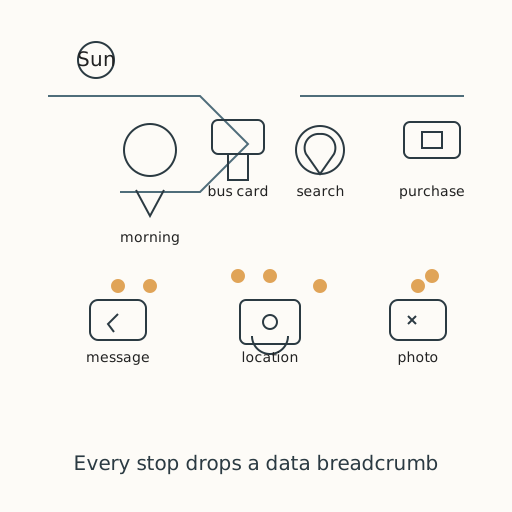
- Data-trail day sheet · 1 per learner A day drawn as a path (wake, travel, school, shop, message, sleep) with blank boxes to record data left at each step
- Journal · 1 per learner
Low-tech / no-cost
- A shared board or large paper Draw the day-path together and record each data point as a group
- Voice and memory Name aloud what a day leaves behind, with no device or sheet needed
Enriched / lab & device
- Device or browser · 1 per pair Inspect the actual trail — location history, ad settings, cookie prompts — on a real device (with care and consent)
- A printed "data broker" price example · 1 per group A sourced example of what a data broker profile contains and sells, to read and discuss
Works in different contexts
- large-group Build the day-path on one large board; each learner adds one data point and the whole group discusses who might see it
- multi-age Younger learners name what they would keep private; older learners categorize each data point by who can collect it
- self-directed A learner fills the day sheet alone, then writes one paragraph on what surprised them and why it matters
- level-grouped A group that finishes early classifies each data point as content or metadata and predicts which is more revealing
- outdoor-only Walk a short outdoor route and note what a watchful observer could record about the walk — where, when, with whom — without any device
Lesson 1 — The Data Trail: What We Leave Behind
Summary
Learners trace the data they leave behind across one ordinary day — where they are, what they search, what they buy, whom they message — and ask who can collect each piece and what it reveals. They meet data, metadata, consent, and privacy, then connect their own trail to a larger social question: what is at stake when a day’s movements become a record.
Objectives
- Trace the data a person leaves behind in daily life and identify who can collect it and what it reveals about privacy. (D10.S1.10.01)
Connection
Every bus pass, every search, every card tap, every message you send leaves a small mark behind — not just the thing itself (where you went) but the shape around it (when, how often, with whom). A single mark tells little; a thousand marks, gathered and sorted, can tell a stranger more about your habits than a close friend knows. Most of us leave this trail without ever being asked, because the asking is hidden in a long “I agree” we never read. Seeing the trail is the first step toward deciding whether we are comfortable with it — in a city, on a farm, or anywhere people carry cards and screens.
Materials
- Data-trail day sheet
- Journal
Preparation
- Copy or draw the data-trail day sheet (a path from waking to sleeping, with a blank box at each stop).
- Retrieval: from Grade 9, recall that algorithms shape what we see and that platforms are controlled by someone (D10.S1.09.01, D10.S1.09.02). Today we look at the raw material those systems run on: data.
- Prepare one worked example of naming the data left at a single stop, and who might collect it.
Facilitator note
This lesson is written to the learner (“you”). The idea to land: ordinary life leaves a trail of data — content and metadata — that others can collect, often without clear consent, and that trail is the raw material of surveillance and automation we study this unit. Keep the facts hedged and non-panicky: data collection genuinely powers useful things (maps, weather, messaging), and it genuinely enables watching. The technology lens is the spine — data is the substrate of the digital systems we meet all unit. The egalitarian lens: who is collected from most and who is left out is uneven, and the digital divide means some people’s data is over-collected while others are excluded from benefits (S-281). The global lens: laws and norms about what may be collected differ widely by country and culture — none is the default (S-281). The environment lens: the servers that store our trail use energy and water, so data is never weightless — previewing a thread we return to. Distinguish evidence (what is collected) from values (what should be collected) (philosophy §5). Preview: next lesson asks who holds power when the data flows to a few.
Procedure
- Recall (5 min). From Grade 9: what does an algorithm do with the things you click and watch? Who do you think decides what the algorithm shows you?
- Meet the trail (10 min). Look at the day-path sheet. Data is information that can be recorded and sorted; metadata is data about data — not the message itself but the time it was sent, the device it came from, the place it went out from. Often the metadata reveals more than the content.
- Worked example (10 min). Watch one stop done step by step — a morning card tap on a bus: (a) the content (you paid a fare); (b) the metadata (the time, the stop, the route, the card’s number); (c) who might collect it (the transit company, an advertiser, a government); (d) what it reveals (where you live, when you travel, your routine).
- Guided practice (15 min). In a pair, fill the sheet for a whole day: search, message, purchase, location, photo. For each, name the content, the metadata, and one possible collector. Agree on which single mark would reveal the most.
- Independent practice (10 min). In your journal, write: which piece of your own trail would you most want to keep private, and why? If you only listed data without saying why it matters, mark “not yet” and try again.
- Close (5 min). Share one finding. Notice that no one reads every “I agree” — the trail is built by default, and consent is often a box, not a conversation. That is the question we take forward.
Differentiation
- Support: Provide a half-filled day sheet (two stops already done) and sentence starters (“The content is __; the metadata is __”).
- Extension: Sort each data point into “content” vs “metadata” and argue which category, overall, tells a stranger more.
- Expression: Learners who do not speak aloud can complete the sheet, write their reasoning, or have a partner read it — no step requires the voice.
Assessment
- Formative (peer + self): Can the learner name the content and metadata left at a stop, identify a possible collector, and say what it reveals?
- Portfolio artifact (unit): The completed data-trail day sheet, as the opening page of the unit’s “technology and power” section.
Home connection
With a family member, pick one app or card you both use. What does it know about you, and did either of you ever choose to share that? Ask: is that a fair trade?
Resources
- On uneven digital benefits and the digital divide (who is collected from and who is left out): World Bank, World Development Report 2016: Digital Dividends, https://www.worldbank.org/en/publication/wdr2016 (S-281).
- On what social-media platforms are and how they collect and use user activity: Encyclopaedia Britannica, “Social media,” https://www.britannica.com/topic/social-media (S-481).
- On asking where information comes from as a core media skill: Common Sense Education, “News & Media Literacy,” https://www.commonsense.org/education/digital-citizenship/topic/news-and-media-literacy (S-063).